

"Better to deliver a bit later, but smarter": young journalists from CIS countries completed an internship in Moscow
What goes on behind the scenes of a major news story, how journalists obtain exclusives, and why it is sometimes better to delay publication slightly to thoroughly verify information? Young journalists from the CIS countries learned about this during the "Internovosti" internship in Moscow. Over the course of a week, the program participants visited the editorial offices of the Kommersant newspaper, the TASS news agency, RT, and the State Duma. The meetings provided an opportunity not […]
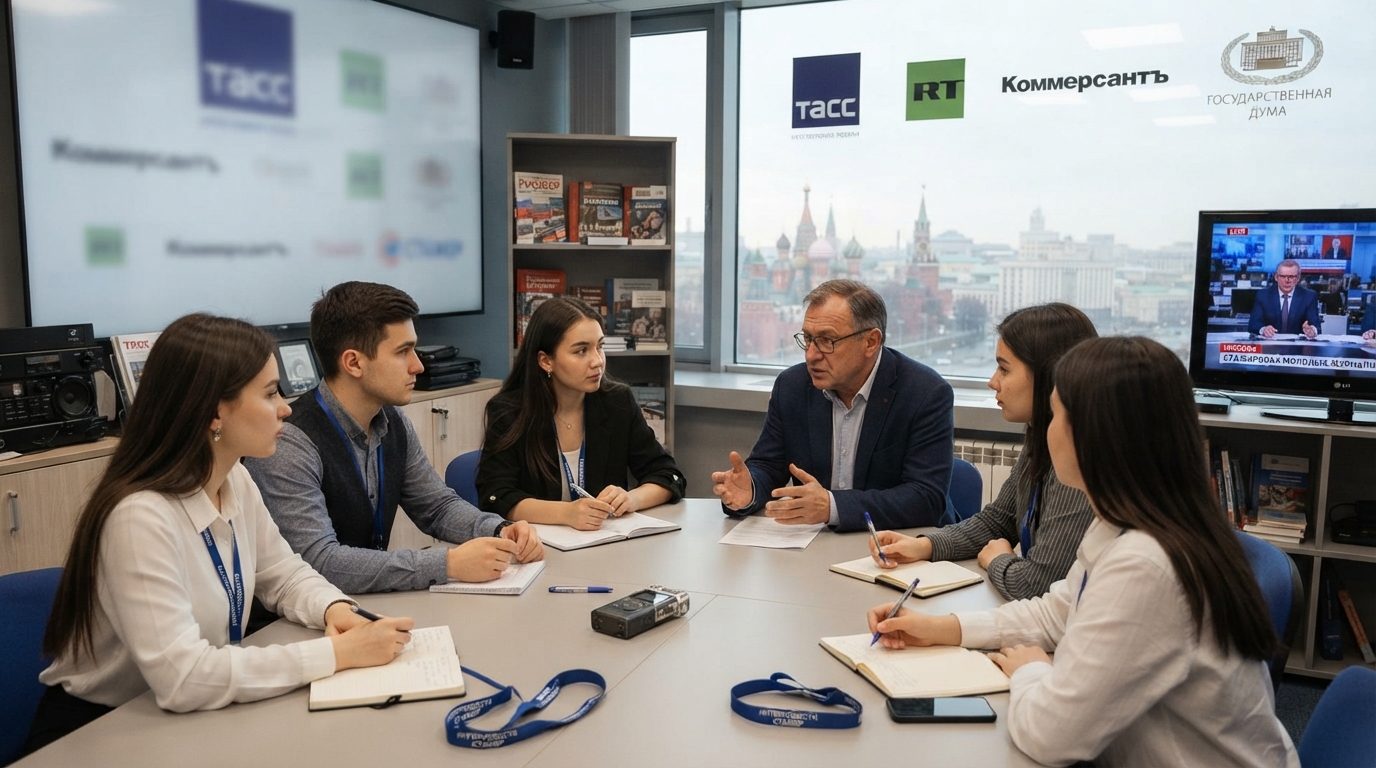
"Better to publish a bit later, but smarter": young journalists from CIS countries completed an internship in Moscow
What happens behind the scenes of a major news story, how journalists get exclusives, and why is it sometimes better to delay publication slightly but thoroughly double-check the information? Young journalists from CIS countries learned about this during the "Internovosti" internship in Moscow.
Over the course of a week, the program participants visited the editorial offices of the Kommersant newspaper, the TASS news agency, RT, and the State Duma. These meetings allowed them not only to see the inner workings of major Russian media outlets but also to communicate directly with journalists, editors, and press service staff.
At Kommersant, the participants met with Editor-in-Chief Mikhail Gusev. He spoke about the specifics of the publication's work, which traditionally focuses on analytics and in-depth materials.
One of the key topics of the conversation was the speed of information dissemination. According to Gusev, modern media must simultaneously take into account both speed and the quality of the material.
"It is better to publish a bit later, but smarter," the editor-in-chief noted, emphasizing the importance of fact-checking and understanding the context.
The participants also discussed the differences between journalism and blogging. Gusev noted that a journalist can become a blogger, but working in an editorial office requires constant discipline and responsibility — even when a topic does not seem interesting and the journalist is not in the mood.
At TASS, the young journalists learned about the operations of a news agency, the principles of news preparation, and the types of exclusives. Anastasia Kirsanova, Deputy Head of the Culture Desk at TASS, explained that an exclusive is not only information that is the first to appear in the public domain.
She spoke in detail about expert exclusives, where a journalist supplements a news story with comments from specialists and helps the audience understand the potential consequences of an event.
Another important topic of the meeting was citation rates. For a news agency, what matters is not only the number of published materials but also how often they are used and cited by other media outlets.
The participants also got acquainted with the work of a Russian video agency. They were told about the creation of broadcasts and video reports for clients. Such content covers a wide range of topics — from politics and economics to social events, the international agenda, and lighter visual materials.
A separate stage of the internship was a visit to the State Duma. Representatives of its press service spoke about interaction with journalists and ensuring media coverage of the parliament's work.
According to the press service representatives, today more than a thousand journalists interact with the State Duma, covering the work of 450 deputies.
Special attention was paid to the reliability of information. The young journalists were reminded that a catchy headline can attract a reader's attention, but the main task of the media is to provide accurate information and help the audience understand the topic.
"Even if something sounds very beautiful, first and foremost you must convey the information," the press service representatives emphasized.
The program participants also shared their impressions.
"The internship is going wonderfully, I like everything. We visited the State Duma, got acquainted with the work of the press service and 'Duma TV', were able to ask questions and get feedback. Over the week, we also visited TASS, RT, and the Kommersant newspaper," said Zhanna Kurmanbekova, a correspondent from Kazakhstan.
Anelya Temirkulova, a program participant from Kyrgyzstan, noted that during the internship, the participants managed to visit the National Center of Russia and other interesting venues. "It was very interesting for me to see how Russian TV channels work and compare them with Kyrgyzstan's television. The difference is indeed very big, so for me, it was an interesting and useful experience," she said.
Thus, the "Internovosti" internship became an opportunity for young journalists to see the work of the media sphere from different angles — from creating breaking news and exclusives to producing video content and media interaction with the parliament.
The main takeaway from the meetings is that modern journalism requires not only speed but also the ability to verify information, work with sources, and explain complex topics to the audience in a simple and understandable language.