

"Who is the defender of journalists now?" - a conversation about the relationship between the press service of a government agency and the media
Failure to respond to requests for information, blocking journalists on the phone, excuses such as "I need to get permission from the head," as well as not responding to official inquiries for months – these are some of the problems that journalists face today when working with government organizations.
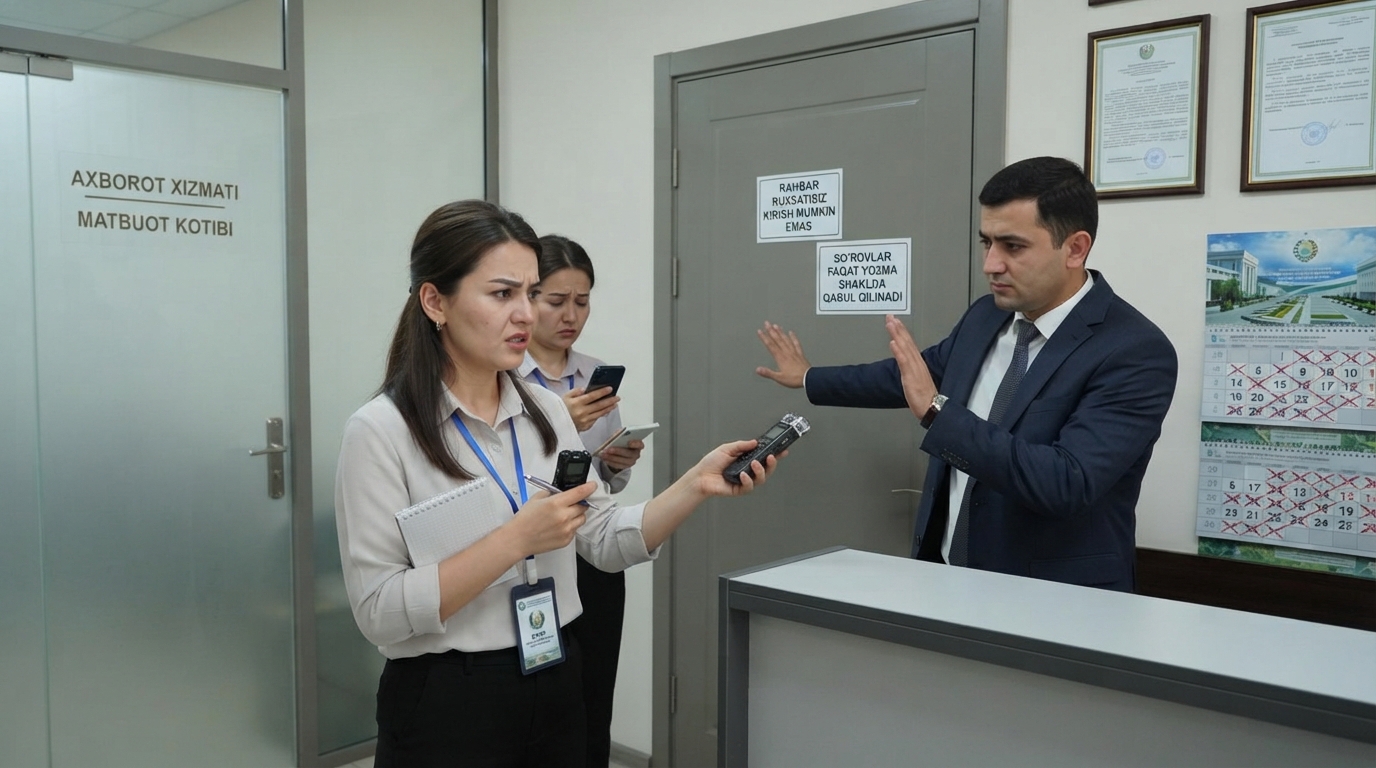
"Who is the defender of journalists now?" - a conversation about relations between state agency press services and the media
Although the media's right to access information is guaranteed by legislation, in practice, journalists sometimes face various obstacles in exercising this right.
Today, the flow of information is incredibly fast. Hundreds of events occur throughout the day, and journalists are required to prepare prompt, reliable, and objective information about them. For this, it is important to receive an official response and the necessary information regarding the event in a timely manner. However, when a journalist contacts the information services of state organizations, although Article 35¹ of the Law "On Media" stipulates that requests must be reviewed within a maximum of 7 days, in practice, there are cases where responses to some urgent information requests are not provided for several weeks or even months.
Botirjon Shermuhammad, the founder of the Vatandosh information portal, explains the problems faced by journalists primarily by the fact that communication channels with the information services of state organizations are not sufficiently established:
"We have official requests sent to some organizations that have remained unanswered for two months. Some press services even bring up the excuse: 'I cannot answer without my manager's permission.' After all, they say, 'I am the head of the press service, but I cannot answer without my boss's permission.' As part of an investigation related to Korea, we also sent a letter to the representative office of 'HRD Korea' in Uzbekistan. It has been almost a month, and there is still no official response. Most interestingly, they say, 'We sent the response to the Migration Agency.' But we did not write a letter to the Migration Agency, nor did we receive a response from them. Such situations occur not only in state organizations but also in the representative offices of foreign organizations."
Gulmira Toshniyozova, a correspondent for the Kun.uz online publication, says she has encountered similar situations in her work experience:
"Speaking from my work experience, on March 16, I sent a request to the agencies within the system of the Ecology Committee regarding the issue of transplanted trees; various excuses like 'I will ask the manager' were made, and even after a month, I could not get an answer. I received a response on August 3 to my request sent to the press service of the General Prosecutor's Office on March 3. It has been almost a month since I sent a request to the Law University, and there is still no answer. Yet, this issue should have been resolved before the start of the new academic year."
In such cases, the problem is not only the delay in the response but also that excuses like "we need to get permission from the manager" are presented as the response itself. Musulmonbek Ibrohimov, a correspondent for the Daryo online publication, drew particular attention to this situation:
"Here, for example, if they said 'I cannot answer' or 'I need to ask my manager' within 7 days — that's it, that must be provided. This should be given as a response, meaning the other party should be informed that they are asking the manager and will respond later. This also has legal consequences. But the public itself must evaluate how well they work with the public. That is, if they say 'I will ask my manager' — it means their manager did not answer. That's all. It means both their attitude and their manager's attitude towards the public is terrible. There should be no such issue as 'I will ask this one, I will ask that one,'" he says.
The lawyer emphasized that according to the Law "On Openness of Activity of State Authority and Management Bodies," the information service and its representatives in organizations are responsible for working with the media and responding to requests, and responding to a journalist's request is the obligation of the information service.
"Journalists can request a lot of information related to the organization's activities: they have the right to receive information about adopted regulatory legal acts, their implementation, state programs, tenders, budgetary and extra-budgetary funds, expenditures, and the relations of the state organization with physical and legal entities. Of course, there are also cases in legislation where the provision of information is restricted. For example, information related to state secrets, investigative secrets, attorney-client, notary, or banking secrets cannot be provided. But apart from such exceptions, it is the duty of the information service to provide information defined as open by law. Therefore, the excuse 'I need to ask my manager' itself does not substitute for a response to a journalist's request. The information service must respond to the journalist within its competence, and if the information cannot be provided, it must indicate the legal basis for this," says lawyer Shohjahon Shomurodov.
Another problem related to journalists' information requests is the existence of different approaches to the form of application. In some cases, instead of answering questions asked over the phone or via Telegram, press services demand that the journalist must send a written request. Lawyers, however, emphasize that the legislation provides for oral, written, or electronic forms of application:
"When we call or write via Telegram, they say 'send a written request.' Even people working in law enforcement agencies or those working directly with legislation say this. However, the legislation stipulates that an application can be in oral, written, or electronic form. If you are sending your request to the responsible agency, that's it, it must be accepted and reviewed. If a journalist approaches you with a request — answer the journalist. 'We will publish it, publish it if you want, don't publish it if you don't want.' In my opinion, the first problem of those working in those press services is that they do not know their existing functional duties. The second issue is related to the heads of these organizations. In practice, the press service wants openness, wants to work with journalists, but unfortunately, the managers do not allow it. They tell us themselves: 'I can give it to you, but I will fall out with my manager, I have my job here,'" says Musulmonbek Ibrohimov.
Gulmira Toshniyozova emphasizes that in the current activities of press services, excessive attention is paid to social networks:
"Today, a heavy workload is placed on press services by the management. They are becoming more preoccupied with running the organization's pages on social networks, filling Instagram, Telegram, and other platforms. This requires a lot of time and resources from them. As a result, the most basic task of the press service — the function of working with the media — is being pushed to the background. They are busier with showing a positive image of the organization, covering events and various projects. However, the task of the press service is not only to run social networks," she says.
Speaking about the current tasks of press services and the resources allocated to them, Botirjon Shermuhammad notes that in some cases, instead of cooperating with the media, they try to perform the specific tasks of the media itself:
"Currently, the expenses of press services have increased. Especially in central state organizations, heads of press services receive large salaries, and there are cases where their staff has increased, reaching up to 8-10 people. Why? In some cases, they are trying to take the place of the media. Large state organizations make podcasts, shoot films. Excuse me, but your task is to cover the work of the organization, share it with us, and help organize interviews with experts or managers. If you do the work of the media, then let's close the media, and they can go about their business freely, why are we here for nothing. Leaving their main task behind, they are taking on additional tasks. In some cases, they even seem to compete with specialized websites. They try not to give us information, and to present the material published by us in a different form. This is an unhealthy situation. There is a question of why so much funding is allocated to them and whether these expenses justify themselves. After all, the press service of a state organization should not compete with the media."
In his opinion, another issue hindering openness is the practice of restricting information important to the public with the phrase "for official use."
"Very many state organizations have published lists of restricted information on their websites. Many documents there are marked as DSP (for official use). For example, the Migration Agency marked even the tariff for sending abroad — a payment in the amount of 50 BCAs — as DSP. After we obtained it through sources and published it, they admitted that 'this is not DSP' and said they would change it. But for years, the public had been unaware of this large tariff. It is impossible to hide information needed by the public under the pretext of DSP or official secret, and then talk about openness. Here, the right to free access to information conflicts with the interests of state organization officials."