

Baxt, who held a sapling instead of a paintbrush, and Lola by the metro (photo essay)
Bakht, who held a seedling instead of a paintbrush, and Lola by the metro (photo essay)
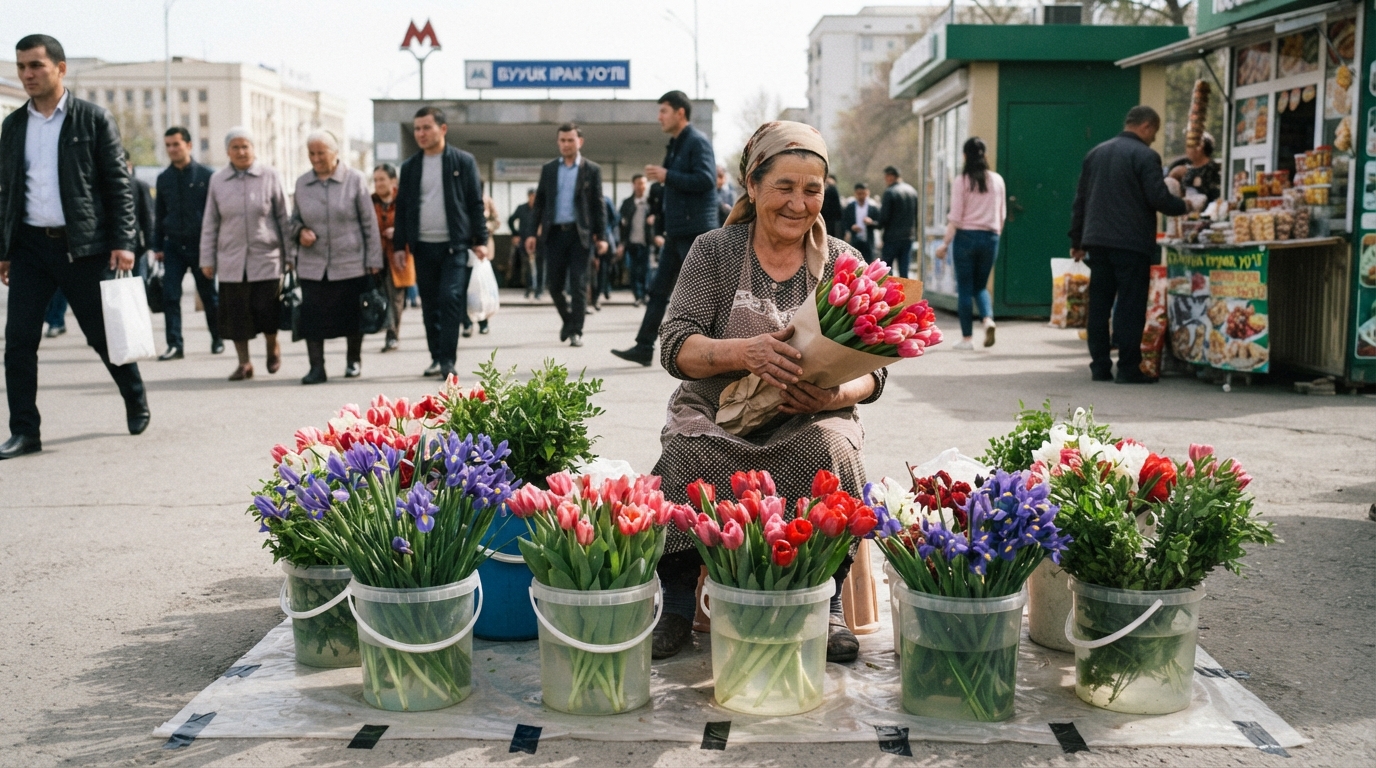
If you exit the "Buyuk Ipak Yo'li" metro station, the surroundings are bustling: on one side, there are those rushing to work or study, whose faces show both satisfaction and fatigue; elderly people walking peacefully hand in hand; passersby who happen to be there; and on the other side, sellers who have made "stools" out of buckets and "tables" out of cellophane bags, selling hot Tashkent corn, boiled corn, and seasonal flowers. Among these sellers is a 55-year-old florist sister named Soliha from Ozodbosh, who sells tulips in spring and asters in autumn. "Daryo" photojournalist Javhar Chorshanbiyeva prepared a photo essay about the family and "livelihood" of one of the flower sellers at the last station of the metro line as part of the "One Day" project.
### From the laboratory to the yard: the florist sister from Ozodbosh
Fifty-five-year-old Soliha opa is from the Ozodbosh village of Bostanlyk district.
"After graduating from school, I studied at the Chirchiq Chemical-Industrial Technical School. After completing my studies, I worked for several years in the laboratory of a factory in the city. Then I got married. Once I had a family, working the factory's shift and evening schedule started to cause inconvenience, so I was forced to resign. Since then, I have been a housewife," she recalls.
### I won't return home until all my flowers are sold
Soliha opa sets off early every morning. She loads the flowers into her brother's car, who commutes from Gazalkent to the capital, and brings them to the "Maxim Gorky" intersection. Choosing a place for trade is the first task of the day: if there is space, she sets up near the supermarket, if not, she moves to the opposite side through the underpass — to a spot close to the metro exit.
Before the rapid rhythm of the capital begins, she spreads cellophane bags on the ground, secures them with tape, and spreads the bunched flowers on top. Then she takes out the colored kraft paper and transparent wraps she brought with her, sorts the flowers, and makes them into bouquets. To prevent the bouquets from wilting, she places them in plastic buckets filled with water.
The florist sister's workday ends when all her bouquets are sold. "I have never returned home without being able to sell my flowers. Whether it is until dusk or until 9-10 in the evening — anyway, I sell and finish everything by the end of the day," she says with satisfaction.
"After our only daughter was 'kidnapped' by the groom, my husband and I are distracting ourselves with these flowers and the worries of making a living. Our daughter is 19 years old, she had just finished school and entered studies in Shymkent. A guy she had known beforehand kidnapped her at the border. Since then, she has her own household, and they will have a child in December. Now our biggest worry is saving money to buy a cradle and dowry items for our future grandchild," says the sister with tears glistening in her eyes.
Speaking about family ties and the paths of destiny, Soliha opa also recalls the history of her own marriage: "If you ask about that, my husband also kidnapped me. We are both Kazakhs, this is our custom."
Before independence, the ancestors of both sides came to Tashkent to work and settled here. After independence, their relatives returned to their historical homeland, Almaty, Kazakhstan.
"Despite the urging of relatives, we decided to stay in Uzbekistan, in this village of ours. We were born here, grew up here, half of our lives passed here. This village, this yard is dear to us, we found our peace here," says the protagonist.
### The cool yard behind the heat and the frostbitten flowers
As soon as you enter the florists' yard from the hot street where the heat of the asphalt hits your face, coolness runs through your body and peace through your soul. Grape trellises starting right from the entrance cast shade on the path. Not a single inch of land is wasted in this household — crops and colorful flowers are growing vigorously everywhere.
"My husband's name is Bakht, he is one year younger than me. Actually, he loves flowers even more than I do. As soon as he finds a container suitable for planting flowers or an inch of land, he immediately plants seeds or seedlings," says Soliha opa.
Not only the yard of the household, but also the rooms are filled with potted flowers. However, due to gas outages and heating system problems last winter, a significant portion of the cared-for flowers perished.
"I don't plant potted flowers to sell, I care for them because I love them. Each one is as precious as my child," says Bakht aka. "Last winter, when the gas went off and the heating system stopped working, more than half of our flowers were hit by the cold. This year too, I am worried about being left without gas in the winter cold and having my flowers dry up."
### A profession that started with snowdrops and blocked water
For the family living in the area of Bostanlyk close to the mountains, floriculture did not suddenly become the main source of income. It all started with picking snowdrops from the mountainside in spring and selling them. Later, Bakht aka started growing flowers in the yard at his brother-in-law's suggestion.
"My brother-in-law grows flowers on a large area in Almaty. One day he gave me seeds and suggested I try planting them myself. Their land is fertile, black soil, and it rains a lot. Our land is salty — I hesitated a bit, wondering if it would work. Then I took a risk and planted them. Now, for 4–5 years, I have been growing and caring for flowers at home myself, and my wife takes them to Tashkent to sell," he says.
Photo: "Daryo" / Javhar Chorshanbiyeva
Photo: "Daryo" / Javhar Chorshanbiyeva
Flowers need to be watered every two days, otherwise they wilt quickly. The disorder in water distribution in the village makes this process even more difficult.
"The water path is often blocked by the owners of restaurants and shops operating nearby. Because of this, sometimes water does not come to our yard for weeks. At such times, we manage to keep the flowers alive with water stored in basins and buckets. If we appeal to the mahalla, they resolve the issue, but after a while, the situation repeats itself. We are tired of constantly complaining," they say.
### Seasonal income and winter tulip worries
In the household, aster flowers are planted in late May and early June. During the season, which lasts from mid-August to late September, Soliha opa takes flowers for sale every other day. Depending on the size of the bunches and the quality of the flower, bouquets are priced from 25,000 to 40,000 soums. Selling 15 to 20 bouquets every other day, the family earns around 10 million soums from asters in one season.
After the aster season ends, the land is fertilized with natural fertilizer, tilled, and rested for a month. In early November, tulip bulbs are planted.
"Snow and rain during the forty days of winter (chilla) are very important for tulips. If there is not enough precipitation during the chilla, the tulips will not develop well and will perish," says Bakht aka, speaking about his worries for the next season.
### Additional income and gifts of nature
After the aster season ends, other chores begin in the household.
"We have land at the foot of the mountain, my husband planted walnuts there. After selling the flowers, we shake the walnuts — if the harvest is good, 4–5 sacks come out in a season. We take them to 'Maxim Gorky' too. Sometimes we pick hawthorn and rosehips from the mountain and sell them. We also planted hawthorn in our yard, it started bearing fruit last year," says Soliha opa.
In addition to flowers, pumpkin, eggplant, blackberry, and lemon are also grown in the household. Bakht aka even planted a tropical fruit seedling brought from Thailand last year — what kind of fruit it is will be known after the first harvest.
### An artist at heart
According to Soliha opa, her spouse is a creative person by nature — he draws beautiful pictures. Although he dreamed of becoming an artist in his youth, he could not follow this path due to his father's opposition. But he still loves colors and greenery, and keeps parrots in his home.
Looking at their lifestyle, one gets the impression that Bakht aka is creating the colors today in the bosom of nature, in the form of living seedlings and flowers, which he could not paint with a brush in his youth.
### Hidden pains and the dream of a greenhouse
No matter how peaceful this lifestyle looks from the outside, heavy domestic and health worries are hidden behind it. Soliha opa is a person with a Group 2 disability, has suffered a heart attack once, and needs constant treatment.
"If only we had the means to build a greenhouse to grow flowers. Then I would work more myself, and maybe employ one or two people. My wife wouldn't have to stand on her feet all day selling flowers in Tashkent while being ill. If only I had the opportunity to meet the president, I would have asked him for an interest-free loan to build a greenhouse," says Bakht aka.
Despite this, the homeowners do not complain about their fate. For them, the most important thing is freedom and the peace that comes from honest labor.
"No one gives us orders, the most important thing is that we are running our household with honest labor. If you give love to the land and nature, it will never leave this love unanswered," Bakht aka concludes the conversation.