

Australian desert covered in flowers - NASA showed it from space
In Western Australia, arid areas have been covered with wildflowers following winter rains. The Landsat 8 satellite captured the landscape that has turned green. Meanwhile, the manager of the local observatory lands said he had not seen such a florid season since 2008.
Australian desert covered in flowers — NASA showed it from space
NASA published satellite images of the Murchison region located approximately 600 kilometers north of Perth. In the image taken on August 30, 2026, the vegetation appears much greener compared to the image from August 19, 2025. The agency presented this comparison on September 23.
In the images taken by the Landsat 8 satellite, a joint project of NASA and the US Geological Survey, riverbeds, roads, and yellowish-brown soil areas are clearly visible. The green strip that appeared after the rain is particularly clearly distinguished along the channels.
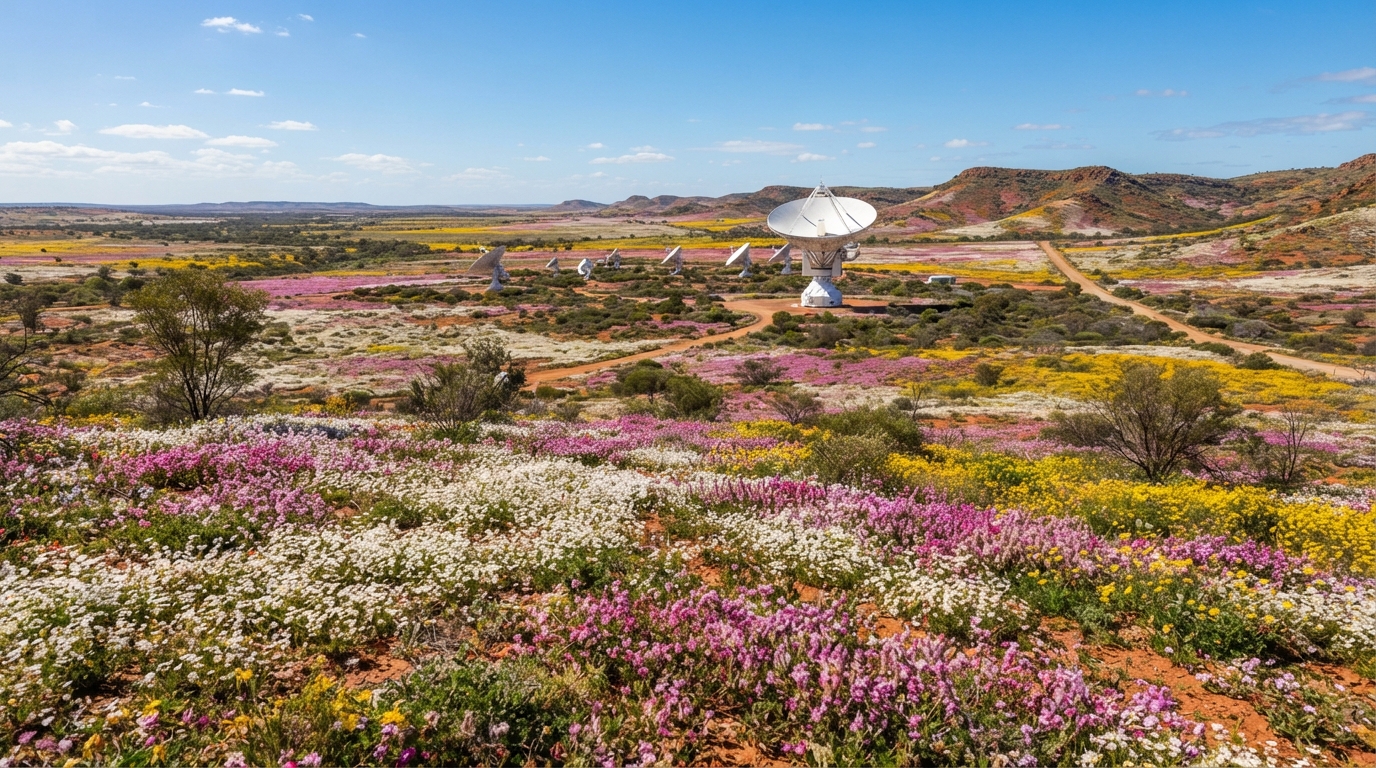
Images taken from the ground showed the scale of the blooming. Broad areas consisting of white, yellow, and pinkish-purple flowers have appeared among sparse trees and bushes.
Before the bloom, a rainy winter was observed in the region. According to the Australian Bureau of Meteorology, average rainfall across Western Australia in June was 30.1 millimeters, which is 12 percent above the 1961–1990 average. In August, 24 millimeters of rainfall was recorded — 62 percent above normal. These figures apply to the entire state, not just an individual wildflower display.
Andrew Whitmarsh, land manager for the CSIRO radio astronomy observatory, linked this year's bloom to early rains. According to him, the moisture allowed seeds that had remained dormant in the soil for years to germinate. As a result, many species bloomed at the same time.
"I don't think I've seen such a good bloom since 2008," Whitmarsh said.
White Cephalipterum drummondii flowers bloomed next to the antennas of the ASKAP radio telescope. Pinkish-purple plants belonging to the genus Ptilotus are blooming among the grasses, and Calandrinia mirabilis on the red soil.
Observatory staff, together with biodiversity specialists, are studying plant populations. The discovery of new growing locations for Calandrinia mirabilis allowed it to be moved from Priority 1 to Priority 3 on the regional list in 2025. This species is still considered in need of additional research.