

Article: published on 18 September 2026
A neighbourhood’s fight to save a cherished ginkgo pits them against an unlikely foe.
Article: published on 18 September 2026
Every summer, Seoul becomes a rich, deep green, thick and vibrant beneath humid skies.
This year, however, one tree was clearly in distress.
"Green leaves were falling to the ground, which shouldn't happen at that time of year," recalls Jung, who lives near the streetside ginkgo in Buam-dong, a largely residential neighbourhood in the north of Seoul.
Locals cherish the tree and believe it has stood in the same place for more than 100 years. Jung could not overlook what she was witnessing. Day by day, her curiosity grew into worry.
Before long, a decaying mat of the tree’s familiar fan-shaped leaves had gathered around it, and the sight was so disturbing that Jung and her neighbours assembled a team of amateur detectives to uncover the cause: what was harming their resilient ginkgo?
The mystery captivated Buam-dong and drew national attention, making headlines across the country. Yet the publicity also troubled Jung, who led the campaign but has since asked not to be named - we are using a pseudonym.
"Imagine a grandfather who silently embraces you every day, listens to you, and has always been strong and full of life," she says. "Suddenly, he begins to die.
"How heartbreaking would that be?"
That was the beginning of one community’s effort to protect a treasured emblem of their neighbourhood. The unlikely suspect, in their view, was a museum created to celebrate a trailblazing Korean artist who loved nature.
As summer progressed, the ginkgo’s branches began to look bare and brown
Nestled between two mountains, Buam-dong is praised by travellers and residents alike for its scenic views, art galleries and intimate cafes - a retreat from the bustle of Seoul.
Because it lies close to the Blue House, the president’s official residence, development has been limited, helping the area preserve its old-fashioned appeal.
In a place where ginkgo trees are usually found in private gardens or wild forests, this one is unusual, Jung says, because it grew beside the road. To her, it is "Grandpa Ginkgo".
"I pass this tree whenever I come home. I would say, 'Grandpa, I'm home.' Or 'Grandpa, I'm heading out now'."
Jung moved there only four years ago, but the venerable tree was the first thing she noticed, and she came to love it.
"It was the only tree in the neighbourhood that belongs to everyone."
For Park Jeon-hee, who has lived there for almost all of his 74 years, the ginkgo is his "oldest friend".
The same is true for 10-year-old Kim On, who walks by it every day on the way to school. It has been there since before he was born, Kim says, and "thinking it might fall down makes me sad".
Buam-dong is a favourite destination for those seeking a break from Seoul’s busy centre
So it was no surprise that Jung quickly found support from neighbours who had also noticed the ginkgo’s fading leaves.
They soon grew suspicious of 10 white plastic funnels visible behind the trunk. Jung first thought they were meant to supply nutrients, but then began to suspect something more troubling.
She and her neighbours combed through security camera footage from a nearby home until they spotted something strange: one morning in late April, the camera captured two men in white gloves crouching at the tree’s base with a drill.
Were these the men installing the funnels? Jung and the others could not tell for sure from the footage.
Then they recalled something the local council had told them: a museum had earlier asked nearby landowners for permission to remove the tree.
The Whanki Museum had reportedly said its outer brick wall, just inches from the ginkgo, was being strained by the tree’s roots.
Residents soon suspected the funnels held some kind of herbicide that was slowly killing the tree - a suspicion shared by arborists who examined it. They believed the Whanki Museum was responsible.
On the same day they viewed the footage, a group of Buam-dong residents entered the museum with four police officers. When confronted, an employee "basically admitted" the museum had done something to the tree, Jung and her neighbour alleged.
"Once they had said it, there was really no taking it back," the neighbour told the BBC.
The museum has neither publicly confirmed nor denied injecting herbicide into the tree, and it has not answered the BBC’s questions.
It did, however, issue a statement in May saying the wall of its compound was "collapsing because of the ginkgo's roots". It said it had sent letters to more than 40 property owners "requesting a solution".
According to the museum, there was no reply, so its staff "attempted to resolve the situation". It did not say what they had done.
A local council representative told the BBC that an inspection last year found "no meaningful connection" between the ginkgo tree and damage to the museum wall. If there had been a problem, "we would have taken appropriate action and informed the relevant parties," the official added.
Residents, who still believe the Whanki Museum installed the funnels, want the museum to disclose what was inside them so experts can treat the ginkgo. They have filed a police report against the museum’s director. Officials say police are investigating, but police declined to provide further details when contacted by the BBC.
Residents allege that the Whanki Museum has poisoned the ginkgo tree
Opened in 1992, the museum honours the late Kim Whanki, a renowned painter and abstract artist widely known as the "Picasso of Korea".
On the museum’s website, architect Woo Kyusung says he wanted to create a space for Kim’s works "that would complement the elements of the nature - the moon, mountains, clouds, rocks and trees - that were so important to his art".
Kim also wrote essays under the pen name Su-wha, which means "conversation with trees".
The irony is not lost on Buam-dong’s outraged residents. Decades after Kim’s death, the museum built in his honour is accused of trying to destroy a tree. A ginkgo, no less, which is highly valued in Korea, where it represents longevity and resilience.
"Treating life that way is ignorance and there was never any apology," Jung says.
Residents have adopted Kim’s poetic nom de plume "Su-wha" for their dying tree. They have also enlisted an environmental activist group, which has launched a petition urging that citizens be authorised as guardians of urban trees.
"When I first heard that a tree next to a museum had been poisoned with herbicide and was dying, I simply couldn't believe it," says activist Choi Jin-woo.
But after seeing the ginkgo wither, he "realised something this horrific could actually happen in our society".
The Whanki Museum is dedicated to a pioneering artist known by many as the "Picasso of Korea"
If there is any consolation in the ginkgo’s ordeal, it is that the effort to save it has brought Buam-dong residents closer together.
While spending her days gathering support, Jung would return home to find home-cooked meals left by neighbours at her door. In return, she made vegetable soup for neighbours she had never met before.
As summer went on, they watched the ginkgo’s branches become increasingly bare and brown. An arborist who examined it said it was "90% of the way toward death", Choi says.
The tree’s fate is now "in the hands of heaven", says a resigned Jung. "Perhaps all I can do is stay beside it and pray."
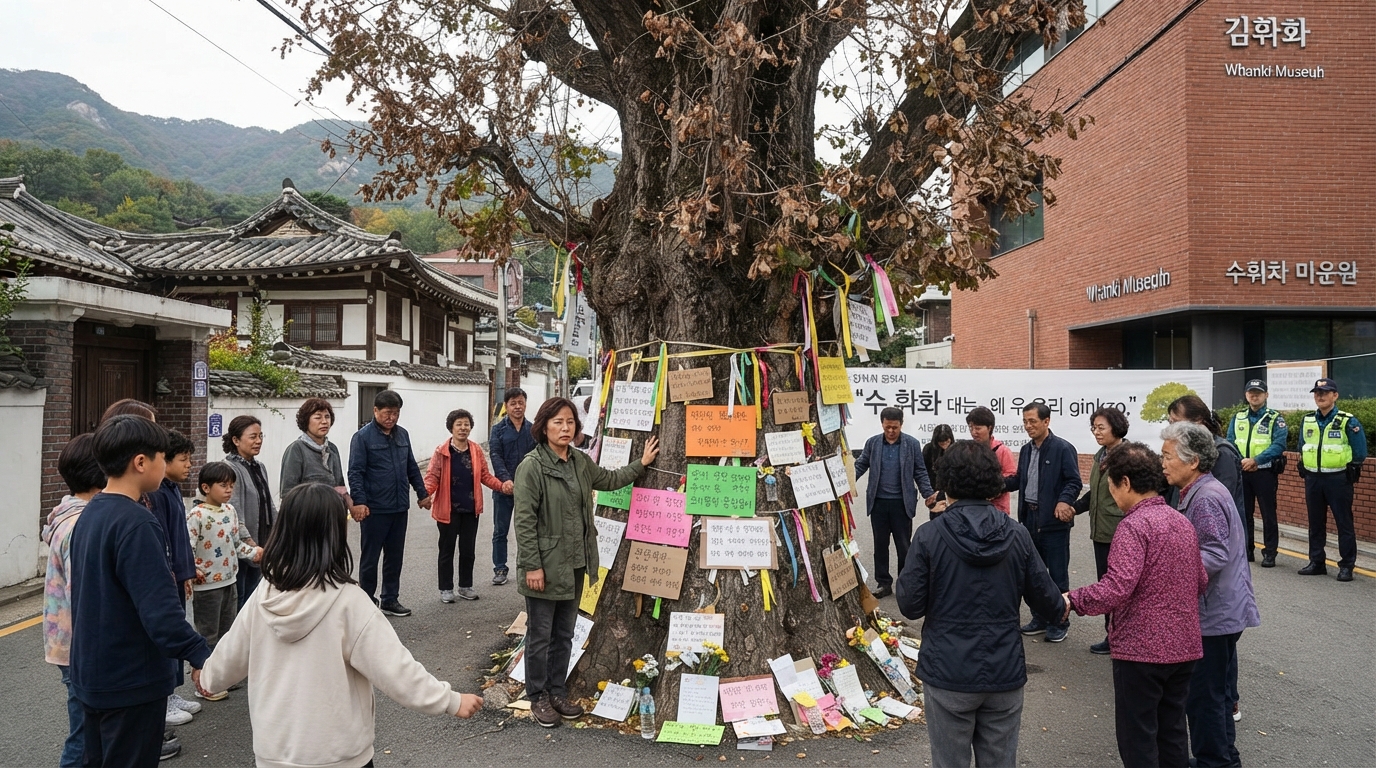
For weeks, about 20 residents gathered regularly in front of the tree to pray for its recovery. Some read Whanki’s essays aloud, while a local shaman carried out a "healing ritual".
Residents perform an "elm dance", which they believe promotes ecological healing
Messages of support fluttered against the trunk as music played, and the group held hands and swayed together in an "elm dance", which some nature lovers and activists believe helps trees heal.
"If someone had truly understood this tree was deeply loved, they probably would not have made the decision to inject herbicide," says Kim Min-joo, who has lived in Buam-dong for more than a decade.
Residents gathered regularly in front of the ginkgo tree to pray for its recovery
Jung recently realised that all the days she spent rushing to save the ginkgo were the most active she had been since she fell ill last winter.
She had found it difficult to walk much and often watched the tree from home. On better days, she walked up to it, even hugging its rough trunk and breathing in its earthy scent to lift her mood.
"I felt so depressed and hopeless but those feelings disappeared. I entered a tree-like state."
She still cannot walk very much, she adds, but "the tree helped bring me back out into life again. Ironically, it was because the tree became sick."
"Although it has been heartbreaking, there were also incredibly moving moments," Jung says, looking back. "The neighbourhood came together, cared for one another, looked after each other."
As Seoul shifts into shades of yellow with the arrival of autumn, the leaves on Buam-dong’s once-prized ginkgo are now a crispy brown.
The neighbourhood is still hoping for a miracle.
Because they cannot imagine an autumn in which they do not stop to admire the ginkgo at its most beautiful, wrapped in a feathery coat of gold.