

Army, duty, heroism: How Russia brought the war into its schools?
**Army, duty, heroism: How Russia brought the war into its schools**
In Russian schools, preparing students for military service and educating them in a military-patriotic spirit has long been viewed as an important issue. However, after the start of the full-scale invasion of Ukraine, attention to this direction intensified significantly. In recent years, militaristic sentiments have penetrated even deeper into the school environment.
In particular, starting from September 1, 2024, the subject "Basics of Life Safety" (OBJ) was abolished in Russian schools. The classes, which had been taught for many years and taught children skills such as traffic rules, fire safety, and first aid, were replaced by "Basics of Safety and Defense of the Motherland" (OBZR).
On the outside, this change might seem like a mere name change. However, the tasks assigned to the subject have expanded significantly. A separate module on basic military training has been included in the new curriculum. That is, this subject is no longer limited only to teaching children how to protect themselves from everyday dangers. It must also perform the task of preparing students for military service and forming a generation ready to defend the motherland.
The publication "Verstka" and the research project "Ne norma" prepared a material about the growing militarism in Russian schools. In the process, they analyzed millions of posts placed by educational institutions on social networks, teachers' testimonies, and court materials.
According to the study, words such as army, military training camps, duty, self-sacrifice, courage, and patriotism in school posts about "OBJ" and "OBZR" have almost doubled. The prosecutor's office has also joined this process. Prosecutors are forcing school administrations to purchase the military equipment necessary for the new subject. In 2024–2026, 597 lawsuits of this nature were filed against Russian schools.
### From "OBJ" to "OBZR": More than just the name has changed
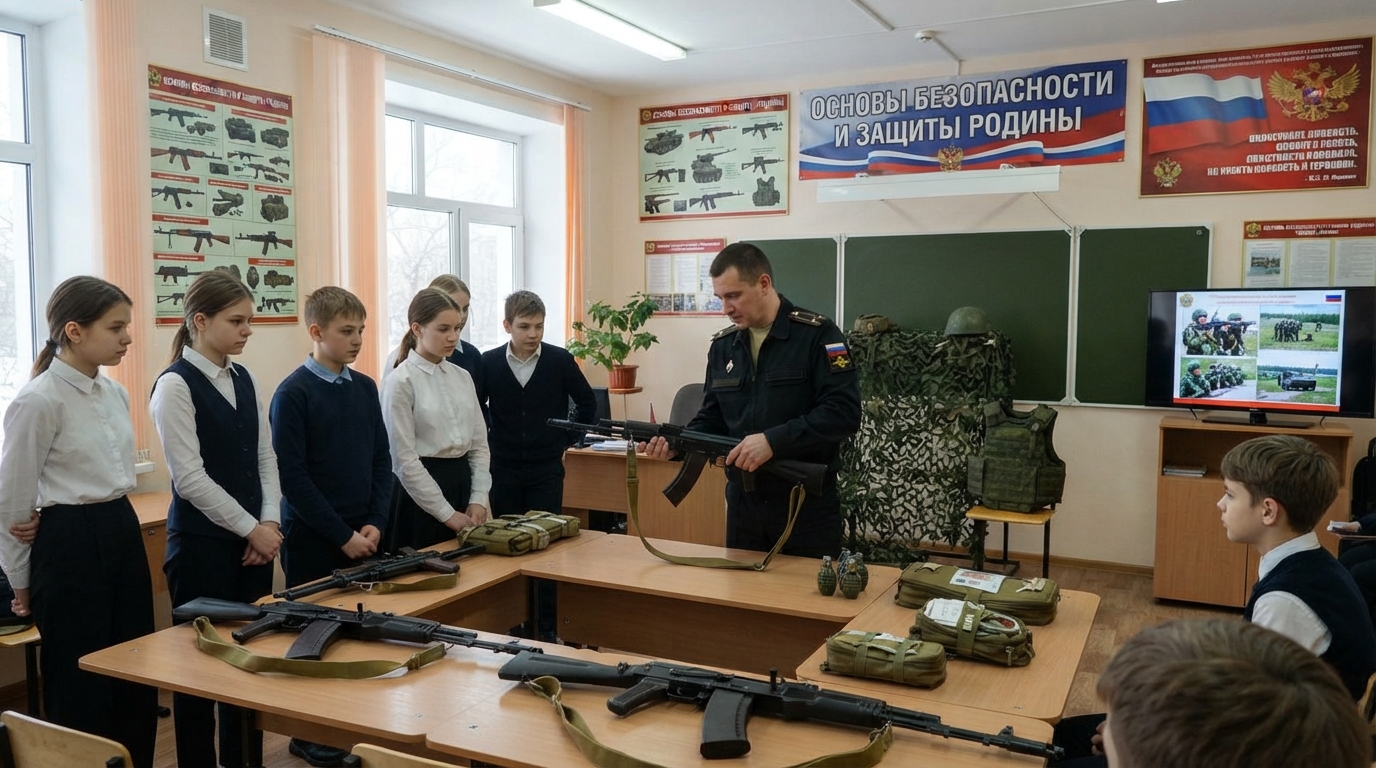
In schools where the new subject has been introduced, students are learning to disassemble and reassemble the Kalashnikov assault rifle. In addition, they are getting acquainted with training models of weapons and equipment, and participating in tactical medicine classes. In some educational institutions, skills in using drones and electronic warfare systems are also being taught.
At the same time, the requirements for equipping "OBZR" classrooms in schools have also been expanded. A list of equipment that must be purchased has been compiled. It ranges from high-quality models of the Kalashnikov assault rifle, Makarov pistol, and hand grenades to training drones and medical equipment. But that is not all. If a school is unable to take students to training camps, it must also purchase additional equipment necessary for military training. Among them are tents, tarpaulins, mats, soldier canteens, field pots, gas burners, infantry shovels, and binoculars.
Some schools have already managed to create such infrastructure. For example, on the territory of a school in the village of Bakhmutovo in the Kaluga region, a special obstacle course consisting of seven elements was built. It includes an artificial trench, a labyrinth, an inclined wall, and a ruined bridge. The school administration stated that these facilities would give students "new opportunities."
### Schools taken to court
In Russia, the issue of equipping "OBZR" classrooms is not only under the control of educational authorities. As mentioned above, the prosecutor's office is also checking whether schools have the prescribed equipment for the new subject. If the requirements are not met, lawsuits are filed against schools and local authorities. According to the publication's experts, in almost all such cases, the court ruled in favor of the prosecutor's office. However, schools have often stated that they do not have sufficient financial resources to execute the ruling.
This is because funds for purchasing the necessary equipment are usually allocated by city or district administrations. If there is no money in local budgets, such expenses, which amount to hundreds of thousands of rubles, become a heavy burden for schools. The reason is that equipment intended for "OBZR" is not cheap. During the preparation of the material, it was found that models of the Kalashnikov assault rifle start from 56,000 rubles ($570). Shooting simulators are much more expensive, with prices ranging from 100,000 rubles to 1 million rubles.
For this reason, some schools are forced to limit themselves to available resources. For example, a teacher from Tatarstan brought a broken "Mavic" drone to show students due to a lack of modern equipment. He told the publication that this problem is even more acute in rural schools.
An example of this is a case heard in Buryatia in August of this year. The prosecutor's office demanded that the Tuzhinkinsky secondary school and the district administration provide the "OBZR" classroom with 20 types of equipment. The list included models of weapons and grenades, a model of a simple shelter, and other educational tools. The court gave the educational institution and the district administration 10 months to purchase the relevant equipment. Meanwhile, the administration of the Kyrinsky district of the Zabaykalsky Krai filed an appeal to the court this year, stating that it could not meet the court's demand. The reason given was a lack of funds even for the payroll fund. The letter also stated that meeting such demands of the regulatory authorities could cost up to approximately 50 million rubles. Nevertheless, some schools managed to find the necessary funds by cutting other expenses.
### Changes are also visible on schools' social networks
The introduction of the "OBZR" subject has affected not only the content of the lessons but also the activities of schools on social networks. Starting from 2022, Russian schools began opening their pages on "VKontakte." As a result, hundreds of thousands of posts reflecting lessons, events, and other activities appeared on the internet. The authors of the material analyzed them and found that the volume of content related to "OBJ" and "OBZR" had increased.
For example, in the 2021–2022 academic year, schools posted just over 20,000 posts about "OBJ." In the next academic year, this figure increased 2.5 times, exceeding 52,000. In the 2023–2024 academic year, when the "OBZR" subject was introduced nationwide, more than 73,000 posts of this nature were published. However, according to the source, the content of the posts is even more important than their total number.
Researchers also studied the frequency of using words such as army, military training camps, duty, self-sacrifice, courage, and patriotism in school posts about "OBJ" and "OBZR." These words appeared in approximately 12 percent of the posts in the 2021–2022 academic year. That is, in every eighth material. In the 2024–2025 academic year, this figure reached 23 percent.
### How is military service presented to school students?
Researchers also focused on how schools' social media pages influence children's perceptions of war. For example, a school in Tatarstan posted a material about students' military training camps. It reported that during the camp, students mastered weapon handling skills, held a real combat assault rifle in their hands, and overcame the psychological fear arising from the sound of gunfire.
The school administration justified such training, emphasizing that students would need it. Teachers explained this by the fact that in a few years, the children would have to serve compulsory military service in the Russian army. Notably, in most cases, participants in the war against Ukraine were involved in conducting such camps.
### War participants in schools
It has become common practice to invite "war veterans" to teach the "OBZR" subject and participate in other events in schools. For example, in 2024, Dmitry Matveyev, who returned from the war, visited an educational institution in the Novgorod region. According to the school's social media page, he called on students to do sports, study history and geography, be patriotic, and prepare for service in the army.
Another school in the Kurgan region invited Dmitry Puzyryov, a local war participant. He returned from the war having lost a leg. Puzyryov was introduced to the students as an example of "courage" and "patriotism." However, it was not mentioned that the former soldier had been convicted twice for theft before signing a contract with the Russian Ministry of Defense.
The introduction of the "OBZR" subject has brought to light another problem. The point is that the question of who will teach it to children and by what methods has not been fully clarified. According to Yevgeniya, a teacher from Samara, there are no textbooks for the new subject yet. For this reason, she uses old "OBJ" textbooks, as well as various websites on the internet.
Nevertheless, Yevgeniya's lessons include practical aspects of military training. Students perform drill exercises, learn to disassemble and assemble the Kalashnikov assault rifle. They also practice tactical medicine. In such classes, they are given tasks such as evacuating a wounded person from a simulated battlefield, providing first aid, and transporting them to a safe area.
Some teachers, however, said that to teach the new subject, the educator themselves must have relevant military knowledge. A teacher from Tatarstan emphasized that an "OBZR" teacher must love the motherland and have an understanding of tactical medicine and drones. Another teacher expressed dissatisfaction with the fact that the attitude toward military service among students is not the same as before. According to him, some students view service in the army as a "lost year."