

Are we trembling creatures or the source of power?
I was prompted to write to you by the story regarding the dismantling of window bars in one of the mahallas of the Mirzo-Ulugbek district of Tashkent. In my view, this is yet another reason to think about who those endowed with power actually take the citizens of our country for
Are We Trembling Creatures or the Source of Power?
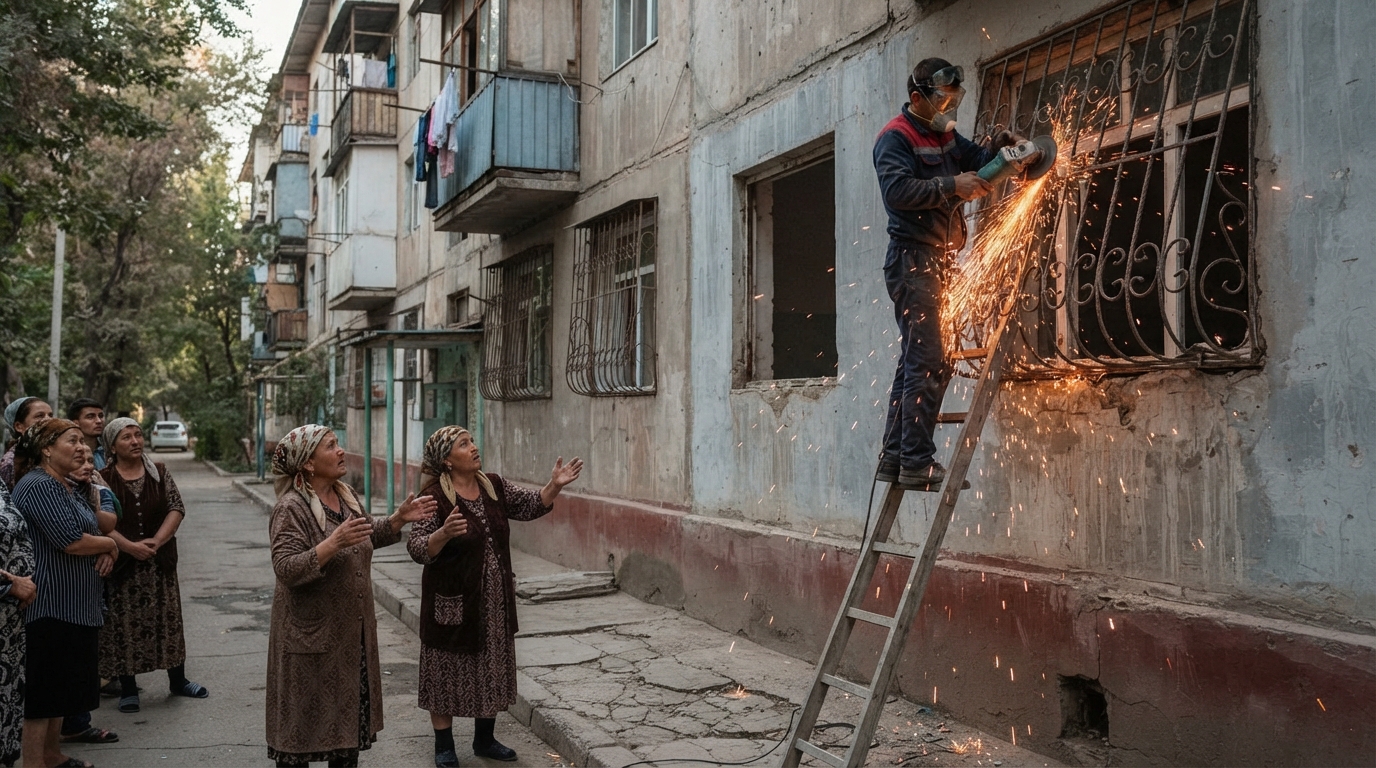
The trigger for this text was the story involving the removal of window grilles in one of the mahallas of Tashkent's Mirzo-Ulugbek district. In my view, this is yet another reason to reflect on how those in power actually perceive the citizens in our country. According to a report published on October 12, residents stated that their window grilles were being removed, after which the work was suspended, and the capital's khokimiyat announced an investigation into the legality of the responsible officials' actions.
The city administration rushed to emphasize that it was not the initiator of the dismantling and opposes such actions, claiming that resident safety, compliance with their rights, and the preservation of property allegedly remain a priority.
But why is it that in our country it is increasingly common for people's windows, houses, property, and way of life to first become the object of orders from unknown bosses, and only later, when people express outrage, do officials remember the law, citizens' rights, and the need to look into the matter? Why must a person first face arbitrary rule and then still have to prove that they have the right to live in their own home, dispose of their property, and independently decide what safety measures they need?
It is particularly alarming that this is far from the first case where the interests of ordinary people end up at the very bottom of the priority list whenever they conflict with officials' ideas of how an urban area should look. Many Tashkent residents remember the story of apartment balconies in multi-story buildings located along the so-called presidential route. Balconies were cut off under the pretext of ensuring the safety of the head of state.
No widespread public outcry occurred. People were outraged and discussed what happened among themselves, but no mass protest emerged that could force the authorities to seriously listen to the citizens. Many were simply frightened of the consequences of open disagreement, fearing that public protest could turn into reprisals against themselves. They are afraid today, too.
Perhaps even more so than yesterday. When a person thinks in advance not about how to protect their rights, but about whether someone will come after them following a complaint or speech, it is difficult to talk about a full-fledged civil society. This is how a vicious circle forms: officials get used to citizens preferring to remain silent, citizens get used to the idea that arguing with officials is dangerous or useless, and the state apparatus gains the opportunity to act brazenly and overconfidently.
It seems to me that over the past six years, relations between the population and the authorities have noticeably deteriorated. This is not necessarily about every individual citizen conflicting with state bodies on a daily basis, but about an accumulated feeling: decisions are made somewhere at the top, and the price is paid by those who were never asked. A person is required to show patience, understanding, and a readiness to adapt, whereas a formal statement that the situation has been taken under control is often enough from an official. At the same time, a promise to look into the matter by no means always means that the citizen will receive a clear answer, the guilty will be punished, and similar incidents will not happen again.
That is precisely why I have never believed the slogan "The official is for the people, not the people for the official," considering it populist and contrary to the true intentions of the authorities. And the actions of the authorities regularly confirm this distrust. It is especially sad that such episodes occur in a country whose leadership regularly speaks of reforms, openness, protection of human dignity, and the building of a state that serves the interests of the population.
It is worth reminding that democracy is measured not by the number of correct words spoken, nor by how modern official statements look, but by real deeds for the benefit of the people. The authorities must finally understand a simple thing: the people do not exist for their convenience, they are not the servants of the authorities, and certainly not slaves. Otherwise, any declarations about democratization sound not like a promise of change, but as a reminder of how far real life has strayed from the proclaimed principles.
It makes one want to ask oneself: are we trembling creatures, or the source of power?