

Arctic on Schedule: Why Global Logistics Is Turning North
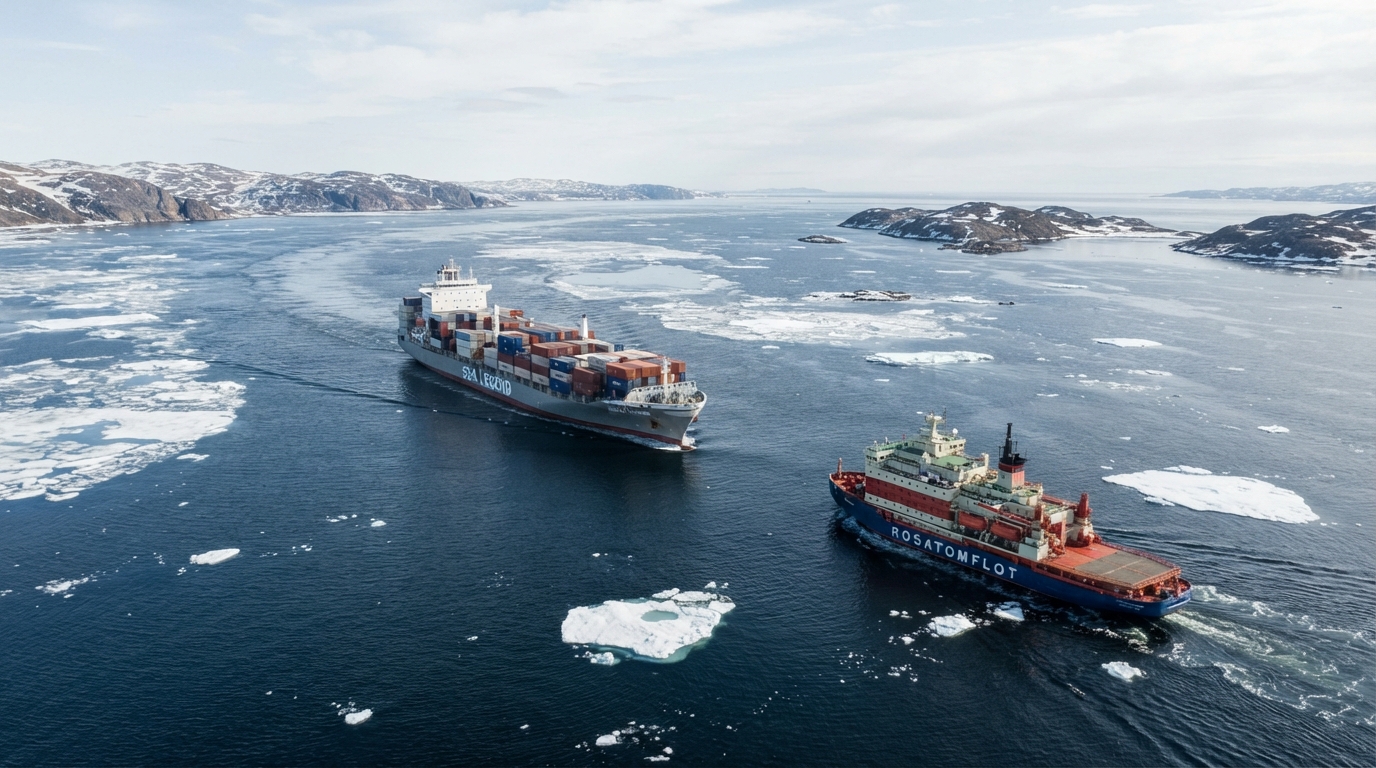
On September 9, the container ship Dubai Tower arrived at the British port of Teesport, completing its transit from China via the Northern Sea Route (NSR). This is the first of eight voyages that the Chinese shipping company Sea Legend plans to make this season on the China–Europe line via the Russian Arctic shipping route. Container ships have been sailing through the Arctic for more than a year, but Sea Legend […]
Arctic on Schedule: Why Global Logistics is Turning North
On September 9, the container ship Dubai Tower arrived at the British port of Teesport, completing its transit from China via the Northern Sea Route (NSR). This is the first of eight voyages that the Chinese shipping company Sea Legend intends to operate this season on the China-Europe line via the Russian Arctic shipping route. Container ships have been sailing through the Arctic for several years now, but Sea Legend is the first to offer a weekly seasonal service directly between China and European ports. Now, the question is not whether it is technically possible to navigate the route, but how commercially viable this service will prove to be.
According to Reuters, the Dubai Tower departed from the port of Ningbo-Zhoushan on August 15 and arrived in Teesport in northeast England approximately 25 days later. For comparison, the route via the Suez Canal takes about 40 days. On board were about 1,500 containers carrying equipment for energy storage systems, batteries, and solar energy components. Sea Legend has announced eight voyages for the current Arctic navigation season using a fleet of seven small and medium-class container ships. Last year, the company completed a trial transit from Ningbo to the British port of Felixstowe in 20 days.
Container shipping along the NSR ceased to be isolated experiments several years ago. According to Rosatom, the infrastructure operator of the route, 14 international container voyages were completed in 2024. In 2025, there were already 24 such voyages, and the volume of containerized cargo more than doubled to 410,000 tons. Another Chinese company, New New Shipping, has been operating commercial voyages since 2023.
The active development of the Arctic shipping line coincided with a period of prolonged instability on traditional maritime routes. In recent years, global logistics has experienced a series of shocks, force majeure situations, and points of tension along conventional routes. Shipping disruptions in the Red Sea due to the Middle East crisis have also forced carriers to reroute vessels around the Cape of Good Hope, increasing distances and delivery times. According to UNCTAD, about 80% of international trade in goods by volume is carried by sea. The specifics of this situation are reflected in the organization's 2025 report. In 2024, maritime trade volume grew by 2.2%, while transport in ton-miles—which accounts for the distance traveled by cargo—increased by 5.9%, nearly three times faster. Due to security risks, vessels are being rerouted to longer paths, and the average voyage distance rose from 4,831 nautical miles in 2018 to 5,245 miles in 2024.
Against this backdrop, carriers' interest in shorter routes seems logical. For instance, the Shanghai-Hamburg route via the NSR is about 7.3 thousand nautical miles, compared to approximately 10.8 thousand via Suez and 14 thousand via the Cape of Good Hope, making it about one-third shorter. A similar pattern is observed on other routes: the distance from Busan to Rotterdam via the NSR is 7.5 thousand miles, compared to 11 thousand miles via Suez and 14.5 thousand miles via the Cape of Good Hope.
South Korean company PanStar also showed interest in the route, dispatching its first container ship from Busan along it in late August. As part of a trial voyage, the container ship PanStar Acro departed Busan on August 22 and arrived in Felixstowe, UK, on September 12, before heading to Rotterdam and Gdansk. According to the company's chairman, Kim Hyung-gon, the transit took about a third of the time usually required for a voyage via the Suez Canal, taking into account standard port calls along the route, Bloomberg news agency reports. The company is considering operating up to three voyages next year, with a subsequent gradual increase in frequency.
Of particular note is Rosatom's cooperation with the world's largest port operator, DP World (UAE), which shows that the NSR is beginning to be perceived as a real part of global logistics. The emergence of a regular seasonal service expands the choice of routes and provides carriers with an alternative to the Suez Canal, allowing them to avoid the longer detour around the Cape of Good Hope, which increases delivery times, costs, and carbon dioxide emissions.
Bakhtiyor Ergashev, Director of the Ma’no Center for Research Initiatives, analyst, and political scientist, primarily points to the difference in the scale of transportation and suggests viewing the Arctic route more as an additional opportunity. In his assessment, for Asia's largest cargo-generating centers, the very ability not to depend on a single direction and to use multiple routes between Asia and Europe is what matters.
The presence of an alternative short route on the global logistics map offers several advantages at once: diversification and economic efficiency. The arguments in favor of the Arctic route are supported by the dynamics of cargo traffic. According to the operator, cargo traffic along the NSR is growing steadily, having increased nearly fivefold over the past 10 years. In 2025, 37.02 million tons of cargo were transported via the NSR. Transit cargo, meanwhile, reached a record 3.2 million tons.
Carriers have already confirmed the feasibility of shortening the path between individual ports in Asia and Europe via the NSR. For a regular service, repeatability of results, predictability of schedules, and voyage economics over several navigation seasons are crucial. The Northern Sea Route already possesses the necessary infrastructure, services, regulatory mechanisms, as well as models for international transit and insurance. A key role here is played by the operator, which has been Rosatom since 2018. Its responsibilities include organizing the safe operation of vessels in the NSR waters, icebreaker escorts, navigational and hydrographic support, and the permit issuance system.
To date, Russia possesses the world's only nuclear-powered icebreaker fleet. It consists of eight active vessels, also managed by Rosatom, and four more are at various stages of construction: the Chukotka, Leningrad, Stalingrad, and the lead icebreaker Rossiya. In March 2026, Rosatom announced the completion of the design for an Arc7 Arctic-class container ship for the planned Russia-China line.
Land-based Eurasian corridors and the maritime route through the Arctic differ in geography, cargo structure, and destination markets, so a direct comparison between them explains very little. It is far more important to understand whether the emergence of new routes means increased competition for cargo flows, or whether global business as a whole is transitioning to a model where multiple alternative delivery chains are used simultaneously.
According to Bakhtiyor Ergashev, contrasting the NSR with land routes in this case would be incorrect.
"There are products that are profitable to transport via the Northern Sea Route, and there are certain types of products that can and should be transported via land routes. This means only one thing: the Northern Sea Route and the land transport corridors passing through Central Asia are not so much competitors; rather, for shippers and consignees, they represent hedging opportunities—that is, reducing transport risks depending on time and product range. Therefore, one must take into account that, overall, neither the land transport corridors nor the Northern Sea Route will be able to fully replace the Suez Canal. And in fact, there is no such goal. The goal is to form alternatives that could serve as a source and basis for hedging risks in global-scale cargo transportation," Ergashev believes.
What is important to note here is not the mere fact of another maritime corridor appearing, but the shift in the logic of global supply chains. The more options shippers have between Asia and Europe, the greater their ability to redistribute flows in the event of disruptions in one direction.
It can already be said that for Asian countries, the NSR means a shorter transport leg between manufacturing centers and European markets, reduced dependence on congested or vulnerable traditional routes, and expanded logistical opportunities for foreign trade. For the global economy, it represents an additional international route, greater resilience in global logistics, diversification of transport chains, and increased supply flexibility in conditions of instability.