

Mexico is building an alternative to the Panama Canal — Bloomberg
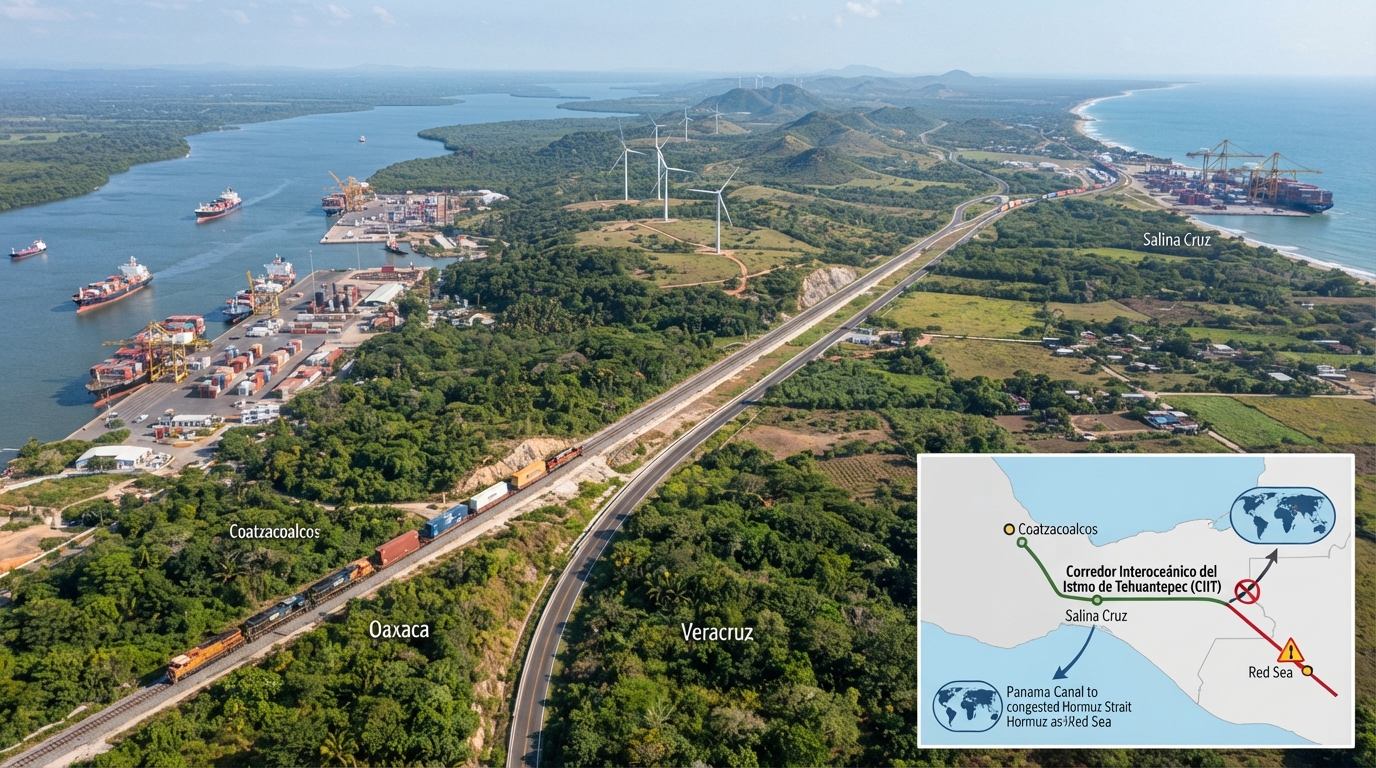
Mexico is working to quickly launch a new shipping route through the Strait of Tehuantepec, which could be an alternative to the Panama Canal. According to Bloomberg, the country sees this route as an alternative to global trade routes that have been destabilized by problems in the Panama Canal, the Strait of Hormuz and the Red Sea. At least 70 billion pesos (about $ 4 billion) have already been spent on the project.
The project is about the 308-kilometer railway corridor (CIIT) that will connect the Mexican port of Coatzacoalcos with the port of Salina Cruz on the Pacific coast.
The Mexican government hopes that the new route will be a solution to congested or unstable routes in global logistics. For example, due to drought, waiting times for ships in the Panama Canal have increased from several days to three weeks. Traffic through the Strait of Hormuz has almost stopped amid tensions between the United States and Iran. In the Red Sea, merchant ships remain at risk of Houthi attacks.
However, Bloomberg notes that the new corridor is unlikely to fundamentally change global trade routes in the near future. Even according to the government’s optimistic forecast, 1.4 million containers could be transported through the corridor annually by 2035. For comparison, about 20 million containers pass through the Panama Canal annually now.
Currently, both ports mainly handle cargoes such as oil, petroleum products and chemicals, rather than transit containers.
“Mexico is finally trying to fulfill a logistics dream that has been around for more than a century, and it seems to be doing it seriously,” Marco Cancino, an expert on public infrastructure, told Bloomberg.
However, turning a geographical advantage into a full-fledged industrial corridor will not be easy. The project is hampered by difficult terrain, poor infrastructure, poverty in the south of the country, and distance from major manufacturing centers in central and northern Mexico.
"The government's task now is to make the corridor so attractive that no one doubts that it is a vital logistics route. For now, there are serious doubts," Cansino added.
**The history of the project is more than a century**
The idea of building a transport corridor through the Tehuantepec Gorge has a history of more than a century. In 1907, Mexican President Porfirio Díaz inaugurated a railway through this area. However, the development of the project stalled a few years later due to the Mexican Revolution and the opening of the Panama Canal in 1914.
The idea was revived in 2018 after Andrés Manuel López Obrador came to power. At that time, the restoration of the old railway and the preparation of sites for the creation of industrial parks began.
His successor, the current president of Mexico, Claudia Sheinbaum, expanded the plan to create 14 "development hubs." The corridor has become one of the main projects aimed at accelerating economic growth.
According to Bloomberg, Sheinbaum personally supervised the project and holds meetings dedicated to its development every two weeks.
So far, only five of the 14 sites have been granted concessions - state permits to operate. At least two permits granted by previous governments have been revoked because the companies did not fulfill their investment obligations.
One of the main problems with the project remains the supply of electricity. According to Bloomberg, most of the sites in the corridor have an electrical capacity of only about 30 megawatts. However, one of the already approved aluminum production projects requires about 400 megawatts of electricity.
The Mexican government has promised to build an electrical substation, but there is no specific date for when it will be commissioned. The railway itself also has problems. In December, a passenger train derailed on a major section of the corridor. The accident killed 14 people and injured 98. In July, a freight train also derailed on the same route. This time, no one was injured, and the causes of the accident are being investigated.
Jean-Paul Rodrigue, a professor at Texas A&M University, noted that there is a huge "inertia" in world trade, which requires a lot of effort to change.
According to him, it is not yet known whether the current global logistics crises will be enough to encourage companies to switch to new transport routes.