

Another flashpoint in the Middle East: Israeli and Turkish interests clash in Syria
A few days ago, Israeli forces struck the Abu Zuhur air base in Idlib, describing it as a necessity to maintain the "status quo" in the region. In fact, Turkey is concerned that if radar and air defense systems are deployed in Syrian territory, Israel will not be able to operate its fighters freely in the skies over Damascus.
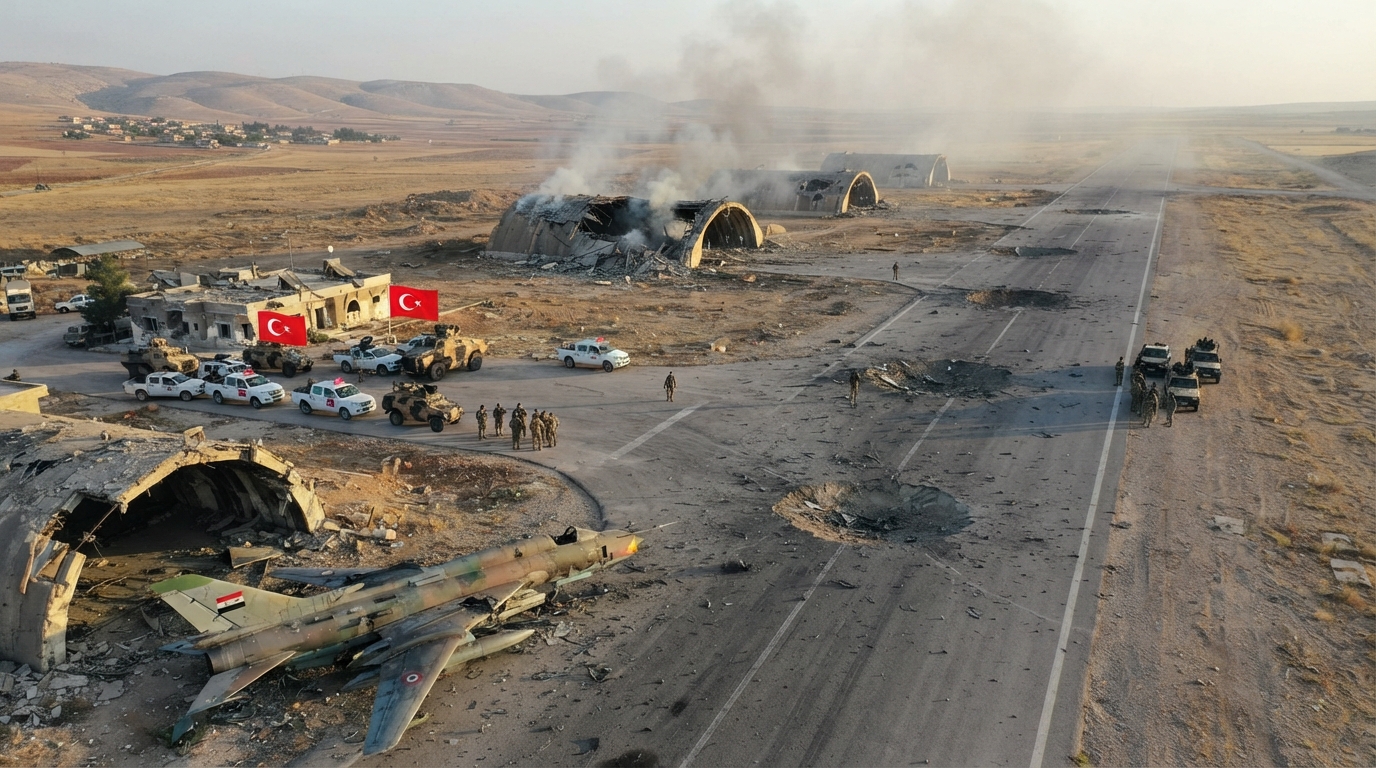
A new flashpoint has emerged in the Middle East as Israel and Turkey's interests in Syria clash.
Syrian state television, citing military sources, reported that Israeli fighter jets carried out eight strikes on the runway and warehouses of the Abu Zuhur military airfield on the night of August 18. The strikes caused material damage but no casualties. Israeli media reported that the strikes on Syria were carried out in four waves.
A notable aspect of the attack is the timing. The Associated Press, citing Syrian officials, reported that the strikes came shortly after Turkish military officers visited the base. Open source (OSINT) observers also filmed two old but refurbished Syrian Su-22 fighter jets flying over the area a few days before the attack. Satellite images published by pro-Israeli media show that the military base has been revived in recent months.
**Israel's excuse: "Status quo violation"**
Israel, which does not abide by international law and bombed another country's territory, remained silent for almost a day. Then Prime Minister Benjamin Netanyahu's office issued a statement without mentioning the strikes on Syria. According to it, "Israel and Syria have agreed to maintain the status quo on security issues. Official Damascus, however, is on the verge of violating this agreement by allowing Turkish troops to station at this air base." It was noted that Israel had repeatedly warned Syria that such a deployment posed a threat to its security, but Damascus did not listen.
Netanyahu later made the tone even more harsh: "Our message was very clear: 'Don't do it!' They [the Syrian authorities] don't seem to have understood the message," he said.
According to Reuters, four days before the strike, on August 14, Mossad chief Roman Hoffman spoke by phone with Syrian Foreign Minister Asad al-Shaibani. Mossad expressed concerns about Turkish military activity to him. This was reportedly one of the highest-level contacts between the two sides since the overthrow of Bashar al-Assad.
In addition, sources close to the Israeli government say that Tel Aviv officials warned the United States before the attack and sent them "highly sensitive intelligence."
The Israeli press is not hiding the real source of the concern: Tel Aviv is concerned about Turkey's role in rebuilding the Syrian air force and air defenses. If radars and air defense systems are deployed in Syrian territory, Israeli fighters will not be able to move freely in Syrian skies - this is the real "red line".
**Rejection by Turkey and Syria**
Syria described the strike as a gross violation of sovereignty and called on the international community and the UN Security Council to condemn Israel's actions.
Syrian Foreign Minister Asad al-Shaibani, in a statement to Axios, completely rejected Israel's interpretation. According to him, there was "no intention to establish a Turkish base, permanent Turkish military presence or deployment of forces" at the base. The minister noted that the base is almost empty, has not yet been fully renovated, and is being worked on specifically for the needs of the Syrian Air Force.
In fact, in recent years, negotiations have been underway on an Israeli-Syrian security agreement under US mediation. Al-Shaibani said the agreement was even ready on paper, but Israel reneged on its commitments.
Turkey responded with a harsher tone. The Foreign Ministry said it "strongly condemned" the strikes, calling them a violation of Syria's territorial integrity and a blow to efforts to stabilize the country.
The Turkish Defense Ministry said "there was no Turkish military delegation at the base either before or during the strike." The Turks also said Israel must stop its "indiscriminate attacks" and would continue to help rebuild Syria's military capabilities.
It is worth noting that while the Syrian side acknowledged the visit of Turkish officers, Ankara has completely denied this.
**US Intervention: "Unnecessary Escalation"**
The unexpected reaction came from a US official who has become a regular target of Israeli attacks in recent times. In a post, US Ambassador to Ankara and Special Representative for Syria Tom Barrack openly criticized the Israeli strikes, calling them an "unnecessary escalation." "Such actions do not serve regional stability," he said.
President Donald Trump confirmed to Axios that he had been informed of the strikes, but declined to comment. Both Erdogan and Bibi are "respected" leaders for Trump. Qatar, Egypt, Saudi Arabia and Jordan have also condemned the Israeli strikes.
**Why is Syria so important to Turkey?**
After the overthrow of dictator Bashar al-Assad in December 2024, Turkey has become the main bulwark of the new Syrian government. There are many reasons for this. First, a stable and attractive Syria is needed for the return of millions of Syrian refugees living in Turkey.
In addition, the reconstruction of war-torn areas, military assistance - a huge economic opportunity for Turkish companies. In August 2025, the two countries signed a memorandum of understanding on military training and advice. After that, Turkish specialists began training the Syrian military. According to analysts, the Abu Zuhur air base, which was hit, is located in the heart of the area that has long been considered a sphere of influence of Turkey - in Idlib.
**Threats from Israeli officials**
In the days after the strike, the Israeli leadership increased its tone instead of lowering it. In a speech on August 19, Netanyahu stated that Israel would not tolerate Turkish military presence moving towards its borders.
**Ankara's response**
Turkey also did not respond to Israeli threats by retreating. The Turkish presidential office, following the statements of Katz and Netanyahu, called the Israeli accusations "baseless" and an attempt to justify an illegal act. The Turks also did not rule out the possibility of deploying military forces in Syria in the future: Ankara will continue to firmly cooperate with Damascus.
Foreign Minister Hakan Fidan, meanwhile, stated that Israel is destabilizing Syria and that Turkey will not hesitate to defend its interests.
Some Turkish publications are evaluating the Israeli strike as a "provocation of war." In government circles, the attack is being perceived as a test of Turkey's reputation as a "regional security partner."
**"Israel does not need a strong neighbor"**
The strike on the Abu Zuhur air base is just the latest link in a chain of major attacks. In fact, since December 2024 - from the first hours of the fall of the Assad regime - Israel has been systematically destroying Syria's military infrastructure.
According to Al Jazeera's calculations, more than 600 strikes were launched against Syria in the first year alone, almost completely disabling the country's air defenses. Israel also occupied the buffer zone and strategic heights in the Golan Heights.
The tension in relations with Turkey was also affected by Israel's genocidal war in Gaza. Turkey stopped trade with Israel in 2024, and Erdogan has been criticizing the Netanyahu government in the harshest terms.
In Israel, it has become a tradition to call Turkey the "new Iran" - a phrase used by former Prime Minister Naftali Bennett. The harshness towards Ankara is also being used as part of a PR campaign ahead of the Israeli elections in October. Because no matter how much Israeli officials threaten, a war with a NATO member with a common defense agreement will weigh on them.
So far, Turkey and Israel are "talking" to each other not directly, but through facilities in Syria and statements on social media.