

Andijan Region: From Quantitative Growth to Increasing Economic Productivity
On September 24, 2026, a meeting was held under the chairmanship of President Shavkat Mirziyoyev on the socio-economic development of the Andijan region, supporting entrepreneurship, and increasing the income of the population.
**Andijan Region: From Quantitative Growth to Increasing Economic Productivity**
At the end of the first half of 2026, the economy of the Andijan region increased by 8.8%. At the same time, industrial production grew by 9.2%, services by 16.1%, and investments by 8.9%. Thus, the services sector shows the highest rate, with its dynamics almost doubling the overall economic growth.
Behind these figures lies a significant expansion of the region's resource base. Over the past 10 years, 20 trillion soums were directed to the region from the republican budget, and bank financing of entrepreneurship reached 90 trillion soums. In the current year alone, an additional 6 trillion soums have been allocated to improve the well-being of the population. The scale of the attracted resources shows that the main question is gradually shifting from the availability of financing to its effectiveness — to what extent the invested funds translate into productivity, employment, and sustainable sources of income.
In parallel, a fairly large layer of regional business has already formed. There are 104 enterprises operating in the region with a turnover of over 100 billion soums, and for 4 enterprises it exceeds 1 trillion soums. This means that further growth can rely not only on the creation of new business entities, but also on the expansion of existing companies, their technological upgrading, and the integration of small businesses into the production chains of large enterprises.
Industrial competence remains one of the most important accumulated assets of the region. Automotive and machine building have been developing in Asaka for 30 years. However, further increasing the return on this base requires a transition from manufacturing competencies to proprietary technologies, engineering solutions, electronics, and software products.
The region has a significant educational resource for such a transition. There are 95,000 students studying in 12 higher education institutions, and another 60,000 young people in 59 technical schools. Of these, 10,000 students receive education in engineering, energy, industry, and information technology. In addition, 46 industrial zones and 56 large enterprises operate in the region, which creates an institutional framework for a closer connection between education and production.
There is already an example of such a model: in the "Ipak Yuli" industrial zone, an investor opened a technical school where training is combined with a stipend and subsequent employment. Thus, a mechanism for training personnel directly for the needs of specific production facilities is gradually being formed.
A notable result has also been achieved in providing the population with drinking water. In recent years, 1.5 trillion soums have been directed to this sector, as a result of which drinking water supply coverage reached 93% — the second highest figure after the capital. At the same time, the reconstruction of 9 km of sewerage networks is underway in Andijan.
The formation of a new urban space also continues. Babur City is being created on an area of 4,000 hectares; 25,000 people have already moved into new homes, and the construction of 800 apartment buildings designed for another 200,000 residents has already begun. This gradually forms a new center of demand for trade, education, healthcare, hotel, and other modern services.
Changes are also taking place in transport accessibility. In September, the "Tashkent – Andijan" high-speed train began operating, reducing travel time from 6 to 4 hours. A bridge on Babur Street was also commissioned in Andijan. Improving interregional and intra-city connectivity reduces the time costs of mobility for the population and businesses.
In agriculture, individual projects have already appeared that can become the basis for scaling new models. A poultry meat production complex worth $20 million was launched in the Balykchy district, and a 5-hectare greenhouse project was identified as a model for further dissemination.
At the same time, only 16% of the fruits and vegetables grown in the region are processed today. This shows a serious gap between agricultural production and post-harvest value creation. That is why further policy shifts the focus from increasing physical volumes of products to processing, storage, branding, and export of finished products.
The results of the reforms have simultaneously revealed several structural constraints. In particular, the $3.5 billion of investments planned for the current year are insufficiently diversified by countries of origin of capital and by industries. Despite the human resource potential and the export of IT services, insufficient investment is directed towards strengthening the technological base of the industry.
Constraints on access to finance also persist. Since the beginning of the year, 35,000 people have not received loans due to the lack of sufficient collateral or a guarantor. Thus, the traditional collateral-based lending model is beginning to hold back the further expansion of entrepreneurship, even in cases where the enterprise has orders, turnover, and a stable cash flow.
Additional constraints include a decline in turnover and jobs at some enterprises, the cessation of activities of a number of business entities, as well as delays in the judicial consideration of disputes over loans, purchase and sale, supplies, utility and tax debts. Therefore, the next stage of regional policy is no longer focused simply on providing resources, but on changing the mechanisms of their distribution and business support.
The central element of the new approach is the revision of investment evaluation criteria. Recently, 1,000 hectares of land were allocated for industry and entrepreneurship. This territory should ensure the attraction of $7 billion in investments and the creation of at least 70,000 high-income jobs. In conditions of land scarcity, investment efficiency will now be evaluated by the volume of value added created per square meter.
The project management mechanism is also changing. Following the experience of Karakalpakstan, project manager positions are being introduced in 13 more regions. In Andijan, such a manager must form a new investment model for the region. The opportunities of each district in industry, services, and agriculture are expected to be evaluated using artificial intelligence, after which the industries with the greatest value-added potential will be identified and targeted plans for attracting foreign investors will be formed.
A separate source of growth is the scaling of already established businesses. For 104 enterprises with a turnover of over 100 billion soums, expansion projects with the potential to create an additional 20,000–30,000 jobs must be prepared. At 4 enterprises with a turnover of more than 1 trillion soums, technological modernization should ensure a 40–50% growth in value added.
On this basis, targets have been set for next year to ensure economic growth of at least 10%, attract $5 billion in investments, and bring exports to $1.5 billion.
**From Industrial Assembly to Engineering Competencies**
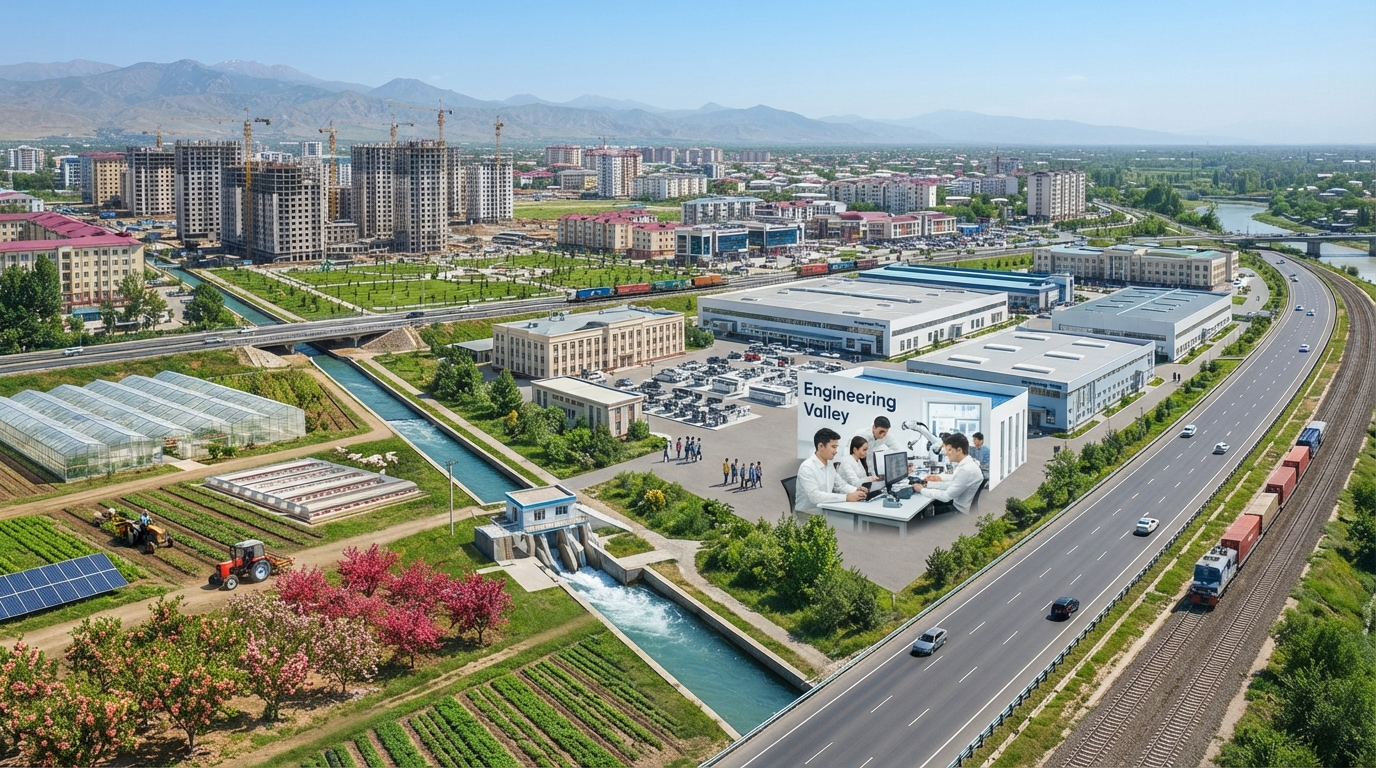
In Asaka, the creation of an "Engineering Valley" is envisaged, which will combine software development, electronics, electromechanics, and engineering services. The economic logic of the project consists in using the experience of automotive and machine building accumulated over 30 years to transition to the development of proprietary technologies and increase the local component of value added.
A similar task is set for the textile industry. Attracting European designers, constructors, and brands should allow shifting specialization from relatively standard products to higher-value goods. The export potential of the industry during such a transition is estimated at more than $1.5 billion.
**Agriculture: Maximizing Value from a Limited Area**
The same principle of intensive land use is applied in agricultural policy. In the Ulugnor district, 5,000 hectares converted from cotton to fodder crops make it possible to form a fodder base for at least 10,000 head of cattle. By the end of the year, conditions for grazing should be created on at least 200 hectares of land along the fields, and projects for large livestock complexes should be prepared in Ulugnor and Bustan.
The experience of the $20 million poultry complex in Balykchy is expected to be extended to other districts: to start 4 projects in Jalakuduk and another 3 in Khojaabad. In Ulugnor, a fish farming cluster is planned to be created on an area of 1.2 thousand hectares.
Another reserve is the foothill lands of Jalakuduk, Markhamat, Asaka, and the Andijan district. A special company, "Agrostar," must provide water to 4,000–5,000 hectares by spring and create industrial orchards with peaches, cherries, apricots, and plums. The orchards will be cultivated for 3 years, after which they will be transferred to the population in finished form. $30 million is provided for the program, with an additional 200 billion soums for the water supply of foothill territories.
In the fruit and vegetable sector, the principle of "maximum value per hectare" is established. The share of processing is expected to be increased from the current 16% to 30%, and exports are to be brought to $500 million. 100 billion soums are provided for leasing small processing units to the population.
The pilot greenhouse project with an area of 5 hectares in Balykchy will be scaled up at the republican level. 300 billion soums are directed to this program, of which 50 billion soums fall directly on the Andijan region.
**Adaptation of the Textile Sector to the Deterioration of the External Environment**
A decline in external demand for cotton and rising logistics costs require a separate support system for farmers, clusters, and manufacturers of finished products. A farmer selling cotton through the exchange and a cluster purchasing it will receive 500,000 soums for each ton. For clusters growing cotton on their own land, a subsidy of 1.5 million soums per hectare is provided.
For exporters of finished products, compensation for part of interest expenses is being worked out for 3 years: for foreign currency loans — in terms of the rate exceeding 5%, for loans in national currency — exceeding 14%. Additionally, it is proposed to consider a refund of 3% of the value of goods sold through marketplaces. Together, these mechanisms are aimed at reducing financial and marketing costs during a period of deteriorating external conditions.
**Incentives Shift Towards Enterprises Creating Mass Employment**
The new support system links state incentives directly to the number of jobs and the quality of human capital. Enterprises with at least 1,000 employees are expected to be compensated for 50% of the costs of training and advanced training of employees, as well as their transportation to and from the workplace. For employees of such enterprises with at least 5 years of service, the tuition contract for their children will be paid.
Enterprises approaching the creation of 1,000 jobs will also be able to receive separate grants. For the Andijan region alone, $20 million is allocated for this area. The draft of the corresponding decision has been instructed to be prepared within 1 month.
**Education Must Be Integrated Directly into Production**
To turn Andijan into a center for engineering personnel in the Fergana Valley, the practical departments of universities and technical schools are expected to be relocated directly to the territories of 46 industrial zones and 56 large enterprises. By the end of the year, the share of dual education must be brought to at least 80%.
The need for such a restructuring is related to the investment cycle: new projects with a total value of about $7.5 billion will increase the demand for engineers in energy, hydraulic engineering, electronics, machine building, IT, and logistics. In this regard, the Andijan Technical Institute will be transformed with the involvement of foreign managers and teachers and the updating of curricula. A separate design faculty will operate on the basis of dual education and will be attached to industrial enterprises; 25 billion soums are provided for its creation.
Thus, personnel policy is actually transitioning from a model in which education and production exist in parallel to a model of training specialists for specific investment demand.
**Energy: Local Resources as a Source of Ensuring Industrial Growth**
Industrial growth increases the load on the power system. The hydropower potential of the Andijan region is estimated at 200 MW, which corresponds to the possibility of producing about 500 million kWh of electricity per year. There are already 400 applicants interested in building small and micro-hydroelectric power plants with a total capacity of 44 MW, while the production of turbines for such plants has been mastered in the region itself.
For the next 2 years, a mechanism for the turnkey construction of micro-hydroelectric power plants with subsequent leasing to entrepreneurs is envisaged. Cascades of hydroelectric power plants are also expected to be taken into account when concreting 81 km of canals. This links energy development with water management infrastructure and simultaneously reduces the initial investment barrier for private business.
**New Urban Spaces Must Become Platforms for Private Business**
The relocation of state organizations from Andijan to Babur City will free up 30 administrative buildings, 13 hectares of land, and about 70,000 sq. m of premises. These assets are planned to be directed to the development of trade and services. The potential is estimated at an additional $1 billion in investments and at least 20,000 jobs.
The centers of Asaka, Shakhrikhan, Kurgantepa, and the city of Khanabad are also expected to be transformed into areas of high-income business. Their master plans will be adapted for projects capable of creating at least 20,000 jobs in trade and services.
An additional investment incentive is being introduced for Babur City. Since projects for shopping complexes, business centers, hotels, private educational, medical, and sports facilities have a long payback period, the starting price of land for such facilities will be set 2 times lower than the cost of land for residential construction.
One of the most significant institutional changes is the revision of state banks' approaches to lending. The problem of 35,000 potential borrowers who did not receive a loan due to the lack of collateral or a guarantor must be solved through wider use of data on the real state of the business.
In credit evaluation, it is expected to take into account cash flow, orders and contracts, accounts receivable, turnover, and the enterprise's position in the production chain. A small enterprise's long-term contract with a leading company or a large customer can be accepted as loan collateral.
For projects worth up to 500 million soums, a business plan will not be required — the decision must be made based on cash flow. When lending for the purchase of raw materials for export products, an insurance policy can serve as sufficient collateral. 9 state banks have been instructed to develop 20 new bank products focused on business development within 1 month.
In fact, this is a transition from evaluating mainly the accumulated property of the borrower to evaluating their ability to generate income in the future.
The role of tax authorities is also changing. If an enterprise's income or jobs decrease, a tax service employee at the mahalla level must establish the reasons and, together with the hokim's assistant and the mahalla banker, propose response measures to the district headquarters. Possible solutions include deferral of tax payments, extension of loans, provision of working capital, assistance in market access or export.
At the same time, the individual cycle of a business reaching profitability must be taken into account, and youth employment becomes one of the criteria for evaluating the effectiveness and remuneration of mahalla tax inspectors. Thus, the control function is supplemented by a mechanism for preventing business closures and job losses.
The construction of the "China – Kyrgyzstan – Uzbekistan" railway is seen as an opportunity to increase cargo traffic 10-fold — up to 15 million tons per year. To service the new flow, a $600 million logistics complex project must be started on an area of 300 hectares in Kurgantepa and Khanabad by the end of the year.
Border infrastructure is of particular importance. An agreement has been reached with Kyrgyzstan to open the "Keskaner" checkpoint, which will be 2 times larger than the existing "Dustlik" checkpoint. Within 3 months, it is necessary to develop a project and start construction. It is expected that cargo capacity will increase 2–3 times, and delivery time will be reduced by 1 week.
For the new transport flows, the design of the 78 km "Khanabad – Andijan" toll highway begins. Next year, practical work should also begin on the construction of the "Tashkent – Andijan" toll highway. Combined with the already launched high-speed train, which reduced the trip from 6 to 4 hours, these projects should simultaneously improve external logistics and the region's connection with the country's largest domestic market.
The next stage after achieving 93% drinking water coverage will be the construction, starting next year, of the second line of the "Khanabad – Andijan" main water pipeline, which should improve water supply for 1 million residents. After the reconstruction of the current 9 km of sewerage in Andijan, funds will be directed to upgrading the remaining 15 km. The capacity of wastewater treatment plants in Altynkul is planned to be doubled, with the project scheduled to start next year.
In the area of women's employment, a specific barrier has been identified: about 3,000 women who want to work remain occupied with childcare. With the achieved preschool education coverage of 86%, entrepreneurs are ready to open another 134 family kindergartens. The relevant agreements have been instructed to be formalized within 10 days. Additionally, a separate women's employment fund of $20 million is being created.
In this case, social infrastructure is directly linked to labor supply: expanding places in kindergartens is seen as a tool for returning some women to the labor market.
In Andijan, Shakhrikhan, and the Andijan district, positions of deputy heads of internal affairs bodies for digitalization and combating cybercrime are being introduced. Street camera data is expected to be analyzed using artificial intelligence to prevent hooliganism, theft, and traffic accidents. At the same time, a program for cyber protection and increasing digital literacy of employees of budget organizations, pupils, students, and pensioners will be developed. By the end of the year, this model has been instructed to be extended to other regions.
Another area of improving the business environment is accelerating the resolution of commercial disputes. In October–November, training on pre-trial settlement, reducing the number of disputes, and judicial procedures is planned to be held for entrepreneurs and lawyers of state organizations across the country.
Within 1 month, procedural legislation must be analyzed and proposals prepared on categories of cases that can be considered in a simplified manner and in shorter timeframes. The economic effect of such an approach is primarily related to reducing the time during which business funds and assets are involved in protracted disputes.
Finally, next year it is planned to prepare a program to give 100 mahallas of the Andijan region the appearance of "New Uzbekistan." Along with large investment and infrastructure projects, this forms the local level of policy — street improvement, maintenance of the irrigation network, and greening of territories.
The combination of the designated measures shows a transition to a more intensive model of development for the Andijan region. The limited nature of land resources makes further growth through simple expansion of areas less and less effective. Therefore, the key criterion becomes the productivity of already available resources: value added per square meter of industrial land and per hectare of agricultural land, the technological level of the enterprise, the quantity and quality of jobs created, as well as the ability of the educational and financial systems to service the new investment cycle.
At the same time, the new measures form several interconnected chains. Technological modernization requires engineering personnel — hence the expansion of dual education. Industrial growth increases the demand for electricity — hence the micro-hydroelectric power plant program. New transport corridors increase cargo flows — hence logistics centers, border and road infrastructure. The limited nature of traditional collateral lending holds back entrepreneurship — hence the transition to evaluating cash flows and contracts. Low processing of agricultural products limits income from land — hence the development of processing, industrial orchards, and agro-clusters.
Thus, the next stage of reforms in the Andijan region involves a transition from increasing the volume of resources to increasing their economic return. While the previous stage created the financial, infrastructural, entrepreneurial, and educational base, the new tasks concentrate on the productivity of capital and land, the technological complexity of production, reducing institutional costs, and linking investments more closely with employment and household incomes.