

And what do you have in your truck beds, guys…
A truck should not return empty: the new trade economy of Russia and Central Asia
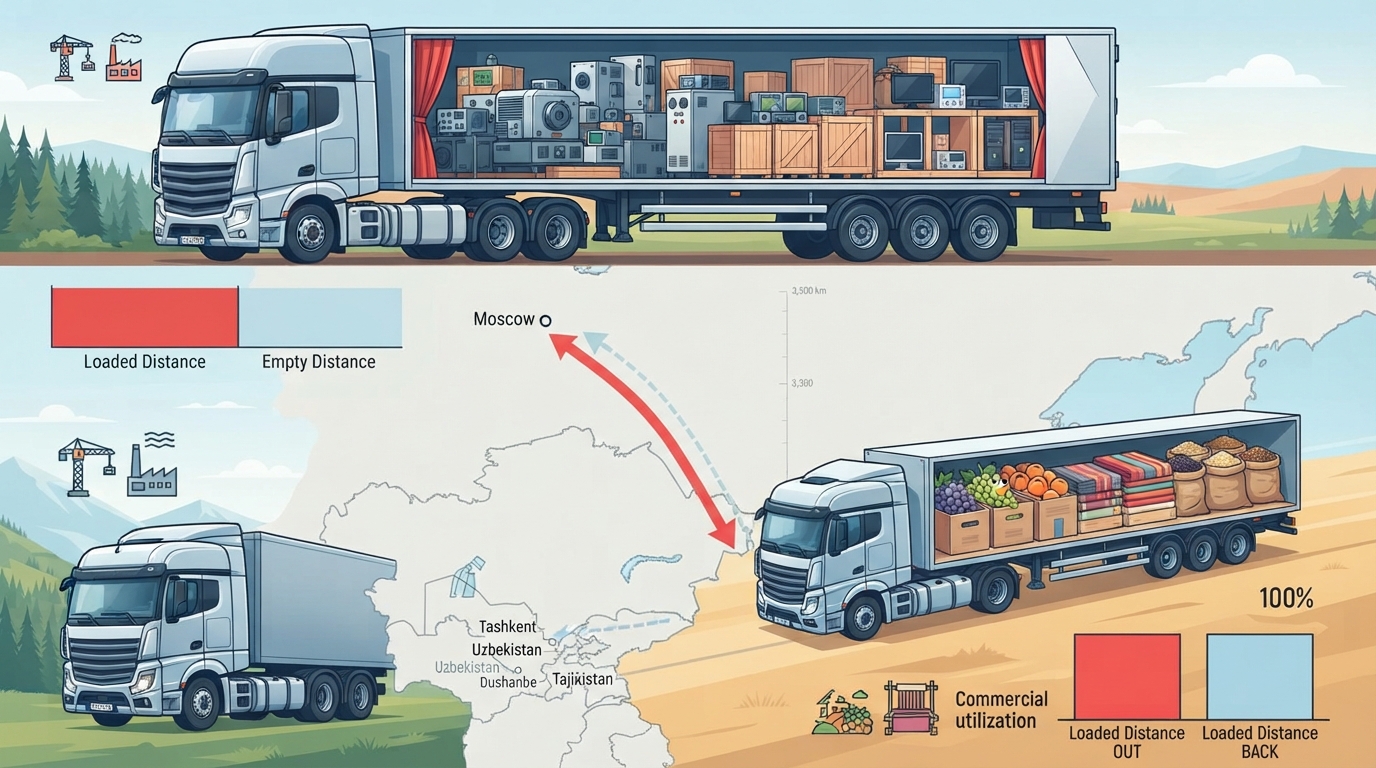
And what do you have, guys, in your truck beds...
In trade between Russia and Central Asia, people usually talk about large infrastructure projects: new railways, border crossings, transport corridors, logistics centers, and the digitalization of customs. But the price of transportation is determined not only by the quality of the road and the speed of crossing the border. Sometimes the main reserve is hidden inside the already existing cargo flow.
A truck that has traveled 3–4 thousand kilometers with goods from Russia to Uzbekistan or Tajikistan performs only half of the possible commercial work. If it goes back empty or is only partially loaded, the carrier still incurs costs for fuel, driver's salary, depreciation of the tractor and semi-trailer, insurance, toll roads, maintenance, tires, and the cost of capital. Then these expenses have to be included in the tariff of the first leg. Therefore, an empty return run is not a private difficulty of a transport company, but a hidden tax on mutual trade. And the longer the route, the higher this tax.
For the Moscow — Tashkent direction, the road route, depending on the chosen highway, is approximately 3.3–3.5 thousand kilometers. The distance to Dushanbe is even greater. One round international trip can mean 7 thousand kilometers of mileage. If a truck delivered 20 tons of equipment, chemical products, or consumer goods and returned empty, then technically it covered 7 thousand kilometers for the sake of transporting cargo on only half of the route. A new highway can reduce travel time by several hours, but a guaranteed cargo in the opposite direction can change the economics of the entire trip. That is why the formation of paired cargo flows between Russia and Central Asia is potentially capable of yielding an effect comparable to individual expensive infrastructure projects.
The economics of a truck are quite rigid. A modern long-haul road train can usually carry about 20 tons of cargo, although the actual load depends on the density of the goods, axle restrictions, and the legislation of specific countries. Diesel fuel consumption for a heavy truck can be approximately in the range of 28–35 liters per 100 kilometers. On a 3.5 thousand kilometer route, this is about 1–1.2 thousand liters of fuel one way alone. But an empty return trip does not make the consumption zero: a heavy tractor with a semi-trailer continues to burn hundreds of liters of diesel, wearing out tires and components. A kilometer remains a kilometer regardless of whether there are goods in the truck bed. If a conditional round trip is 7 thousand kilometers, and the carrier's full operating costs are equal to 1 dollar per kilometer, then the trip costs about 7 thousand dollars. If commercial cargo is carried in one direction only, all 7 thousand dollars actually need to be recouped with one order. If the truck carries 20 tons there and 20 tons back, the same physical mileage already provides 40 tons of commercial transportation.
Of course, the tariff is not automatically cut in half: there are costs for finding a second client, additional loading, documents, downtime, customs procedures, and possible deviations from the route. But the arithmetic itself shows the scale of the reserve. Even a 10–15% reduction in the average cost of international road transport for bulk cargo may prove to be more important than a nice 100-kilometer reduction in the route. For goods worth 100 thousand dollars, saving 1 thousand dollars on logistics means a one percentage point reduction in the transport component. For products with a low value per kilogram — vegetables, building materials, certain types of raw materials, textile products — the importance of backhauling is even higher.
The problem of Russia and Central Asia is not a shortage of goods for return transportation, but that the cargoes do not match in time, place, packaging, and transport requirements. Russia supplies the region with machinery, equipment, metals, timber, chemical products, food, components, and a wide range of industrial goods. Central Asia can form a counterflow of fruit and vegetable products, textiles, yarn, ready-made clothing, individual metals and chemical products, dried fruits, processed products, building materials, and a growing assortment of industrial products. On paper, it turns out to be an almost ideal scheme: Russian cargo goes south, Central Asian cargo goes north. In practice, a truck that delivered industrial equipment to Tashkent is not necessarily suitable for the immediate transportation of fresh sweet cherries or grapes. Perishable products require a refrigerated truck and a stable temperature chain.
A truck that unloaded goods in Dushanbe may find a suitable return batch not in Dushanbe, but in Khujand, which means additional mileage will be required. Export goods may be ready in three days, and the driver cannot wait that long. The batch may be 8 tons with a payload capacity of about 20 tons. Transporting food products after certain types of industrial cargo will require preparation of the body. Finally, a Russian importer and a Tajik or Uzbek exporter may have different freight forwarders, information systems, and transport partners. Physically, two cargoes exist, but informationally they do not see each other. This is the main paradox of modern logistics: the state may know the value of billion-dollar trade flows between countries, but the market is often unable to quickly connect a specific free semi-trailer with a specific 18 tons of goods ready for shipment tomorrow morning.
Therefore, the next stage of transport integration could be the transition from corridor development to managing cargo flow density. What is important now is not only the question of how many trucks pass through a border crossing per day, but also how many of them are actually loaded in both directions. If out of a conditional 100 trucks arriving from Russia, 30 return empty, the task is not necessarily to build an extra lane, but to reduce those 30 empty trips to 20, then to 10. Even a small change gives a noticeable result. Suppose that on a certain route 100 thousand international trips are made per year, the average empty return leg is 2 thousand kilometers, and the share of empty returns is reduced by just 10 percentage points. This means eliminating approximately 20 million kilometers of unproductive mileage. At an average consumption of 30 liters per 100 kilometers, we are theoretically talking about 6 million liters of diesel fuel that no longer need to be burned for the sake of moving empty trucks. At the same time, driver and equipment resources are freed up. If the average commercial speed of an international trip, taking into account stops, borders, and labor regulations, is several hundred kilometers per day, every eliminated empty run returns days of productivity to the carrier. The same fleet of trucks is capable of transporting more goods without a proportional increase in the number of tractors. For a region where distances are huge, this is fundamentally important: Russia and five Central Asian states together occupy a territory of over 21 million square kilometers, so geography itself turns transport efficiency into a competitiveness factor.
Especially interesting is the idea not of an isolated return load, but of paired commodity chains. This is a more complex model. Instead of randomly searching for any cargo in the opposite direction after each unloading, carriers, manufacturers, retail chains, and logistics operators link stable flows in advance. For example, industrial products go from a Russian region to Uzbekistan several times a week, and textile products from Uzbekistan are sent to Russian distribution centers according to a pre-agreed schedule. Another option is Russian food products or packaging materials delivered to Tajikistan, and on the way back the transport accepts dried fruits or other export products. It is not even necessary to return the truck to the exact starting point. In logistics, it is more important to create a closed loop: Moscow — Tashkent — Shymkent — Yekaterinburg — Moscow or another route where each section has a commercial load. Then the transport system begins to work not as a pendulum, but as a network.
Kazakhstan acquires special importance in such a model due to its geographical location between the main territory of Russia and most of Central Asia. Uzbekistan, with a population of over 39 million people, forms a large consumer and manufacturing market. Tajikistan and Kyrgyzstan can connect through their own export specializations and distribution hubs. As a result, a single truck is capable of servicing goods from several countries, rather than simply making a bilateral trip between two cities.
This requires much more accurate information about cargoes. A modern transport system should see not only the fact of export itself, but also its parameters: 18 tons of textiles are ready in Fergana on September 18, a curtain-side semi-trailer is needed, the destination is the Moscow Region, the loading window is eight hours; 20 tons of Russian goods arrive in Tashkent on September 17, after unloading the truck is free. If these two events are automatically matched, savings occur. But if information passes through dozens of phone calls, closed chats, and a chain of intermediaries, a truck can leave empty a few hours before a suitable order appears. Therefore, the digitalization of transport is not just an electronic consignment note or an electronic permit. Its economic meaning lies in reducing the informational distance between cargo and an available truck. In the long run, algorithms can take into account thousands of parameters: route, body type, permissible weight, delivery times, driver's working hours, temperature, insurance, customs status, probability of delays at the border, and fuel price. Even an increase in the capacity utilization rate by a few percentage points across tens of thousands of trips translates into tangible money.
The railway has a similar problem, although the mechanics are different. It is also desirable not to return a railcar or container empty. Containerization is particularly convenient for building paired flows because it allows separating the cargo unit from a specific tractor. A container can be delivered by train to a terminal, reloaded onto a truck, filled with return goods, and returned via another chain. But this requires synchronization of terminals, container operators, railways, warehouses, and customs procedures. As a result, a logistics center ceases to be just a territory with several warehouses. Its real value is determined by whether it is capable of consolidating small batches. For a small producer, 3 tons of goods are not enough to order a separate international truck. If a logistics hub combines five batches of 3–4 tons into one shipment, export becomes accessible to enterprises that previously could hardly enter a neighboring market on their own. Thus, the fight against empty runs simultaneously becomes a mechanism for supporting small and medium-sized businesses.
There is also a broader effect. Reducing transport costs gradually changes the structure of trade. With expensive logistics, it is profitable to transport primarily goods with a high value per kilogram. The cheaper the transport, the more product categories become economically suitable for cross-border trade. A factory can start supplying relatively inexpensive components, a farmer — processed products, a small textile manufacturer — batches of ready-made clothes, a construction industry enterprise — materials to a more distant market. An additional $500–1,000 in logistics expenses may be imperceptible when transporting expensive equipment, but critical for a batch of goods with a small margin. Therefore, backhauling directly affects the number of enterprises that can participate in mutual trade at all. In this sense, the transport tariff is a kind of economic distance. Two cities can be 2 thousand kilometers apart from each other, but with a stable two-way cargo flow they can be commercially closer than cities at a distance of 1 thousand kilometers between which transport regularly returns empty.
That is why Russia and the countries of Central Asia should look at transport cooperation not only through kilometers of new roads and volumes of capital investments. A new highway costing hundreds of millions of dollars remains an important asset, but the efficiency of already built infrastructure is determined by what moves along it. The cheapest ton of cargo is the one for which a separate trip did not have to be created, because an available truck was already driving back. If countries can link export calendars, logistics centers, electronic documents, freight exchanges, rail terminals, and large retail chains into a single system of counterflows, the economic result will consist of millions of imperceptible optimizations. One truck with a return load does not change regional trade. Tens of thousands of such trips do. A 5%, 10%, or 15% reduction in empty mileage means less fuel per ton transported, higher transport fleet productivity, faster equipment turnover, and lower pressure of logistics costs on the final price of goods. In trade between Russia and Central Asia, the next major transport reserve may be located not underground where a new road is to be laid, but inside an empty semi-trailer that today travels thousands of kilometers back without a load.