

An increased amount of microplastics was found in Siberian snows
Scientists from Tomsk State University detected microplastics in all snow samples collected over three years in Western Siberia. The average number of particles per square meter of snow cover rose from 711 in 2021 to 1,112 in 2023.
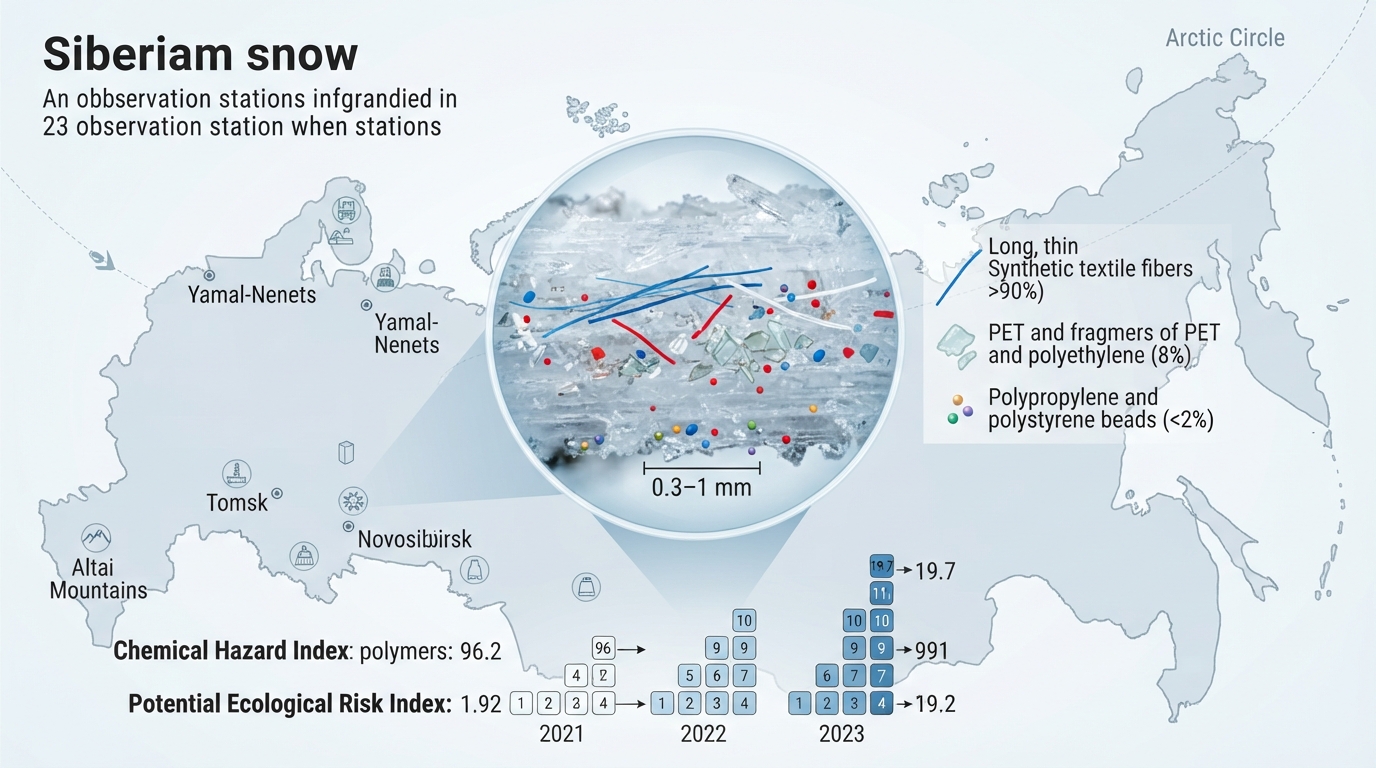
**Increased Levels of Microplastics Found in Siberian Snow**
The study published in the journal *Pollutants* covered an area stretching from the foothills of the Altai Mountains to the Arctic Circle. Samples were taken at 23 monitoring stations in 2021–2023, during the period of maximum snow accumulation.
Observations were conducted in the Tomsk, Novosibirsk, Omsk, Tyumen, and Kemerovo regions, the Khanty-Mansi and Yamalo-Nenets Autonomous Okrugs, and the Altai Krai.
Although microplastics were not distributed evenly across the regions, scientists noted that their average amount has been increasing over the years. The authors interpret this as a trend of microplastic accumulation in the snowpack.
Fibers accounted for more than 90 percent of the identified particles. The proportion of small fragments reached up to 8 percent, while film fragments and spherical particles together did not exceed 2 percent. Particles mainly sized 300–1000 micrometers, i.e., 0.3–1 millimeter, were encountered.
In 2022–2023, the share of polyethylene terephthalate (PET) in the samples was above 40 percent. Polypropylene, polyethylene, and polystyrene were also detected. These materials are used in the production of synthetic fabrics, clothing, plastic bags, bottles, and containers.
The researchers noted that the abundance of fibers and their composition indicate that synthetic textiles could be one of the main sources of pollution.
The analysis found no direct correlation between the amount of microplastics and population density, gross regional product, or proximity to highways. However, a moderate correlation was observed with snowpack depth: as precipitation increased, the deposition of atmospheric particles into the snow also intensified.
Scientists also assessed potential ecological risks using several indices. The chemical hazard index of polymers increased from 96.2 in 2021 to 991 in 2023. According to the authors, this corresponds to the lower threshold of the hazardous level in the assessment method used.
The increase was explained by the appearance in the samples of polyacrylonitrile and polyurethane, which have a high hazard score. At the same time, the potential ecological risk index, which also takes concentration into account, rose from 1.92 to 19.7, but remained in the lowest risk category.
Study participant Alexey Rednikin explained that although polymers with a high chemical hazard indicator occur, their concentration is currently relatively low. However, the growth of these indicators demonstrates the need to continue observations.