

An image of an ancient hunter has been found on the cliffs of Jizzakh
In the Jizzakh region, archaeologists have discovered previously unknown Stone Age settlements and about 30 rock art images. Among the drawings are depictions of a hunter shooting a bow, a mountain goat, livestock, and a dog.
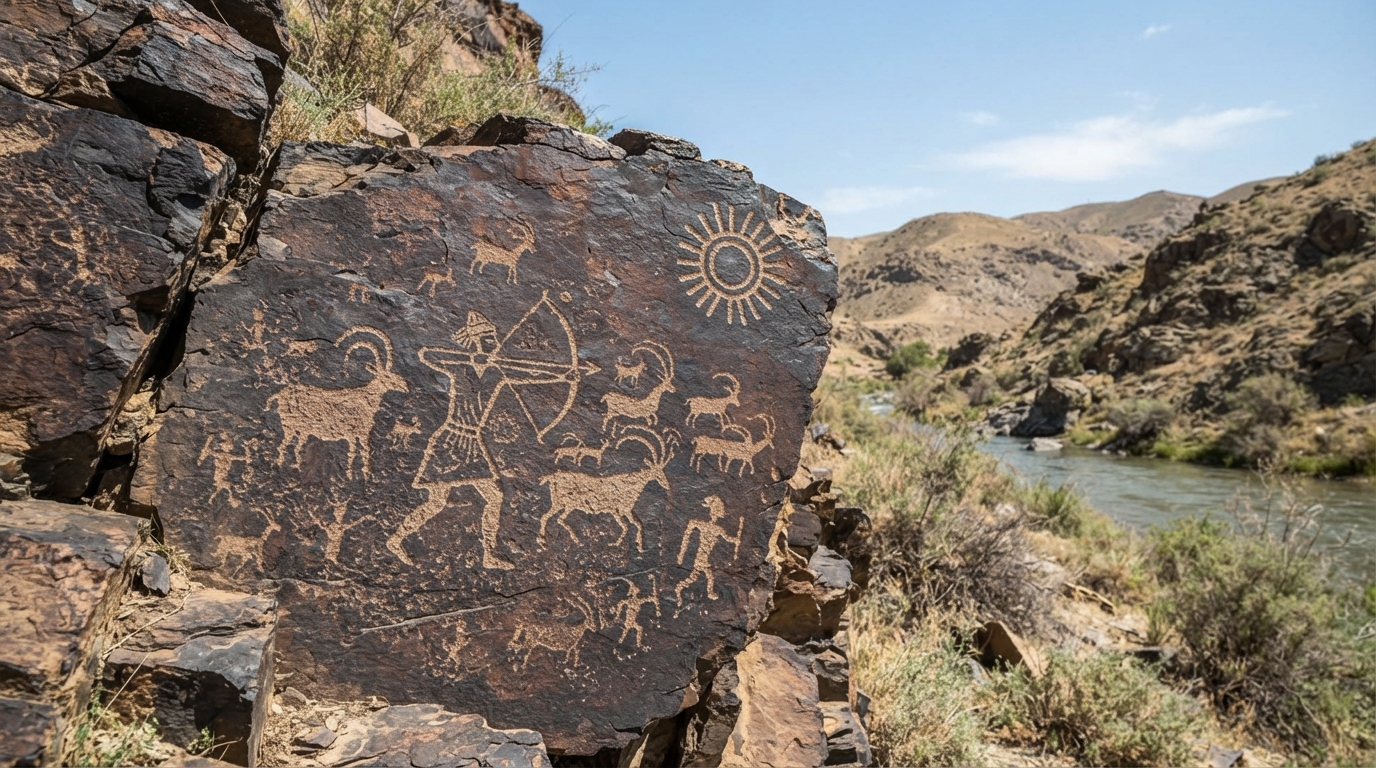
An image of an ancient hunter has been discovered on the cliffs of Jizzakh
According to the "Dunyo" information agency, citing the British publication Heritage Daily, the search operations were carried out in September by specialists from the Cultural Heritage Agency and the Samarkand Institute of Archaeology.
The research covered the Zaamin and Sharof Rashidov districts of the Jizzakh region. As a result, several settlements where ancient humans lived were found in the Zaamin oasis and on the slopes of the Turkestan mountain range.
In particular, a settlement belonging to the Paleolithic — the Old Stone Age — was identified in the eastern part of the Achchi village in the Zaamin district. Near the Peshagor village, a Neolithic — New Stone Age — settlement was found.
Neolithic artifacts were also identified in the western part of Achchi and around the Arja village.
The occurrence of settlements from different periods in one area indicates that the Zaamin oasis and its mountainous regions were favorable for ancient humans to live and utilize natural resources. The findings could help study their migration routes and economic activities.
Meanwhile, near the Ravot village in the Sharof Rashidov district, a previously unrecorded complex of petroglyphs — rock art — was discovered. They were carved on the slate rocks on the left bank of the Ravotsoy River.
To date, about 30 images have been documented on the surfaces of seven rocks. Along with the image of a hunter shooting an arrow from a bow, a symbol resembling a sun sign was also identified on one of the rocks.
According to the preliminary assessment of specialists, the rock carvings were created in different periods — possibly from the Bronze Age to the Early Middle Ages. Therefore, there is currently no basis to consider them as belonging to the same period as the discovered Stone Age settlements. Additional research is required to determine the exact age of the images.
In the future, scientists plan to study the new sites more extensively to determine their age, cultural significance, and connection with other ancient monuments in Central Asia.