

An explanation was provided for the introduction of a limit on the number of places in national certificate exams
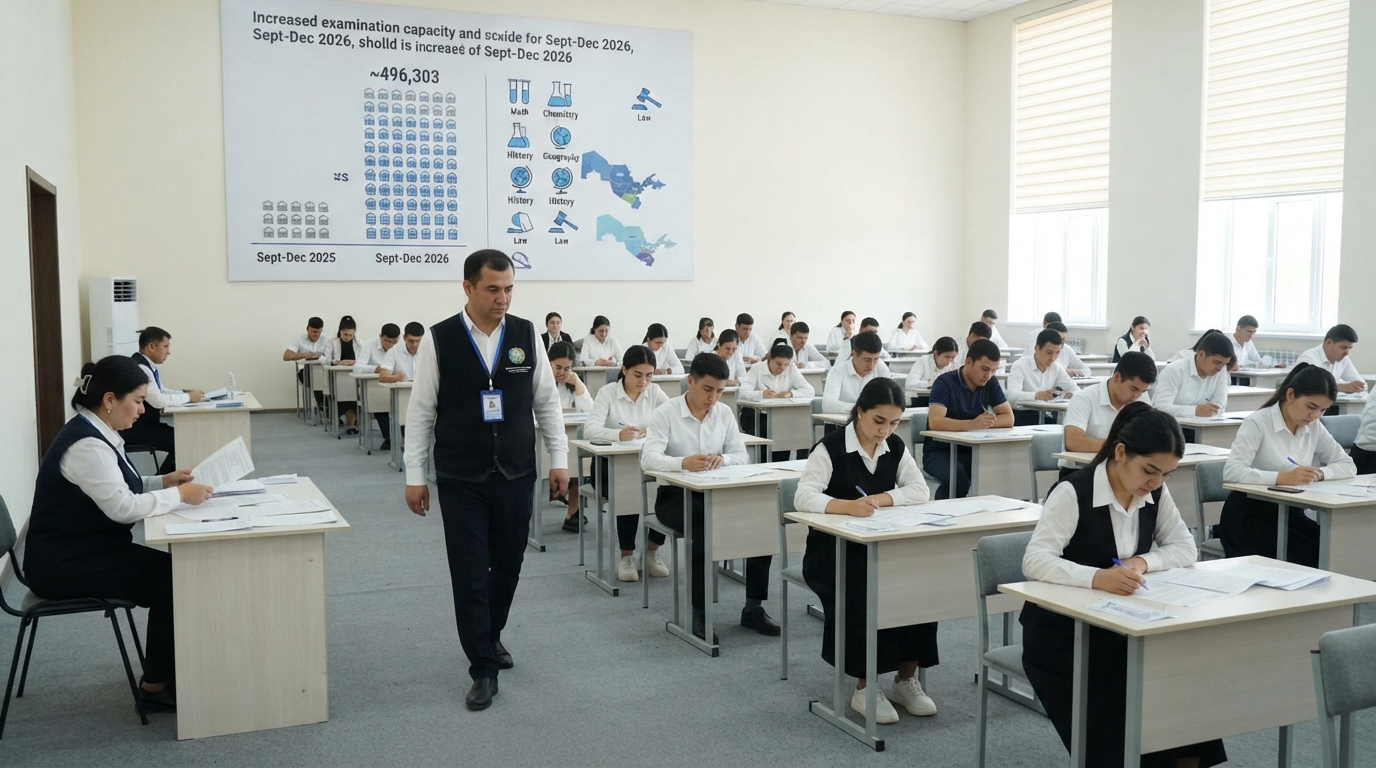
Explanation provided for the limit placed on the number of seats in national certificate exams
The Agency for Assessing Knowledge and Skills has issued an official response after various opinions were expressed on social networks regarding the limits set for registration for national certificate exams.
The agency stated that the number of seats was not set to restrict applicants or to artificially reduce the number of participants who could achieve high results.
It is noted that by the decision of the Cabinet of Ministers dated July 29, 2026, relevant amendments and additions were made to the regulation "On the procedure for determining the level of knowledge of general education subjects and issuing certificates." According to it, the venues for test trials, the number of seating places by region, and the exam dates are determined.
A total of 496,303 seating places have been allocated for September–December 2026. Of these, 125,753 seats are designated for September, 129,535 for October, 112,335 for November, and 128,680 for December.
Additionally, the frequency of holding national certificate exams is also being increased. In September–December, exams are planned to be held twice for mathematics, chemistry, geography, biology, physics, mother tongue and literature, and history, and once for jurisprudence. A total of 15 exams are scheduled to be organized.
For comparison, a total of 11 exams were held in September–December 2025, in which 255,217 applicants participated.
According to the agency, the main purpose of setting the number of seats by region is to make rational use of existing infrastructure, technical equipment, personnel, and control resources, to optimally distribute the workload by region, and to organize exams in a stable and quality manner.
It was also noted that this approach is aimed at ensuring the necessary conditions for announcing the results within the specified timeframes.
The relevant regulation was approved by the decision of the Cabinet of Ministers dated September 17.
The tasks of the central apparatus and regional divisions of the agency are specified separately. Regional divisions must implement the tasks set by the center on-site, organize assessment processes, and generate the relevant data.