

Alliance by language preference
Persians of all countries, unite: Tehran makes a powerful move on the Eurasian chessboard
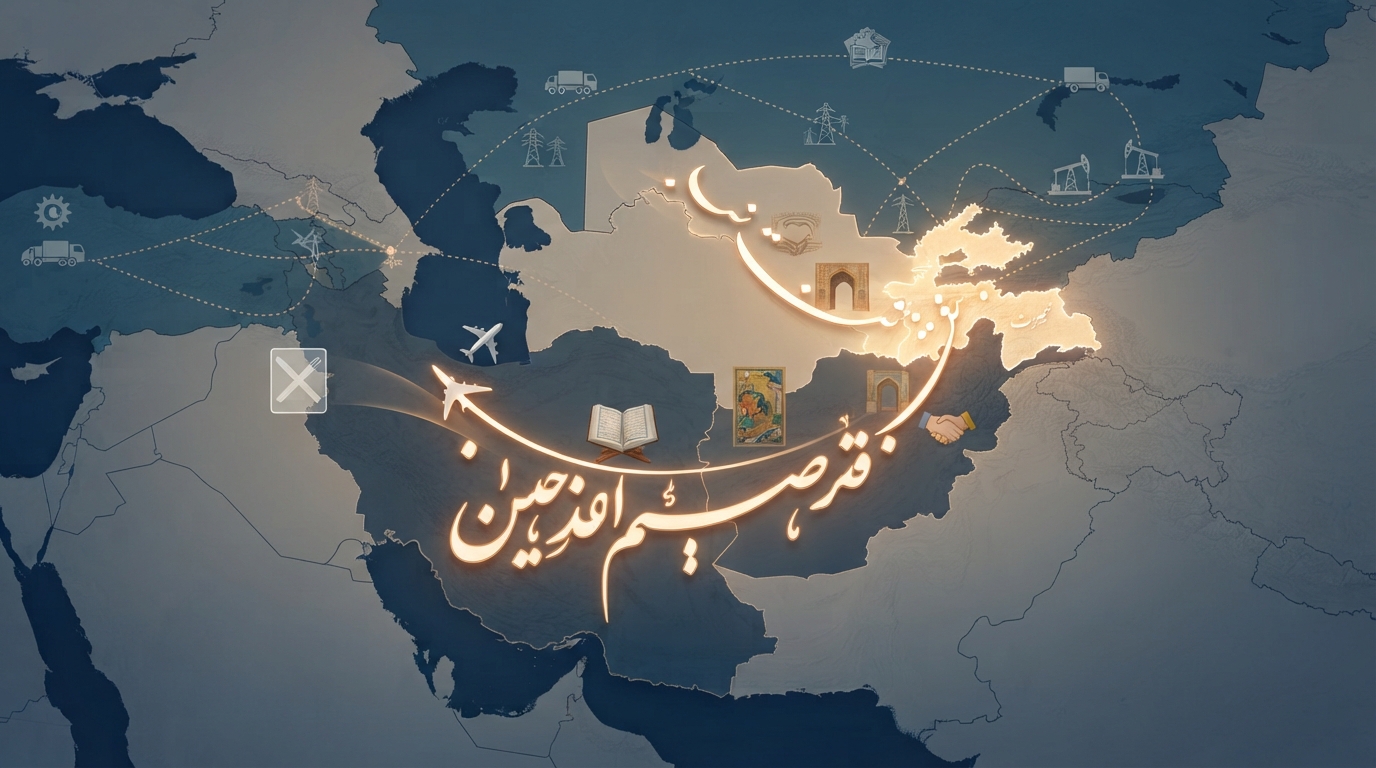
An Alliance Based on Linguistic Preferences
Why whoever manages to transform the Persian language from a cultural memory into a political asset will get the key to Central Asia — in the material by "VES 24".
Alliance of Farsi-Speaking Countries
The other day, First Vice President of Iran Mohammad Reza Aref, at a meeting with the Minister of Energy of Tajikistan Daler Juma, voiced an idea that at first glance might have seemed like an ordinary polite social remark, but in essence had a deep meaning: it was about the possibility of creating an alliance of countries and "Farsi-speaking regions." Without a charter, without a list of participants, without a roadmap. Yes, in its current form, this is merely a political statement. But the very fact of such a statement is already a signal.
We see how Turkey, over many years, has been investing in Central Asia through the Organization of Turkic States: from joint media and schools to transport corridors and military agreements. Ankara has built a systemic network of influence. Iran, at the exact same point, proposes the "Alliance of Farsi-Speakers." This is a geopolitical stance in which language becomes a civilizational argument.
In the end, the main question is not whether such an alliance can be created. The main question is that Tehran is testing a tool it has rarely used before — defining its sphere of influence based on language, rather than religion.
Hidden Strategic Logic
Reducing Aref's proposal to a "response to the Organization of Turkic States" is, of course, cognitive and analytical laziness. However, the superficial logic is indeed obvious. The Organization of Turkic States includes Turkey, Azerbaijan, Kazakhstan, Kyrgyzstan, and Uzbekistan, with Turkmenistan and Hungary participating as observers. This structure, which grew out of the Cooperation Council of Turkic-Speaking States, accelerated its transformation from a cultural platform into a multidimensional mechanism for the economy, transport, energy, and security. Iran's presence in Central Asia through this institutionalized Turkic framework is gradually being eroded. Tehran — like many others — dislikes the excessive momentum of the OTS. And Iran is trying to break out of the structural deadlock of its foreign policy.
Iran's foreign policy toolkit after 1979 was built almost entirely on the narrative of "religious-ideological unity": revolutionary Shiism, the "axis of resistance," anti-Americanism, and anti-Israelism. This tool yielded tangible results in Lebanon, Iraq, Syria, and Yemen. But it has a limit: Central Asia.
Tajikistan, Uzbekistan, Kazakhstan, Kyrgyzstan, Turkmenistan — and Afghanistan — are overwhelmingly Sunni-majority societies. The logic of exporting revolutionary Shiism here is not only ineffective, but is also capable of causing wariness and even rejection. Central Asian governments have plenty of reasons to keep their distance from Tehran to avoid being drawn into the whirlpool of confessional politics. Language is a fundamentally different tool.
Language does not require conversion, does not require accepting a confession. Language appeals to things that are older, pre-religious, and pre-ethnic: shared poetry, shared historiography, shared administrative tradition. Rumi wrote in Persian and was buried in Turkish Konya — this in itself is a quiet debunking of the dual "Turk - Fars" narrative. Persian was the language of education for the Ottoman court elite, alongside Arabic and Ottoman Turkish.
Tajikistan is the sole pillar of this path. But the ability of this pillar to withstand the load depends on whether Tehran can restrain the urge to politicize the cultural platform, as well as on whether Dushanbe is ready, in a region multilaterally covered by Turkic, Russian, and Chinese languages, to open sufficient strategic space for the Persian civilizational axis.
Tajikistan and Iran Have Fully Opened Borders for Mutual Visa-Free Travel
From October 5, 2026, a visa-free regime for holders of general civilian foreign passports entered into force in full between Tajikistan and Iran. This was reported by Saijon Shafizoda, Deputy Head of the Information and Press Department of the Ministry of Foreign Affairs of Tajikistan.
According to the Memorandum of Understanding, citizens of both countries may enter, transit, and stay in the territory of the partner state without a visa for up to 30 days within a 90-day period. The rule applies at all international checkpoints — both at land borders and at airports, including arrivals on flights from third countries.
The foreign ministry emphasized that these relaxations are intended exclusively for short-term trips. The visa-free regime does not grant the right to long-term residency or official employment. For these purposes, citizens still need to issue the relevant documents in the standard manner provided for by the legislation of the two states.
High-level meetings: On October 10, 2026, the Presidents of Tajikistan and Iran, Emomali Rahmon and Masoud Pezeshkian, held talks on the sidelines of the CIS Summit of Heads of State in Turkmenistan, emphasizing their commitment to strengthening friendly and brotherly ties.
Trade and economic relations between Iran and Tajikistan are actively developing; Iran is among Tajikistan's top 5 key trading partners. According to the finmarket.ru portal, following the results of 2025, mutual trade turnover amounted to $438 million, which is 28% more compared to 2024. Tajikistan's exports to Iran reached $112.8 million, while imports from Iran stood at $371.2 million (a negative balance for Tajikistan).
Oil and gas sector: In August 2026, the parties (within the framework of talks with the Ministry of Petroleum of Iran) agreed on a long-term contract for the supply of crude oil, as well as diesel and aviation fuel to Tajikistan for local oil refineries, including the possibility of preferential prices.
Energy and transport: Regular meetings of the Joint Commission on Trade, Economic, Technical, Scientific, and Cultural Cooperation are held (the last meeting took place in May 2026 in Dushanbe). Particular attention is paid to logistics, transport, and energy projects.
Investments and business. Iranian capital presence is expanding in Tajikistan: companies are implementing projects in the mining industry, mechanical engineering, raw material processing, and agriculture.
Shared history and civilization: In ancient times and the Middle Ages, the territories of Iran and Tajikistan were part of unified states and cultural-historical spaces of the East, including the Achaemenid Empire and the Samanid state. The Samanid dynasty is recognized as the foundation of modern statehood and a shared spiritual basis for a number of peoples in the region (primarily the Tajiks).
Great literary heritage. Classics of Persian-Tajik poetry — Rudaki, Ferdowsi, Hafez, Saadi, Omar Khayyam — are revered as national poets in both countries.
Religion and traditions: Predominance of Islam (Shia in Iran, Sunni in Tajikistan, with shared cultural and everyday traditions and holidays, such as Nowruz).
Linguistic affinity: The Tajik language (a dialect of Persian) and the Persian language (Farsi) belong to the exact same Iranian group of the Indo-European family. Inhabitants of both countries largely understand each other's speech. Tajiks and Iranians (Persians) are united by deep historical, cultural, and social ties.