

Alexey Likhachev: Uzbekistan will not stop at four reactors, there will be movement forward
During his visit to Uzbekistan, the head of Rosatom, Alexey Likhachev, met with President Shavkat Mirziyoyev and visited the NPP construction site in the Jizzakh region, as well as the Central Asian region's youth nuclear platform based at the Tashkent branch of NRNU MEPhI. Before flying home, Alexey Likhachev answered questions from foreign and Tashkent journalists. — Your meeting with the President of Uzbekistan, what […]
Alexey Likhachev: Uzbekistan Will Not Limit Itself to Four Reactors, Progress Will Continue
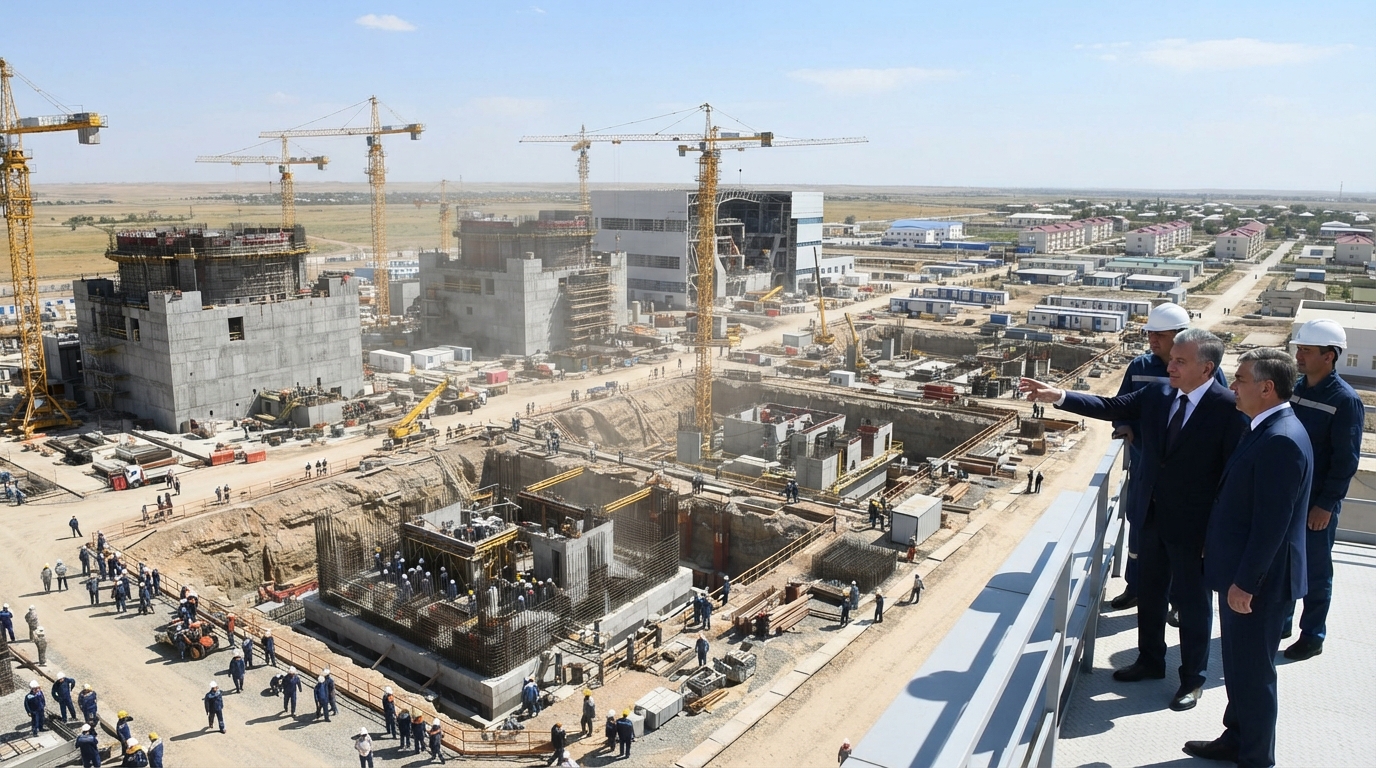
During his trip to Uzbekistan, Rosatom head Alexey Likhachev held a meeting with President Shavkat Mirziyoyev, visited the NPP construction site in the Jizzakh region, and also visited the youth atomic platform of the Central Asian region, established on the basis of the Tashkent branch of the NRNU MEPhI. Before flying home, Alexey Likhachev answered questions from foreign and Tashkent journalists.
— Your meeting with the President of Uzbekistan, what were you able to discuss? And was the question raised regarding the statement that Uzbekistan plans to build a second and third nuclear power plant, and what is Rosatom's position?
— The meeting is unique because it takes place against the backdrop of the ongoing construction of all four units. The project in Uzbekistan is outstanding: two gigawatt-class units and two low-power reactors are being constructed simultaneously. The financial scheme involving an international financial institution is also unique. The increased attention to social profiles is pleasing — the creation of an Atomgrad with developed infrastructure, healthcare, and education is ahead of the construction schedule.
Uzbekistan will not stop at these four reactors, there will be movement forward, and we are ready to take part in it. The choice of partners is up to the customer, we are not afraid of competition, and series production increases competitiveness and reduces cost price.
Great work is underway on training personnel: the youth atomic platform of the Central Asian region has been established on the basis of the Tashkent branch of MEPhI. The contracting of the first specialists for small NPPs in Uzbekistan will take place as early as next year. Russia is forming a long-term mutually beneficial partnership with Uzbekistan.
— What can you say about how the work on the construction of the NPP in the Jizzakh region is progressing?
— Work is on the rise. We note the active role of the local subcontractor — the localization of competencies here reaches up to 40%, which is beneficial for both the economic model and personnel sustainability. Specialists from Belarus, and in the future from Uzbekistan, will be able to be involved in other Rosatom projects in third countries.
This year, the concreting of the foundation slab of the reactor compartment of the small units will be completed at the site, and the construction of the control building, reactor hall, and turbine hall will begin. The manufacturing of the reactor vessel for the small station weighing over 200 tons is already underway, with customer inspectors present at all stages of production abroad.
Next year will bring the completion of surveys and the design for the large station, as well as the deployment of full-scale construction: the number of personnel at the facility will double and reach 12–13 thousand people at peak load. About 350 people are studying at the Tashkent branch of MEPhI and about 900 in Russian universities. All construction participants work as one team.
— Can you explain why the meeting of nuclear industry leaders with the youth is so important?
— Personnel is a key element in the nuclear industry, where we deal with immense energy and high technologies. Specialists must possess basic knowledge, practical skills (internships at operating reactors in the Russian Federation, training centers, technical academy) and undergo individual licensing.
In addition to skills, shared values are important: safety priority, the drive for continuous self-improvement, and service (since a nuclear facility is a state facility equivalent to public service). Work needs to begin with youth as early as possible. Furthermore, communicating with young specialists helps shape strategic development programs for the 2050s–2060s, taking into account their views and aspirations.
— Kaja Kallas recently stated that the European Union will seek free passage through the Northern Sea Route, seeing a threat in the activity of Russia and China. How could you comment on these words?
— There is an obvious contradiction here: on the one hand, a desire for freedom of trade and cooperation is declared; on the other, the presence of Russia and China is perceived as a threat. European leaders would do well to make up their minds.
The Arctic Ocean is an open territory, but only Russia has the necessary icebreaker fleet for safe navigation. In our economic zone, we have created a comfortable transport corridor: we provide icebreaker escorting, navigational support, rescue functions, and communications. No fee is charged for passage through the NSR; only accompanying services are paid for at absolutely acceptable prices.
We are ready to work with European companies on the basis of cooperation and development. Interest is being shown by South Korea (which conducted a test voyage and is preparing for systematic cooperation), India, Vietnam, and China. There are no unfriendly peoples in Russia, and such unfriendly rulers will pass into history.
— The day before yesterday, Reuters published news claiming that Hungarian authorities were planning to change the contractor for the expansion of the Paks NPP. Later, the news was refuted. Can you comment?
— The news is that there is no news. The "neither peace nor war" situation remains: the audit of the Hungarian contractor (Paks-2) continues, deadlines are shifting to the right, and there is no information about the completion of the audit or its results. We are waiting for the results, but we are not stopping work on the Paks-2 production program for the current year, approved by the Hungarian government.
We would like clarity, as Paks-2 is a modern bestseller of the global nuclear market, with which Hungarian construction and energy companies associate hopes for the prosperity of the region. We are hostages of the customer; we respect the sovereignty and powers of the Hungarian government, which has the right to continue or stop the project. Our task is to demonstrate the efficiency of Russian technologies, which have an obvious advantage over similar projects in Europe and the US in terms of time and cost. We expect a positive outcome.
— Touching upon the construction of the NPP in Finland, you called the decision of the International Court of Arbitration an important victory, but the Finnish company Fennovoima states that the court ordered Rosatom to pay more than 600 million euros. Who actually won the court case?
— Nobody has definitively won the court case yet; arbitration levels still lie ahead. Litigation consists of three parts:
* Legality of contract termination: all previous instances, including the court in Sweden, recognized that the Finnish side terminated the contract unlawfully, committing violations.
* Reasons for delays: the judicial instance confirmed that the nearly five-year delay lies within the customer's area of responsibility, as the contractor can only move at the speed set by the customer.
* Finances: our claim amounting to more than $2 billion includes investments in Fennovoima's authorized capital and a loan issued to the Finns to implement the project. Taking into account mutual set-offs (advances and payments), the court's decision as a whole is on our side regarding both the fact of termination and the reasons for the delay. The court considered us absolutely right as of 2022, which gives us the right to present the full amount for payment, taking into account possible set-offs.
— Could you comment on the situation at the Zaporizhzhia NPP as of today?
— Another difficult day has passed. In Energodar, there were strikes on the ZNPP infrastructure: a printing house, transport facilities, and a garage cooperative were damaged. Fortunately, unlike yesterday, there were no casualties, but the city lives a hard frontline life.
Work continues in a mode of silence on the energy infrastructure, which is planned to be completed at night to strengthen energy security and the station's external power supply. The situation is under control, the station is in a safe condition, and the personnel continue their heroic work to preserve it.