

A joint venture will be established to monitor the construction of the nuclear power plant in Uzbekistan
In Uzbekistan, there are plans to establish a joint venture with an international engineering company for the independent expertise of design solutions and construction works at the nuclear power plant. In 2027, it is planned to transition to the licensing of large VVER units and the ordering of long-lead equipment.
Joint Venture Planned to Monitor NPP Construction in Uzbekistan
At the peak of the construction of the integrated nuclear power plant in the Jizzakh region, more than 10,000 workers and specialists are planned to be deployed at the site, with 65–70% of them expected to be local personnel. This was reported by the Atomic Energy Agency (Uzatom) following a report to President Shavkat Mirziyoyev.
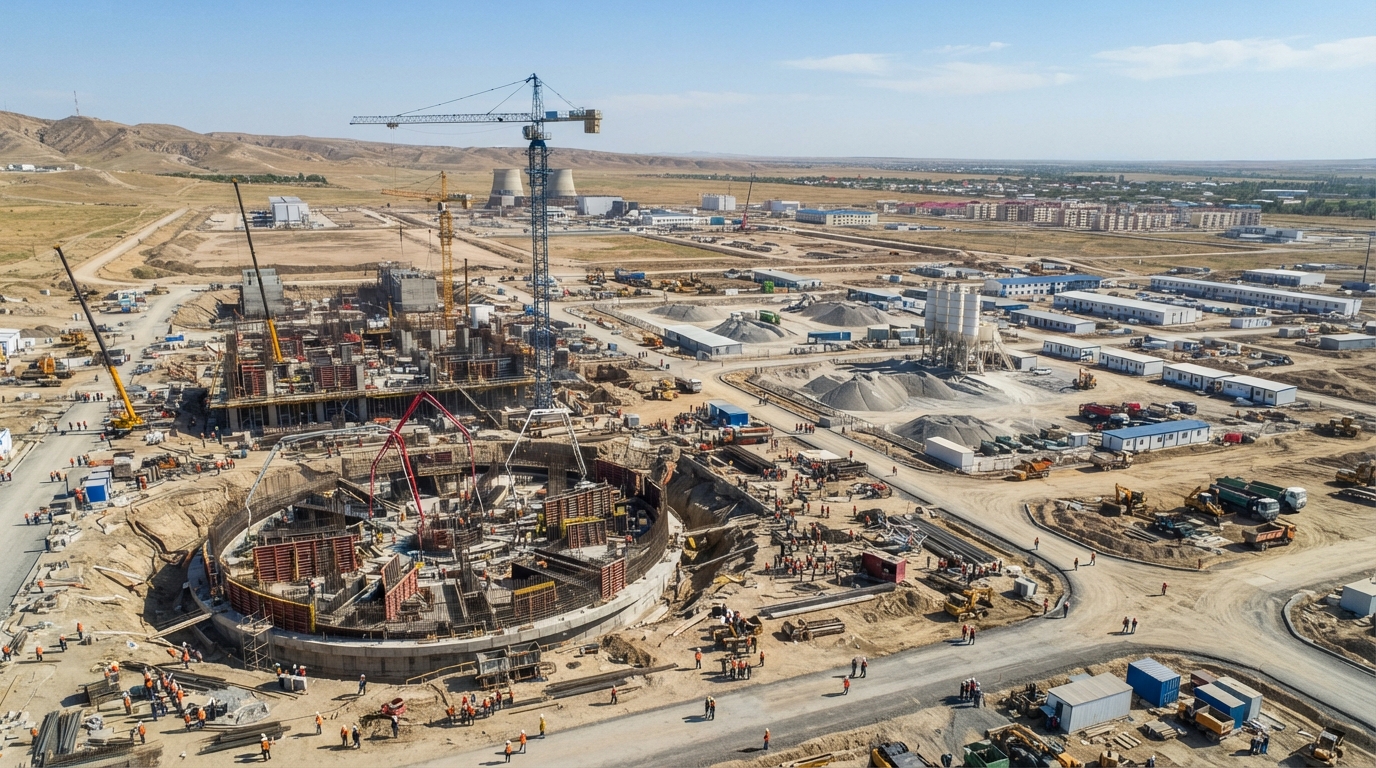
The project for Uzbekistan's first integrated NPP has entered its active construction phase. Currently, the main work is focused on the foundation of the first power unit. Since June 4, 916 cubic meters of concrete have been poured at the site, and the construction and assembly base, as well as foundation works, are proceeding on schedule, according to Uzatom.
"This is no longer a demonstration stage. The excavation pit is closed, concrete is flowing, and the base is being deployed. The task of the directorate is to maintain the rhythm and prevent any gaps between excavation, concrete, and design works," said Abdijamil Kalmuratov, Director of the NPP Construction Directorate.
According to him, the 916 cubic meters is "not a symbolic pour, but the beginning of the load-bearing structure of the first unit." The next step will be to accelerate the design of balance-of-plant facilities and the manufacturing of long-lead equipment.
Uzatom also reported that the environmental impact assessment document has been developed and approved, and the necessary permits and licenses for the siting and construction of small modular reactors have been obtained.
On June 22–26, Uzbekistan hosted a follow-up IAEA Phase 2 INIR (Integrated Nuclear Infrastructure Review) mission, which involved 41 officials and specialists from 16 ministries and agencies.
According to Uzatom, the mission concluded that most of the recommendations issued to Uzbekistan in 2021 have been implemented. The official report is planned to be published on the IAEA website after the completion of procedures.
Rozaliya Kamaeva, Advisor and Head of the Consolidated Information, Analysis, and Strategic Planning Department at Uzatom, called the mission a "global stress test of the entire state machinery."
"A nuclear project is tested not only by cubic meters of concrete, but primarily by the technological maturity of the country; it is a project of trust and a test of the ability to function in a regime of absolute nuclear safety," she said.
Uzbekistan has made significant progress in preparing its nuclear power infrastructure, the IAEA mission previously concluded. At the same time, the country still needs to complete feasibility studies and strengthen its nuclear regulator.
A separate focus of the project will be expanding the participation of local enterprises.
According to Uzatom's estimates, the current localization potential is up to 21% of the total project cost. More than 30 enterprises in Uzbekistan are capable of supplying cables, rolled metal, reinforced concrete structures, and waterproofing materials.
To bring localization above 30%, it is proposed to establish a specialized industrial zone covering 200 hectares in the Farish district, 25 km from the plant. It is planned to organize production and assembly of products across 15 sectors there, creating up to 2,000 jobs.
"The NPP must deliver not only kilowatt-hours but also an industrial school. The industrial zone in Farish is a tool that translates localization from a declaration into a production chain," Abdijamil Kalmuratov noted.
For external infrastructure, the president set a separate target of 60–70% local products and services. According to the head of the directorate, the nuclear island will remain the responsibility of the general contractor, while the site, construction base, materials, and infrastructure should maximize the potential of Uzbek companies where technologically permissible.
As part of the NPP's external infrastructure, it is planned to build 388 km of power grids, a substation, 21 km of drinking water pipelines, 120 km of industrial water supply, 39.5 km of roads, and 11 km of railways.
The territory of the plant itself will cover 525 hectares. The nuclear town, according to Uzatom, will occupy 100 hectares and is designed for 33,000 residents. About 10,000 apartments are planned, with 3,000 of them to be built in the first phase.
The town will also feature scientific institutes, schools, kindergartens, medical, sports, and cultural facilities. Uzatom refers to it as a future high-tech scientific-industrial cluster and eco-city.
"The nuclear town cannot be viewed as a temporary shift settlement. It is a residential, social, and educational environment that retains personnel in the region and changes the economy of the Farish district. A city keeps people. Not a shift, but families, schools, medicine, and a normal lifestyle," Kalmuratov stated.
At the peak of the plant's construction, more than 10,000 workers and specialists are planned to be employed at the site. The share of local personnel should be 65–70%.
Since 2023, 216 students have graduated from the Tashkent branch of the National Research Nuclear University MEPhI. Of these, 83 are continuing their master's and postgraduate studies at universities in China, Hungary, France, Italy, and South Korea. Another 100 specialists are undergoing training at four universities in Uzbekistan.
"The operation of a plant does not begin in the year of its commissioning. It is being prepared now. The 216 graduates of the MEPhI branch are the first foundation of the future industry. But diplomas alone are not enough: we need operators, engineers, radiation safety specialists, and a strong state management apparatus," said Rozaliya Kamaeva.
To strengthen technical control, it is proposed to establish a joint venture with one of the leading international engineering companies.
It is expected to independently evaluate design documentation, key equipment components, and the quality of construction work, forming an additional layer of control alongside the construction directorate itself. The composition of participants and the timeline for establishing the joint venture are currently being determined.
"The general contractor builds, but the full responsibility for safety before its people and the international community lies solely with the customer," Rozaliya Kamaeva emphasized.
According to her, the joint venture must simultaneously ensure the transfer of engineering and management competencies to Uzbek specialists. The project also plans to adapt and implement about 1,000 industry standards.
By the end of 2026, the authorities intend to complete the design documentation, begin construction of external networks, deepen localization, and accelerate the training of the customer's personnel and future plant workers.
In 2027, it is planned to develop licensing documentation for large VVER units, begin designing balance-of-plant buildings, and place orders for long-lead equipment.
The integrated NPP under construction in the Farish district of the Jizzakh region will consist of four power units: two with VVER-1000 reactors with a capacity of 1 GW each, and two RITM-200N small modular reactors of 55 MW each. The total capacity of the plant will be 2,110 MW, with an expected annual output of up to 17 billion kWh.
Uzatom notes that the site allows for the future placement of two more large power units.
The technical launch of the first small modular reactor is scheduled for October–November 2029, with the second one following six months later. The first large power unit is expected to be launched in 2033, with the project fully completed in 2034–2035.
The base cost of the project was previously estimated at no more than 9.5 billion dollars. The bulk of the financing is planned to be raised in the form of loans, including a concessional export credit from Russia.