

Air India pilot's reported cannabis test: what it can and can't tell investigators
A reported cannabis-positive test involving an Air India pilot raises questions about what such a result can actually tell investigators.
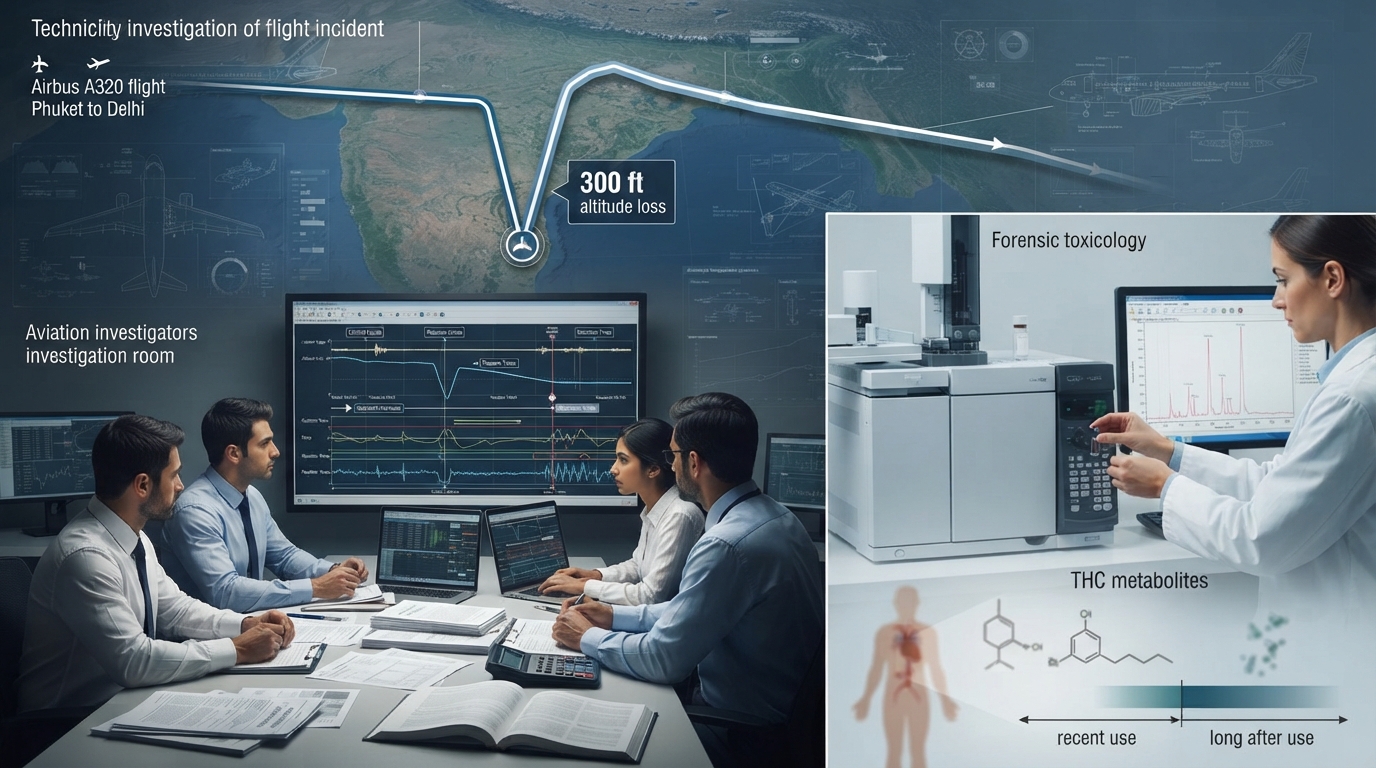
**Air India Pilot's Reported Cannabis Test: What It Reveals and Conceals for Investigators**
Reports indicating an Air India pilot tested positive for cannabis following a flight would typically alarm aviation investigators. However, this reported outcome remains unconfirmed, and even official confirmation wouldn't automatically provide a definitive explanation.
On August 4, an Air India Airbus A320, en route from Phuket to Delhi, experienced an abrupt 91-meter (300-foot) altitude drop, resulting in injuries to 13 passengers and four crew members. The aircraft, carrying 137 passengers and eight crew, landed safely in Delhi. The incident is currently under investigation.
India's aviation ministry stated that both pilots underwent standard post-flight screening for psychoactive substances. The captain's initial test necessitated "confirmatory testing," and both pilots have been grounded pending the inquiry. Earlier this week, media outlets, citing sources, reported that the captain subsequently tested positive for marijuana in a confirmatory lab test. Air India has not verified this result, and the reports have ignited a debate in India regarding pilot drug testing and aviation safety.
As of now, there is no official link between the captain's alleged drug test result and the sudden altitude loss. Investigators are broadly examining the incident, considering technical, operational, medical, and human factors, and the cause of the aircraft's plunge remains unknown.
The obvious question is whether cannabis played a role. The more complex question is what a positive cannabis test truly indicates about a pilot's mental state several hours prior.
While the impact of cannabis on complex task performance is well-documented, accurately pinpointing impairment from a positive test remains challenging. Some of the most relevant data comes from studies involving pilots themselves.
A 1976 experiment had 10 pilots smoke a moderate dose of marijuana before flying a simulator. Their performance declined, with errors in altitude, heading, and radio navigation. These effects were noticeable for at least two hours and generally subsided within four to six hours.
A decade later, researchers investigated the effects after the initial "high" wore off. Ten experienced private pilots were tested on a flight simulator 24 hours after cannabis use. They exhibited significant deterioration in several areas, including elevator and aileron control, landing accuracy, and vertical and lateral deviation during approach. Notably, the pilots were unaware of their impaired performance.
A 1991 follow-up study yielded similar warnings. Nine active pilots flew a simulator after smoking a cigarette containing 20mg of THC (tetrahydrocannabinol), the primary psychoactive compound in cannabis. Performance was impaired at 15 minutes, four hours, eight hours, and 24 hours later. Seven of the nine pilots showed some impairment at 24 hours, but only one recognized the drug's effects.
These studies, though small, dated, and conducted with simulators rather than modern airliners, suggest that cannabis can interfere with the fine motor control, attention, and complex human-machine interaction required for flying.
A review by aviation-medicine specialist David Newman for Australia's Transport Safety Bureau reached a similar conclusion: cannabis affects behavior, cognition, and psychomotor performance in a dose-dependent manner, with complex tasks like flying being particularly susceptible. The review also found evidence of residual effects lasting up to 24 hours.
However, the science has become more intricate as cannabis use has become more widespread and product potency has increased globally. A 2022 randomized clinical trial led by Thomas Marcotte at the University of California San Diego tested 191 regular cannabis users. Those who smoked THC performed worse on a simulated driving task, but researchers found that impairment could not be inferred from the cannabis's THC content, users' prior experience, or their blood THC concentration. While the drug initially impaired performance, after approximately four and a half hours, those who had consumed it performed similarly to those who had not received the active drug.
This finding is crucial for aviation testing. A positive test indicates the presence of THC but doesn't necessarily reveal when cannabis was consumed or if the person was impaired at that specific time. The relationship varies based on dose, consumption method, frequency of use, and individual biology.
This distinction presents a challenge for regulators that alcohol does not. Marcotte explained to the BBC, "Unlike with alcohol where there's a more robust relationship between alcohol concentrations in blood and impairment, the association is much more complex with THC. THC rapidly leaves the bloodstream after smoking, and there is limited to no correlation between blood THC concentrations and impairment." He added, "In people who use at least occasionally, THC can be detectable in blood for days and sometimes weeks after last use, particularly in more frequent users. This is long after any acute impairment has subsided."
Studies indicate that impairment after smoking cannabis typically lasts three to five hours. When ingested, such as in an edible, impairment lasts longer—typically six to eight hours, and sometimes more. After edible use, the metabolite 11-OH-THC (11-hydroxy-THC) is often more closely linked to impaired cognitive function than THC itself, which may be present at lower concentrations, according to Marcotte.
Consequently, there is no universally accepted cannabis test that can definitively state: this person is currently too impaired to fly.
Canada addressed this by adopting a strict approach. After legalizing recreational cannabis in 2018, Transport Canada implemented a rule prohibiting flight crews and flight controllers from consuming cannabis for at least 28 days before duty. The regulator stated this rule aimed to address uncertainties surrounding cannabis impairment and detection, and airlines can enforce stricter regulations.
The American aviation experience also cautions against overinterpreting a positive test. A 2026 US National Transportation Safety Board (NTSB) study of pilots killed in US civil aviation accidents between 2018 and 2022 found that 52.8% had at least one drug detected, while 27.7% had two or more. THC was the primary contributor to the increase in illicit-drug detections. However, the NTSB emphasized that the study focused on drug presence, not pilot impairment.
Clearly, detecting cannabis in someone's system does not, by itself, prove it caused an incident or accident. Yet, in some cases, investigators have drawn stronger conclusions. In a 2011 Canadian crash, a Cessna 208B pilot had 50.1 nanograms per milliliter (ng/ml) of THC in his blood. The Transportation Safety Board concluded that the amount of psychoactive cannabinoids was sufficient to impair cognitive processes and likely affected the pilot's planning and conduct of the flight.
Conversely, in a 2017 New Zealand helicopter crash, THC was detected in the pilot's blood from cannabis use two days prior. A forensic toxicologist determined he was unlikely to have been under its influence at the time of the accident, and investigators found cannabis very unlikely to have contributed.
The takeaway from these cases is not that a positive cannabis test is meaningless, but that its significance depends on concentration, timing, circumstances, and other evidence available to investigators.
In the Air India case, investigators will need to establish much more than the alleged fact that the captain's confirmatory test was positive. They will need to know what sample was tested, whether it contained THC itself or a metabolite (a substance produced when the body breaks down THC), at what concentration, and what that indicates about the timing of use. Air India is now mandated to immediately test all its pilots for banned substances following the incident, expanding on existing rules that require at least 10% of pilots to undergo random screening.
According to Marcotte, urine, blood, and even saliva can show exposure to THC, but they cannot reliably establish when it was used or whether the person was impaired at a particular point several hours earlier. Saliva is more closely linked to recent use but can still detect THC many hours—and potentially a day or two—after consumption.
Experts believe the question isn't simply: Was the pilot using marijuana? It's threefold: Was cannabis consumed? Was the pilot impaired while flying? And did that impairment contribute to the aircraft's sudden loss of altitude? The first question may soon be answered; the other two are considerably more challenging.