

Ah, it is not difficult to deceive me…
"A Trap for Fools": How the US stiffed the entire world with the WTO
Ah, it is not difficult to deceive me…
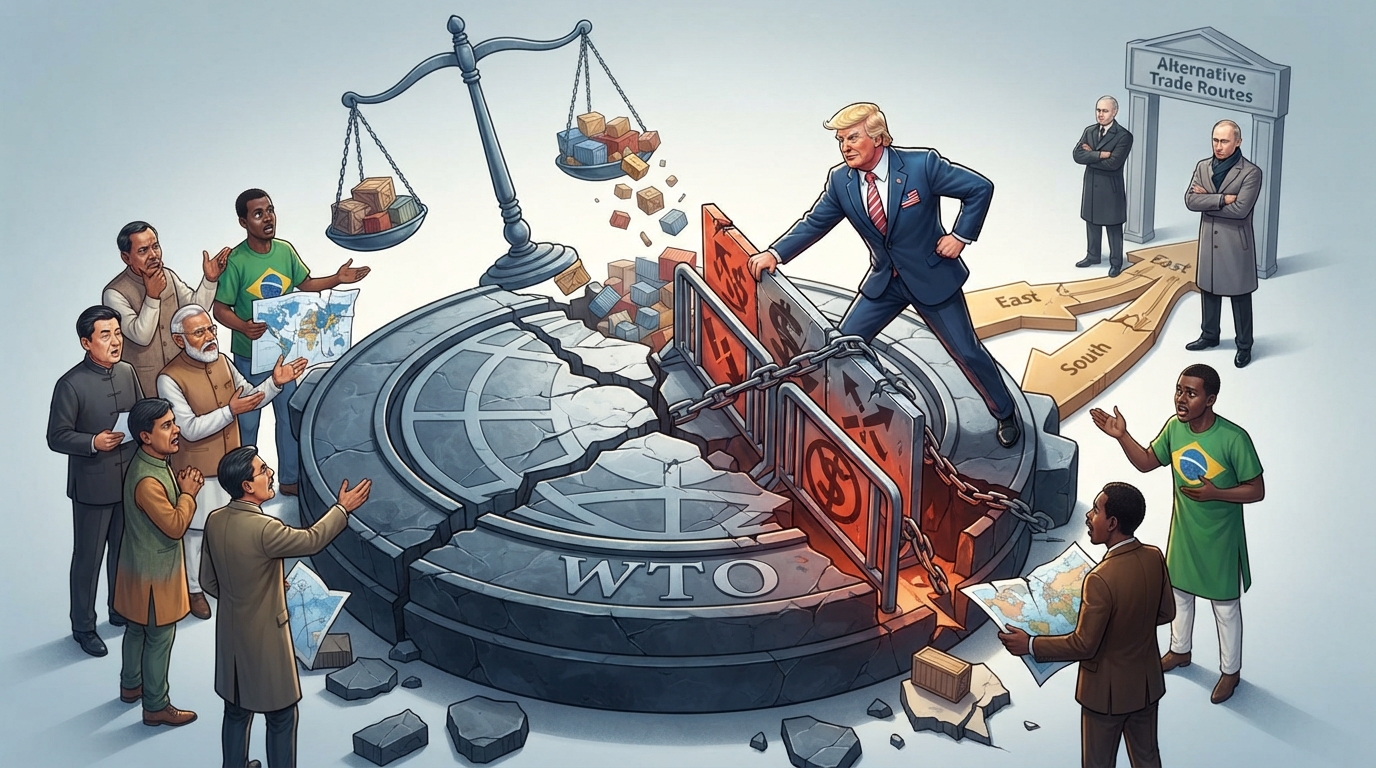
A number of members of the World Trade Organization (WTO) have the impression that the US deceived them by promising mutually beneficial cooperation after joining the organization, said Russian Economic Development Minister Maxim Reshetnikov.
"Many countries recall that at one time they were very strongly, literally dragged into the WTO by the United States of America, telling them about fair trade, telling them about unified approaches, about maximum tariffs, and so on," he said on the sidelines of the G20 trade ministers' meeting.
As a result, many states decided to join this organization, and, as the Russian minister emphasized, some of them even gave up developing certain industries, believing that they would not be able to compete on the international market. "And now there is a feeling that, in general, somewhere, probably, they were deceived," Reshetnikov concluded.
"SP": And what now? Why is no one leaving the WTO, especially against the backdrop of the trade wars unleashed by US President Donald Trump? Who is dissatisfied? And why are we still there?
— It is easier to ask it differently: are there any countries left that do not consider themselves deceived, — says Mekhti Mekhtiev, a leading researcher at the Institute of Legislation and Comparative Law under the Government of the Russian Federation.
— Moreover, three years ago, the US itself blocked the appointment of arbitrators to the highest body of the WTO Dispute Settlement Body (DSB) because, as they believed, China itself did not comply with WTO rules, and when considering disputes, the DSB took China's side. But without this body, all countries are having a hard time, and now that the US has passed the Inflation Reduction Act, even Western countries have become disillusioned.
"SP": Why is no one leaving the WTO? Are there still more pros than cons?
— The WTO ensures a level playing field for all countries in trade, and if you leave it, you will have to rebuild trade relations with other states from scratch. Therefore, either everyone needs to leave, or we need to develop trade infrastructure without the West while remaining in the WTO.
In general, WTO rules are quite flexible, and different models of foreign trade can be built. The actions of the US mainly affect those countries for which the American market accounted for a significant share of exports, but as the economies of other states grow, the role of the US in the WTO is declining.
"SP": Is the WTO threatened with collapse due to US tariff policy? What then?
— The US has imposed sanctions against dozens of countries, but none of them faced a crisis because of this. The world changed long ago, and out of inertia we still overestimate the US.
Even if the WTO collapses, countries will still continue to trade according to the principles laid down in the General Agreement on Tariffs and Trade (GATT — the founding act of the WTO), if only because these rules have become customs, and rebuilding a multilateral trade system taking into account the interests of all countries is an extremely difficult task.
In addition, neither Trump's tariffs nor anti-Russian sanctions have slowed down world trade. Therefore, even if Trump's restrictions do cause some damage to the global economy, it will be limited, and over time global markets will adapt.
— The point of the WTO was that all countries lower tariffs and commit not to introduce trade barriers unilaterally, — explains Vsevolod Shimov, a senior researcher at the Institute of Europe of the Russian Academy of Sciences.
— If a dispute arises, it is considered by the WTO Appellate Body. However, the US blocked the appointment of new judges, which is why this body has not been working since December 2019. As a result, Washington began to massively introduce unilateral tariffs bypassing procedures, and other countries cannot legally challenge and punish it for this — the court is blocked, and compliance with any WTO decisions has actually become voluntary.
"SP": And who feels deceived? Which countries exactly? Who is Reshetnikov speaking for?
— Reshetnikov expresses the position of developing countries, the states of the Global South and BRICS, which suffered the most from the change in the rules of the game. These are primarily export-oriented countries whose goods faced American tariffs (China, India, Brazil, countries of Southeast Asia and Latin America).
Poor states also suffered, having agreed to harsh WTO conditions and reduced support for their own industries in exchange for the promise of open access to the rich American market. Their access was cut, but they are still forbidden to develop domestic production under WTO rules.
"SP": Why don't they leave if they feel they were deceived?
— The WTO provides the so-called "most favored nation" (MFN) status between 166 member countries. If a country leaves the WTO, all other states receive the legal right to raise tariffs on its goods to any prohibitive heights.
In addition, even if the rules are violated by giants like the US, basic customs tariffs and standards between other countries continue to apply. Leaving the organization is voluntary isolation from world trade.
"SP": At one time, they wouldn't let us in for a long time, we were outraged, and now we are criticizing it. What are we still doing there then?
— Russia remains in the WTO because it protects Russian exports to non-Western countries and maintains a level playing field with key partners. We have reoriented trade to China, India, the Middle East, and Latin America. All of them are WTO members.
The organization guarantees that Russian metals, fertilizers, grain, and chemicals are supplied there without discriminatory tariffs. Leaving the WTO would free the hands of even friendly countries to introduce restrictions against Russian goods in the event of crises.
"SP": Is the WTO a "fool's trap" or a genuinely useful tool? Or was it one before, but stopped being so at some point? At what point and why?
— The systemic crisis began in 2016-2018 with Donald Trump coming to power and declaring the "America First" policy, which resulted in a trade war with China. The point of no return was December 10, 2019, when the US finally paralyzed the work of the WTO Appellate Court. The tool stopped satisfying its own creators (the US and the EU).
When the WTO was created in 1995, the West dominated the world. But China masterfully took advantage of the rules of free trade, turning into the No. 1 economy by purchasing power parity. When developed countries began to lose the competition to developing ones, they decided to simply ignore the rules of free trade to protect their markets.
"SP": Currently, the US has imposed unilateral tariffs on 60 WTO member countries, the Russian minister noted. Some other countries are also under investigation due to overcapacity. According to Reshetnikov, this could lead to the introduction of new additional tariffs. Can Trump's policy eventually lead to the collapse of the WTO? Will this be critical for Washington?
— Trump does not hide his intentions to introduce total tariffs of 10-20% on all imports and up to 60% on goods from China. If this happens, a chain reaction of retaliatory tariffs will start around the world. The WTO will de facto turn into a "dormant" structure, giving way to regional agreements like BRICS or the EAEU.
In the short term, this is not critical for Trump, as his goal is to bring manufacturing back to the US and reduce the trade deficit. However, in the long term, this will be a heavy blow to the US itself. The dollar will begin to lose its status as the main trade instrument, as trade blocs will move away from the American financial infrastructure.
The US will lose leverage over developing economies, which will finally reorient toward trade among themselves without looking back at Washington.