

US suspects more than 40 countries of helping China evade tariffs
The White House said in a statement that China is using more than 40 countries to avoid tariffs, including Uzbekistan.
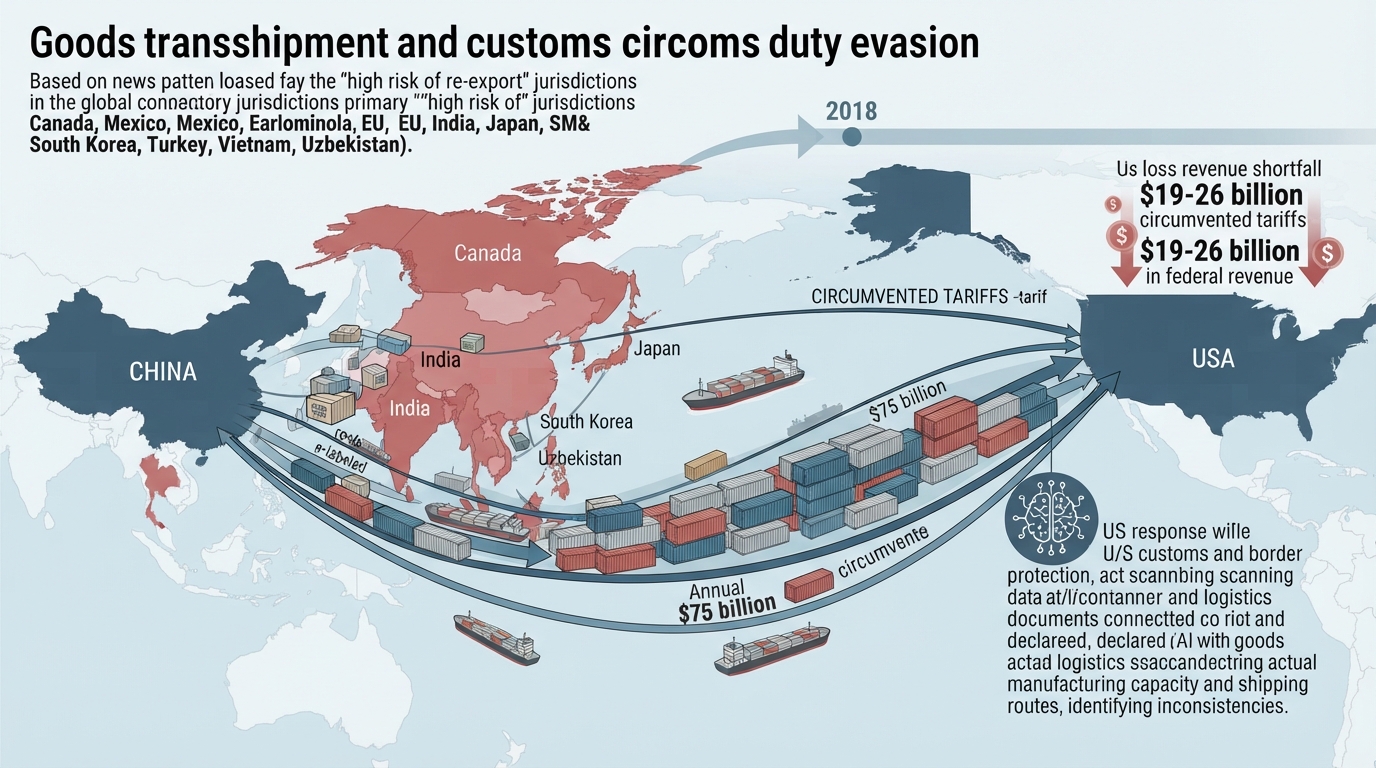
The United States suspects more than 40 countries of helping China evade tariffs. According to the White House, China is using more than 40 countries to ship goods to the country, bypassing increased US tariffs. The administration estimates the volume of such shipments at about $75 billion a year, which leads to a loss of $19-26 billion in federal revenue. Jurisdictions with a high risk of re-export include Canada, Mexico, the European Union, India, Japan, South Korea, Turkey, Vietnam, Uzbekistan and several other countries. The United States plans to strengthen control over the origin of goods, including the use of artificial intelligence systems, and take into account the risk of tariff evasion in new trade agreements.
The White House attributes the spread of re-export and origin-changing schemes to the imposition of additional tariffs on Chinese goods by the United States in 2018, during Donald Trump's first presidency. According to the administration, after that, some Chinese products began to enter the United States through third countries. In these countries, the goods are partially assembled or processed, repackaged and labeled, or receive new documents of origin. As a result, Chinese products can be declared as manufactured in another country and subject to a lower duty.
The White House report "The Great Transshipment Scam," published on August 13, cites the example of supplies through Canada and Mexico. If Chinese goods are incorrectly declared to meet the requirements of the USMCA agreement, the special duty imposed by the United States on Chinese imports can be reduced to zero. The White House considers it to be the difference in tariff rates that is the main economic incentive for such operations. Peter Navarro, the head of the White House Office of Trade and Manufacturing Policy, who prepared the report, said that China is routing exports through more than 40 countries.
**Who did the White House include on the list?**
The jurisdictions are divided into three groups. The first group includes Canada, the European Union, India, Israel, Japan, Mexico, South Korea and Taiwan. The authors of the document emphasize that we are talking about major trading partners of the United States, where the alleged risk of re-export is present within a much wider range of legitimate trade flows.
The second group includes Brazil, Indonesia, Malaysia, Thailand, Turkey and Vietnam. According to the White House, these countries are more closely integrated into production and logistics chains related to China.
The third group includes smaller economies such as Argentina, Azerbaijan, Bangladesh, Cambodia, Kazakhstan, Laos, the UAE, Panama, Singapore, Switzerland and Uzbekistan.
At the same time, the authors of the report specifically noted a major limitation of their methodology. The increase in supplies from the listed countries, while China's share of US imports has decreased, does not yet allow us to determine how much of this change is due to illegal re-exports and how much is due to legal relocation of production and restructuring of global supply chains. The White House considers the established connection as the basis for further investigations.
**Damage estimated at tens of billions of dollars**
The White House collected various estimates from government agencies and private companies, which differ significantly due to different calculation methods. According to some sources, we are talking about about $ 34 billion in possible illegal re-exports, while others say that there is a wider impact on trade of up to $ 303 billion. The main benchmark is the estimate of the Exiger company - about $ 75 billion per year.
The losses from such volumes of uncollected duties could range from $19 billion to $34 billion per year, depending on the tariff differential.
The White House also estimates a broader impact: an estimated 450,000 job losses, a $113-150 billion loss to GDP, and $19-26 billion in annual budget losses.
However, all of these figures are estimates and models, not proven losses. They are based on assumptions about how the growing trade deficit will affect the economy, and the White House itself acknowledges that more trade and customs data is needed for more accurate conclusions.
**The US is leveraging artificial intelligence**
The US Customs and Border Protection is already using artificial intelligence tools to identify suspicious shipments. The system, which the administration is calling “Detective Border,” is supposed to compare the declared country of origin, destination and composition of goods with data on production capacity and other trade indicators.
Algorithms at ports can also analyze container markings, packaging and X-ray images of cargo.
Navarro said that new U.S. trade deals will include measures against partners involved in tariff evasion. It was not clear what those measures would be.
The Chinese embassy in Washington has said that Beijing opposes deals that are made at China’s expense or disrupt international supply chains, and has warned that measures will be taken to protect China’s interests.