

A way to make the study of gas fields cheaper has been found
Scientists at the Gubkin University of Oil and Gas in Russia have proposed an approach aimed at reducing the costs of exploring gas fields. According to the authors' calculations, a mathematical analysis method called "tornado" could allow for savings of 30 million to 300 million rubles per year on a single field.
A way to make gas field exploration cheaper has been found
To estimate how much gas can be extracted from a field, engineers create computer models. Such models require hundreds of indicators, such as rock porosity, permeability, reservoir pressure, and water properties.
Determining them requires well drilling, rock sampling, and laboratory analysis. These tasks involve both time and financial resources. Researchers sought to answer the question of whether it is necessary to study all indicators equally thoroughly in every field.
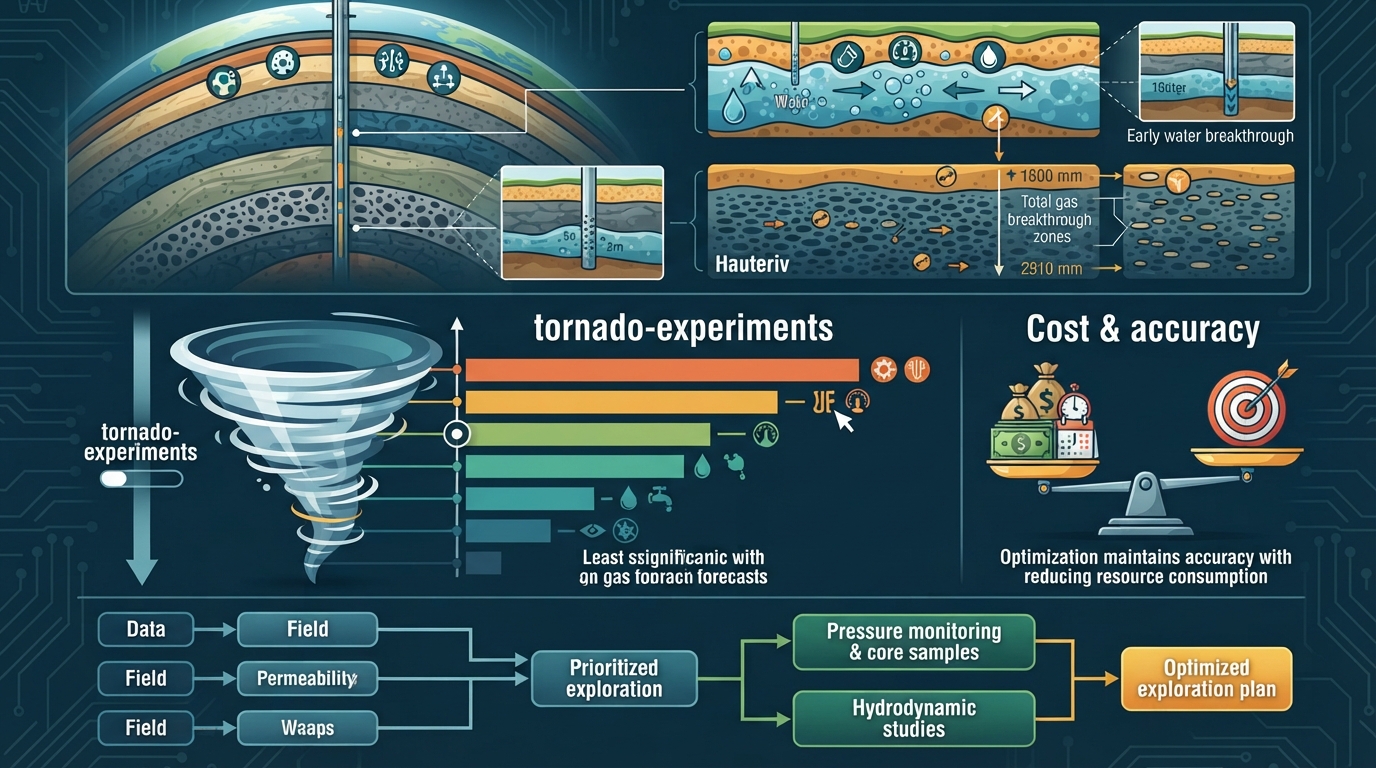
Scientists analyzed data on 66 gas deposits in Western Siberia. For this, the "tornado-experiments" method was used: in the model, each geological indicator was modified one by one, and its effect on the production forecast was recorded.
The name of the method does not imply that an experiment was conducted with a natural tornado. The analysis results are displayed in diagrams resembling a whirlpool shape: the factors with the strongest impact on the forecast are marked with the widest bars. This helps to separate key indicators from secondary ones.
The study also revealed that priority factors differ for various geological layers.
As project participant Artyom Yeliseyev explained, in the Cenomanian layers, which consist of relatively shallow, loose, and porous rocks, the properties of the bottom water drive and how gas and water move through the rocks are important. In such fields, water may enter the wells earlier than expected, and part of the gas may remain trapped in the reservoir.
In the deeper and denser Hauterivian layers, other issues take priority: accurately estimating the gas volume and determining which layers are actually contributing to production.
Based on these results, the scientists proposed an algorithm that defines which measurements must be conducted at each field and which ones can be reduced or eliminated. For example, while it is necessary to step up pressure monitoring and take more rock samples in some fields, in others, focus should be placed on hydrodynamic studies that examine fluid and gas movement in wells.
The savings are expected to be achieved primarily through more precise planning of the field study program. The authors emphasize that such an approach reduces excessive research costs without compromising the accuracy of the forecast.
Software developed in Russia was also tested during the research. According to the scientists, its speed and accuracy were compared with foreign alternatives across hundreds of calculation options, demonstrating that it is in no way inferior to them.