

A two-year diploma program has been launched at the Naqsh Craft School in Tashkent
A two-year diploma program for artisans has been launched in Tashkent. Students will learn skills such as ornamentation, ceramics, decorative painting, and wood carving. The classes are organized by the Naqsh School of Crafts, the Art and Culture Development Foundation, and the British school KFSTA.
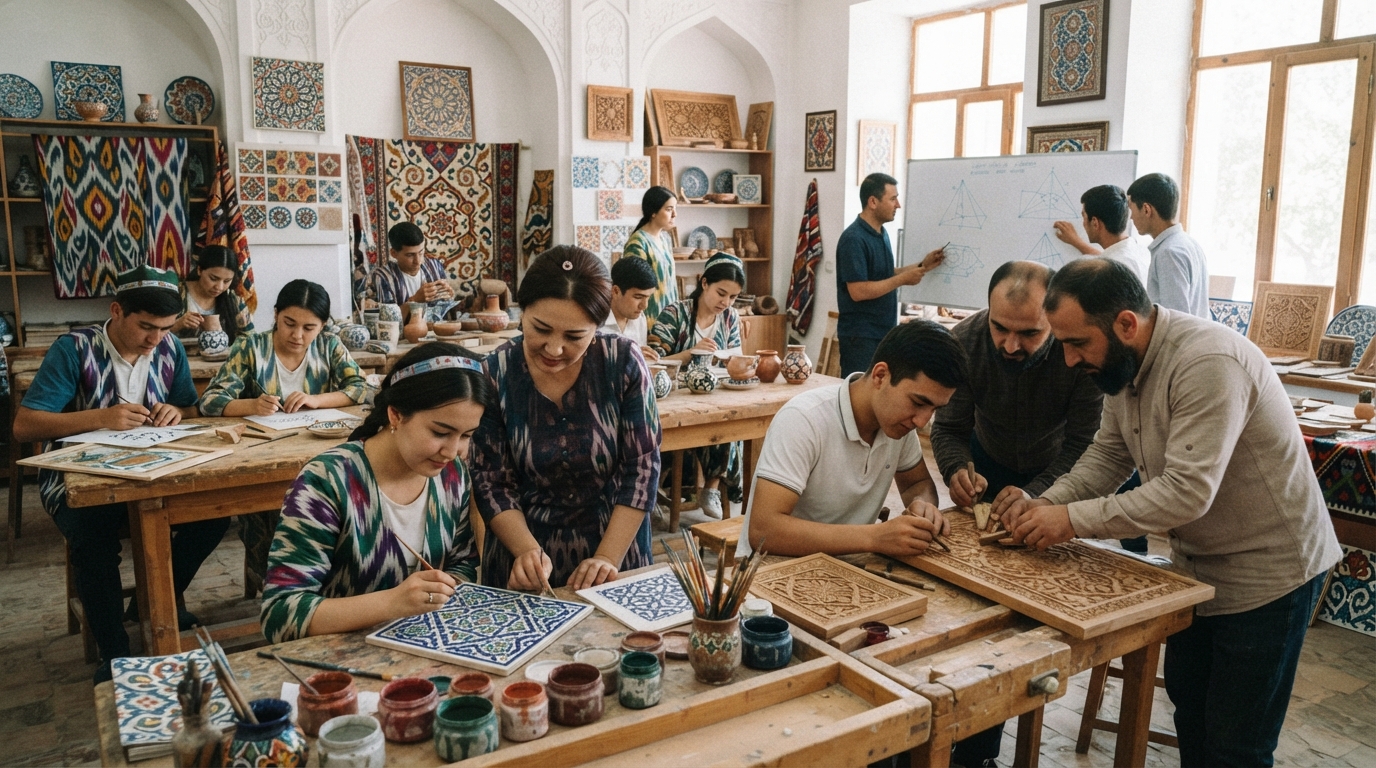
A two-year diploma program has launched at the Naqsh School of Crafts in Tashkent
On October 5, a two-year full-time diploma program commenced at the Naqsh School of Crafts in Tashkent. Developed by the Foundation and the King's Foundation School of Traditional Arts (KFSTA) of the United Kingdom, this program aims to train specialists capable of preserving and developing Uzbekistan's traditional crafts by combining historical techniques with a contemporary creative approach.
As part of the opening ceremony, the Chairperson of the Foundation, Gayane Umerova, and the Director of KFSTA, Dr. Khaled Azzam, signed an agreement on a new stage of cooperation.
At the school, students will master geometry and pattern, ceramics and tile-making, calligraphy, decorative painting, wood carving, and other traditional disciplines over three terms of 8 weeks each.
Experts from the United Kingdom, Iran, Russia, Turkey, and Jordan, including graduates of the King's Foundation School of Traditional Arts, are involved in the educational process.
"Uzbekistan's craftsmanship has always been a living language passed down to the new generation. Within this program, we aim to teach students not only the techniques of our ancestors but also the principles of beauty that allow traditions to develop," said Khaled Azzam, Director of the KFSTA School of Traditional Arts.
Theoretical classes will be conducted alongside practical sessions in workshops. As part of the program, students will also develop their own projects based on the architectural and cultural heritage of Uzbekistan. At the end of their studies, students will defend a diploma thesis.