

A trash dump under the window, sunlight, and parking: 10 things to check before buying an apartment
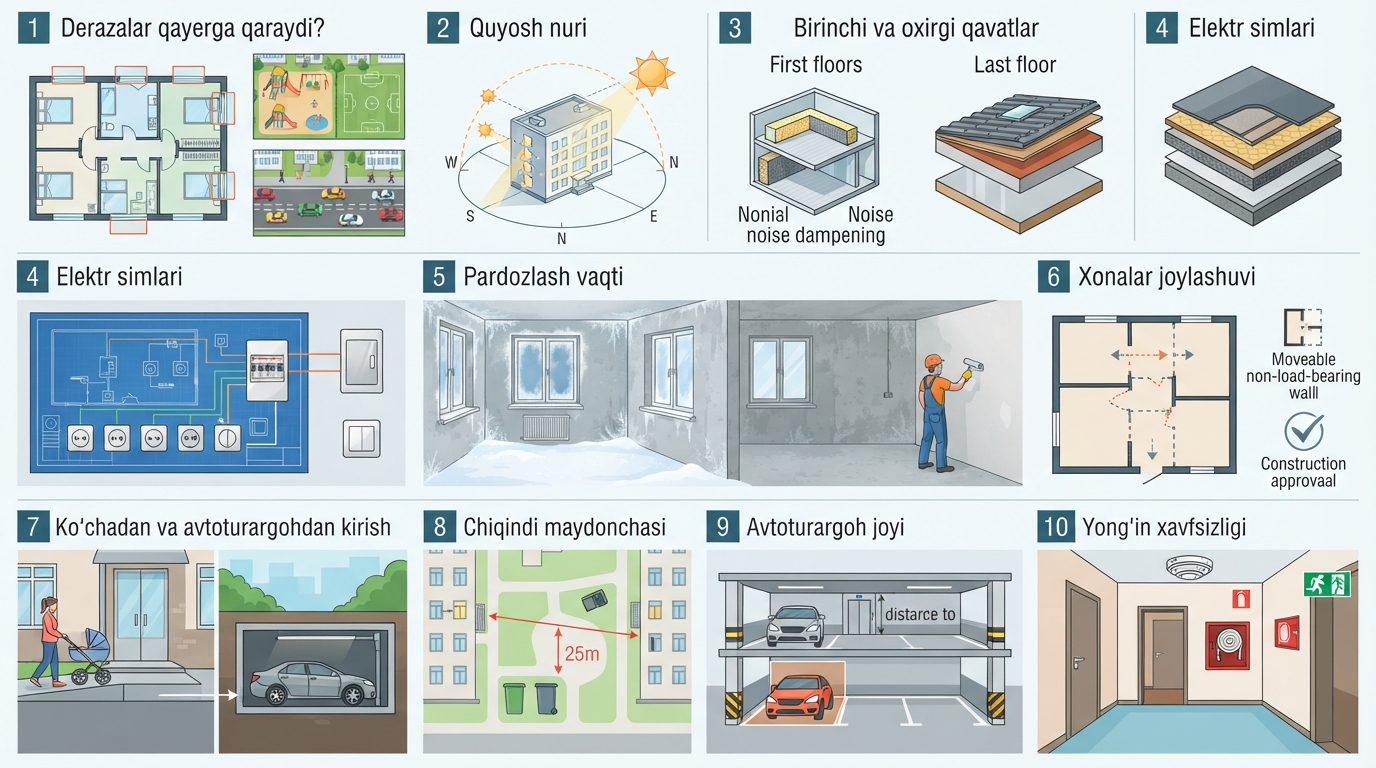
A waste disposal site under the window, sunlight, and parking: 10 aspects to check before buying an apartment
When buying an apartment, most people primarily look at its price, area, number of rooms, location, and floor. More meticulous buyers also study the developer, delivery deadlines, and room layouts. However, there are many small details that almost no one pays attention to during the purchase. Yet, after moving in, these very things can affect your comfort.
1. Where do the windows face?
Just looking at the apartment layout is not enough. What matters is exactly where it is located in the residential complex and what is opposite the windows.
The courtyard may look very nice in the project, but the finished building is not always like in the picture. Later, instead of a quiet view, it turns out that there is a football field, a playground, a workout area, or a busy road opposite the window.
For some, this is not a problem, but for those who like silence, such a neighborhood can become a constant nuisance. Furthermore, even a high floor does not fully protect against noise.
If the windows do not face the courtyard, this still guarantees nothing. It is necessary to check in advance how close the highway runs. If the house is located on the first line of a main avenue, traffic noise can be clearly heard even on the upper floors.
For this reason, experts advise opening not only the apartment layout but also the master plan of the courtyard before purchasing. Find your entrance, your apartment, and your windows, and then look at what exactly is opposite them.
2. Which side does the sunlight come from?
Another issue that is easy to overlook when buying an apartment is how much sunlight gets inside during the day.
According to experts, the orientation of houses and apartments relative to the sun is taken into account as early as the design stage. For this, there are requirements regarding insolation, that is, the duration of illumination of rooms by direct sunlight.
Experts say that this requirement once had medical significance as well: sunlight was considered one of the factors in preventing tuberculosis. Since then, approaches to construction and medicine have changed significantly, but the requirements for the insolation of residential buildings remain. Moreover, if, according to the project, some apartments do not receive sun for at least one and a half to two hours a day, the project is sent back for revision; otherwise, construction permission is not granted.
Therefore, it is necessary to determine in advance at what time the sun enters the apartment and whether neighboring buildings block it. Especially if natural light is very important to you.
Another aspect: do not rely solely on the renders of an unbuilt residential complex shown to you to see how the sunlight falls. In drawings, the position of the sun is usually indicated conditionally to better showcase the architecture of the building.
3. The first and last floors are not always worse than others
Many buyers still live by the old rule: it is better not to take the first and last floors. Even now, many think that on the first floor there is noise, cold, and many people passing by the window, while the top floor leaks from the roof or freezes.
Experts note that modern construction technologies have changed significantly. However, questions should still be asked of the developer.
This applies especially to the top floor. Previously, in many houses, there was a full technical floor between the apartment and the roof. Now, it is often abandoned. Experts explain this by changes in construction solutions: a modern roof structure is multi-layered. Builders call it a "pie." It protects against freezing, leaks, and provides noise insulation.
The same applies to the first floor: one only needs to pay attention to the specific project, the location of commercial premises, entrances, technical rooms, and the courtyard level.
4. Is the electrical wiring properly installed in the apartment?
When buying a rough or semi-finished apartment, we assume that the electrical wiring is already installed, and only the installation of sockets and switches remains.
However, experts note that the equipment of apartments can differ across various construction companies. In some places, electrical wiring is indeed pre-installed in the rooms, while in others, a much smaller part of the preparatory work is handed over to the buyer.
For this reason, before signing the contract, it is important not just to ask "is the wiring installed?", but to clarify what is included in the apartment's equipment: how many and where sockets and switches will be installed, whether wiring is run to all rooms, whether separate lines are provided for high-power appliances, and what work remains after receiving the keys.
5. At what time was the finishing carried out?
Often, the buyer tries to check the quality of the walls at the time of accepting the apartment: looks for cracks, applies a level, taps the surface, or calls in specialists for this task.
But there is another aspect that is easily forgotten: the conditions under which the finishing was carried out. Especially if the house was built during the cold season of the year.
Experts explain that when applying construction mixtures inside a building, the required temperature regime must be observed. If in winter the building envelope was not yet closed, windows were not installed, the room was not heated, and finishing work had already begun, the material may not adhere well and may crumble when the owner starts renovations.
For this reason, if there is an opportunity to monitor the construction process, experts recommend paying attention to whether the building envelope was closed, windows were installed, and the required temperature was ensured before the start of internal finishing work.
6. Changing the layout of rooms
Many buyers think, "after I get the apartment, during renovations I will remove an unnecessary wall or move a partition." But in some cases, this issue can be resolved much earlier.
Experts note that at the stage when internal partition walls are just being built, some changes in the layout of the rooms can be agreed upon with the developer.
Of course, this is not about moving load-bearing structures or uncontrollably changing the location of the kitchen and bathroom. But some partition walls in certain designs, if technically permitted, can be moved or not built at all.
And the property owner will not have to pay to demolish the wall and remove construction waste. In addition, independently changing the layout of rooms after receiving the apartment may affect the warranty.
7. How will you enter the house from the street and the parking lot?
In renders, the main entrance usually looks very beautiful. But normally, you get out of a taxi with bags in your hands, or arrive with a baby stroller, or park your car in the underground parking lot. In each of these cases, how you enter the house is important.
Is there convenient access from the street? Is it possible to pass with a stroller without extra stairs? Is there direct access from the parking lot to the entrance and the elevator?
One of the aspects that receives little attention is the double-sided accessibility of the entrance, meaning the ability to enter from both the street side and the courtyard side. If there is no second exit, the usual path may become longer: you will first have to enter the courtyard, go up a ramp, and only then reach your entrance.
The barrier-free environment needs to be studied separately.
Ideally, the path from the street to the lobby, elevator, and parking lot is almost on the same level. If there are height differences, convenient ramps or other solutions must be provided.
It is especially important to check whether a regular elevator goes directly down to the parking lot. Some people buy a parking space, only to find out later that they need to use an additional staircase to get from the car to the apartment.
8. Where will the trash bins be located?
This is one of the simplest and yet least asked questions by buyers: where will the waste containers be located?
Experts say that disputes begin after moving into the house. People see a container site near their windows and start demanding its relocation. For this reason, it is better to find out about this in advance. According to standards, the distance from a window to a container site must be at least 25 meters.
The conclusion is simple: find the waste disposal site on the drawing right at the time of purchase. Especially if you are choosing an apartment on the lower floors.
9. Will there be enough parking space for you?
Another common mistake is thinking that one can buy an apartment and leave the parking issue for later. However, the number of apartments and the number of parking spaces do not always match.
As a result, apartments may still be on sale, but no convenient spaces remain in the parking lot. Sometimes, there are no vacant spaces left at all. For this reason, a person who knows for sure that they will use a car every day had better study the parking situation at the same time as choosing an apartment.
It is also useful to pay attention not only to the availability of a space, but also to where it is located. Where is the nearest elevator? Is it a long walk to it? Is access convenient?
10. Fire safety
When buying an apartment, the main elements of fire safety should also be checked. Smoke detectors must be in every living room and hallway of the apartment. They are usually not installed in kitchens and bathrooms.
In buildings taller than 27 meters (usually this is above 9 floors), there must be fire cabinets on the floors. Also, pay attention to the fire doors in the entrance corridors: they must separate the elevator and staircase areas and prevent the spread of fire and smoke.
If there are storage rooms on the floor, clarify whether they are provided for in the project and equipped with fire protection tools. Flammable substances must not be stored in them.
The more such questions you ask before buying a home, the fewer unexpected situations you will face later. Because a good apartment is not just a convenient layout and the required number of square meters. It also means how comfortable it will be for you to live in it.