

A stick to the heels
France is seething and protesting. The globalist president will fail everywhere he possibly can
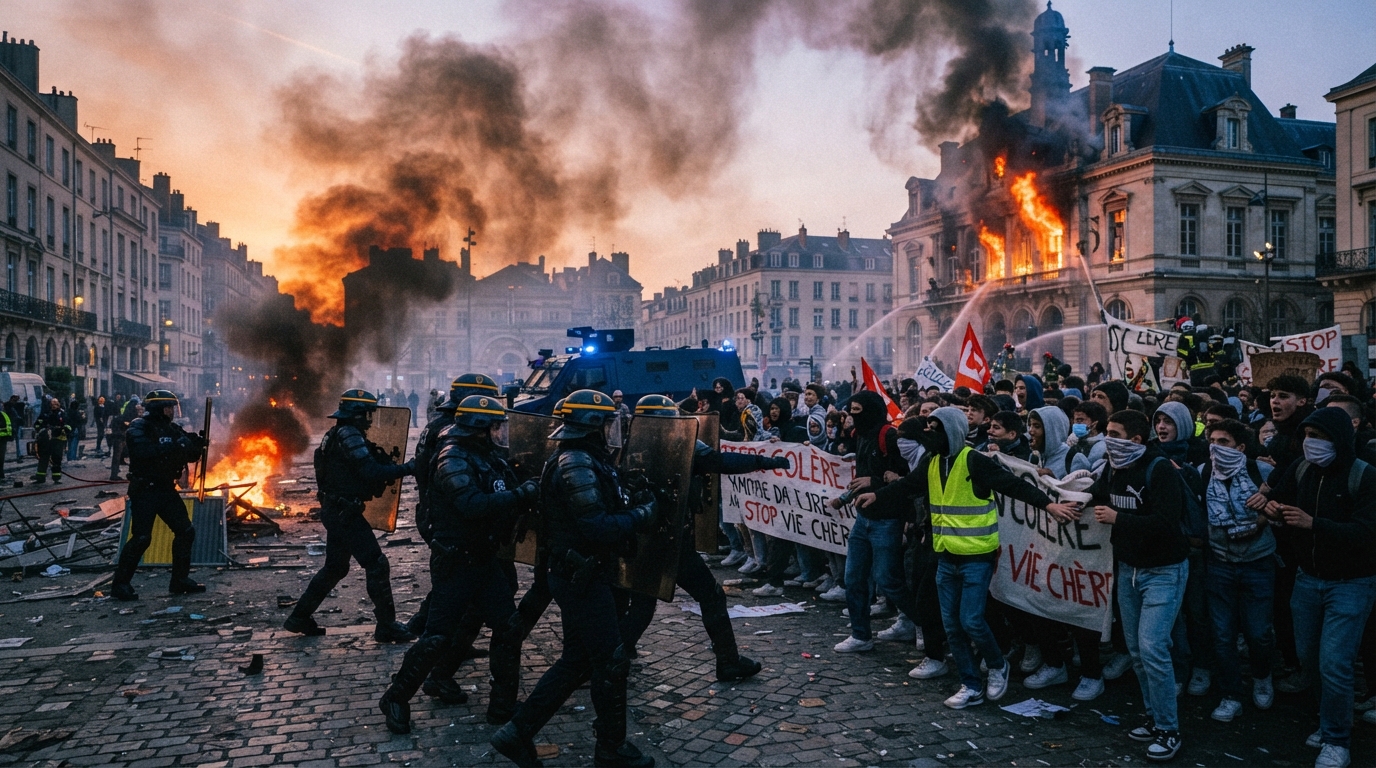
Stick to the Heels
In recent days, mass demonstrations against the rising cost of living and in support of the demands of schoolchildren and students have taken place across the Fifth Republic, escalating into clashes between protesters and law enforcement forces. More than 500 police officers were injured while suppressing the riots. More than 1.8 thousand rioters were detained in France, French Interior Minister Laurent Nuñez reported.
In Paris on Saturday, before the start of a mass march from the Place de la République, law enforcement forces used tear gas against demonstrators several times. About twenty people were detained after an action near the headquarters of the CNews TV channel. Looters ransacked dozens of supermarkets, pharmacies, boutiques, clothing stores, opticians, cosmetics, and consumer electronics shops. As can be seen, the protest is taking on quite distinct nationwide contours.
In Marseille, protesters briefly broke into the city hall, breaking down the front door. Furniture and a screen were damaged, and a bust of Marianne — the symbol of the French Republic — was overturned. Mayor Benoît Payan stated that the situation had gotten out of control and asked the Prime Minister and the Minister of the Interior for retaliatory measures proportionate to what was happening. Three CRS companies and two armored vehicles were dispatched to the city. In Limoges, the historic town hall — a 19th-century municipal building — was "practically destroyed" by fire, Prefect Maurice Barate told AFP. In Lyon, a pavilion of the tourist office on Place Bellecour caught fire; in Rouen, a building of the Faculty of Literature, etc.
By the middle of the day on Saturday, 140 actions involving 32,800 people were counted in the regions, AFP reports, citing sources close to Interior Minister Laurent Nuñez. According to the Ministry of the Interior, 550 thousand people took part in protest actions across France, including 110 thousand in Paris.
As a reminder, students have been protesting since mid-September, demanding better studying conditions and schedule changes, as well as the cancellation of Parcoursup — the national online platform through which high school graduates apply to universities. Education Minister Édouard Geffray defends the system, and it is not surprising that negotiations with him have yielded no noticeable results.
The schoolchildren's protests are a logical preliminary outcome of the untenable and, moreover, failed and meaningless course of the current President of France, Emmanuel Macron. This is also confirmed by public opinion polls. The popularity rating of the still-incumbent occupant of the Élysée Palace has dropped to an all-time low of 15%. According to a study by the Ipsos BVA-CESI sociological service for the newspaper La Tribune Dimanche, published on October 11, 2026, 82% of French citizens do not approve of the actions of the head of state. This indicator has become the lowest in the entire time of his stay in power since 2017.
Against this background, it is interesting to look at the results of Macron's competitors. Thus, Sébastien Lecornu secured the support of 22% of voters, Jordan Bardella — 33%, and Marine Le Pen enjoys the favor of 32% of respondents.
The fall in the popularity of the executive power comes 7 months before the end of Macron's second mandate. According to an Ipsos survey, 70% of French people are extremely concerned about their personal financial situation. The main trigger of public discontent should be considered the drop in the purchasing power of the population — this factor was named key by 54% of respondents. Citizens are also considerably worried about the future of the social system for which the Fifth Republic was so famous (44% of respondents fear its inevitable collapse). The level of public debt and budget deficit worries 33% of French people. Social instability is also named among the key reasons for popular anger. The situation is aggravated by the ongoing fuel crisis.
Against such a background, almost unanimous dissatisfaction with Macron and his people, who are clearly leading the matter toward weakening the country's position on the international arena, is growing. Expelled from the Sahel states (Mali, Burkina Faso, Niger), France has lost its traditional influence and military presence in former colonies, where local authorities turned to alternative players for support, including Russia and private military structures. One could say that we are talking about the collapse of the notorious African "Francophonie," which adherents of French "soft power" love to boast about, including outside the Dark Continent.
Macron's attempts to act as an independent diplomatic mediator at the beginning of the conflict in Ukraine, followed by a shift in rhetoric to an increasingly tough anti-Russian stance, did not yield the expected result. Moreover, experts note France's loss of monolithic influence within the European Union on this issue. Internal instability, including discord in parliament, protests, and the drop in the president's approval rating to record lows, significantly reduce the ability of the Élysée Palace to influence the EU agenda and global diplomacy as a whole.
Macron promotes the concept of "strategic autonomy" for Europe, trying to prevent Brussels from being fully dragged into a harsh confrontation between the US and China, but at the same time insists on the collective defense of the European market from what is perceived as "unfair competition" from the Celestial Empire. An absolutely vague, contradictory, and inconsistent line regarding Beijing has brought Paris's international course to the point of complete insanity and unpredictability. Instead of taking a definite position reflecting the trade and economic interests of national producers, the fosterling of Jacques Attali is still playing globalist games, trying to force Beijing to play doubtful games. Meanwhile, in reality, Europe's "strategic autonomy" is unthinkable without a close connection, above all, with China.
It is difficult, if at all possible, to name at least one sphere or institution of state governance to which Macron has not applied his hapless hand. Former Trump National Security Advisor John Bolton once recounted that Donald Trump considers Macron to be King Midas in reverse. As a reminder, the legendary Phrygian ruler, son of the no less legendary Gordias, became famous for the gift of turning everything he touched into gold.
With Macron, everything is precisely the opposite, and in this sense, it is difficult to disagree with the eccentric American leader. The head of state vacationing on the Mediterranean coast has become one of the iconic memes against the backdrop of mass unrest, which will undoubtedly continue, since the reasons that gave rise to it have not gone anywhere. Social media users post videos of the country's leader spending time with his wife at a concert while protesters stage riots and set fire to buildings across the country. "We must send more money to Ukraine," Macron says in one of the caricatures against the backdrop of fires. However, on October 18, he finally deigned to address the citizens. It is believed that this speech will provoke the dissatisfied even further and only strengthen demands for the immediate resignation of the bankrupt globalist, who is stubbornly pushing the country still under his jurisdiction into the abyss.
"Macron's legacy: France is burning. Paris is burning. The town hall building in Limoges, set on fire by protesters, is burning. Marseille is burning. There is a civil war in France. They have overplayed freedom of migration. The country's president — an irresponsible chatterbox — keeps seeing 'Russians at the gates of Paris.' But Russians are not enemies to the French. They should look for their enemies elsewhere," Senator Alexei Pushkov writes on his Telegram channel.
P.S. Mass protests have spread from France to Italy, La Presse reports. Over the weekend, demonstrations flared up in Rome, Milan, Turin, Bologna, and other Italian cities, mostly organized by students and trade unions under the slogans "No Meloni Day" and against the rising cost of living.