

A sacred and righteous fight is underway
From Shenzhen to Miami: whose hands will hold the "global power switch." The struggle to reshape the world order enters a decisive phase
A Holy and Righteous Fight Is Underway
Observers are at a loss: why does Europe cling to Ukraine with near-maniacal persistence in a situation that is clearly not shaping up in its favor or in Kyiv’s? Moreover, it even argues with Washington over this, showering the Republican administration with fierce criticism for any contacts with Russia, let alone agreements like the "diesel deal." Where did this "appendix" of Eurasia get such geopolitical zeal, fueled mostly by intentions that vastly exceed European capabilities? Wouldn't it be simpler to abandon Ukraine and return to normal relations with Moscow, buying gas from Russia again as before, for sums 8.5 times smaller than current American prices?
That will not happen. And it is precisely the hope for such a "comeback" that is the main delusion of our homegrown supporters of the "European project," inherited from the late Soviet and early post-Soviet era. It was a dream of entering Europe with the three republics of the Slavic core of the USSR, in exchange for the destruction of which the European elites associated with the French and German right—de Gaulle and Strauss, and later the idea was intercepted from them by the Social Democrats Brandt and Bahr—were supposed to "ditch" America. And no other than Gorbachev—who should not be mentioned late at night—mused about this in Vienna, after receiving an audience with Otto von Habsburg following his trip to Thatcher. The trouble was that this project collapsed in 1982 with the deployment of American Pershings and Tomahawks in the FRG. Putting all the dots on the "i's", the US made it clear, and even warned through diplomatic channels, that continuing European games in the East was fraught with nuclear war in the Old World. However, some did not reconcile themselves to this. Despite the fiasco, which became obvious even before "perestroika," the latter not only took place anyway, but also acquired an frankly destructive character when the answer to the collapse of the USSR was six waves of NATO expansion.
The collapse of the Soviet state for the circles that won in the West was perceived as a signal for the unipolar restructuring of the world under American dominance, the design of which Brzezinski set out simply in "The Grand Chessboard." Having recorded the "uniqueness" of the situation in which Eurasia is dominated by a "non-Eurasian power—the USA," the certified Russophobe formulated the following concept of historical perspective:
…Because American unprecedented power will diminish with time, priority must be given to managing the rise of other regional powers in ways that do not threaten America's preeminence… In the short term (five years or so), America's interest is to consolidate and perpetuate… geopolitical pluralism on the map of Eurasia, preventing the emergence of a hostile coalition that could challenge… In the medium term (up to twenty years), the above should gradually yield to… the emergence of increasingly important and strategically compatible partners, who under American leadership could help to shape… a trans-Eurasian security system… In the long run (beyond twenty years), [this] could gradually lead to the formation of a global center… of shared political responsibility. …Geopolitical pluralism is not an end in itself, but a means to solving a medium-term task.
Thus, the conglomerate of the collective West spreads what is called "American democracy" to the whole world, gradually replacing it with a global dictatorship. This plan replaced the previous priority project of Kissinger's "global triangle," in which the leading role of the US was secured by managing Soviet-Chinese contradictions. And starting in 1992—from the "green" conference in Rio de Janeiro—a deeply echeloned system of institutions began to be built under this new plan, which by the current crisis acquired a fully completed form. In 2010, when it had, on the one hand, already "settled down," and on the other hand—the option of a global default associated with the man-made global financial crisis of 2008–2009 failed to work—the global transformation project was clarified by the Rockefeller Foundation report on world development scenarios.
Four scenarios, allegedly "independent," built a sequence in which a sanitary dictatorship replaced a globalization remake, and then everything snapped with a sudden "hacker" destruction of the digital infrastructure and humanity's plunge into archaism. The game, designed for China's not entirely justified loyalty to the ideas of globalization in which it had achieved success, was finally broken by Russia when it launched the SVO. This is precisely where the Rockefeller plan cracked. Trump had no chance for a second coming—it was a gesture of despair by Western elites who needed any counter-game against the SVO to regain the initiative.
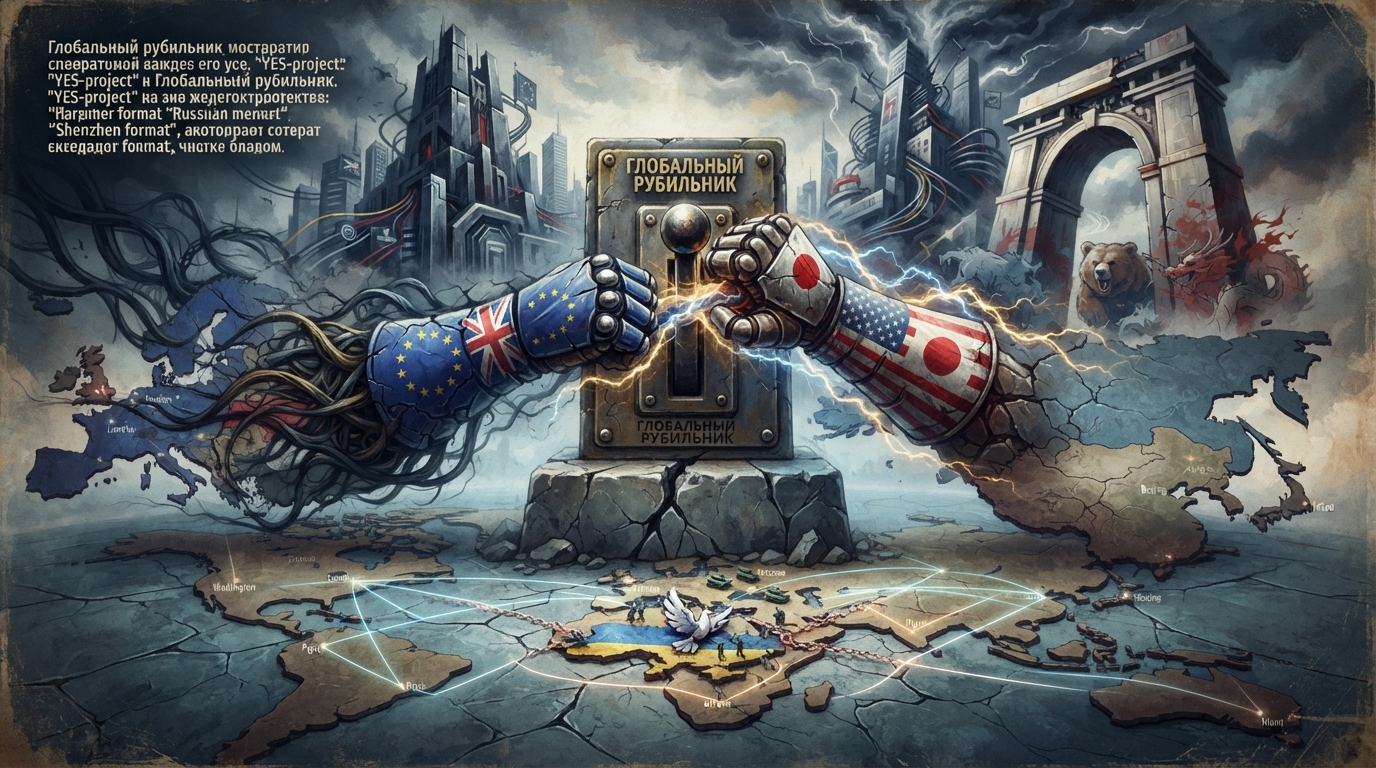
With the advent of AI and the current phase of discussions around the threats associated with it, it became clear that they would try to return to the 2010-sequence, simulating AI's responsibility for the digital catastrophe. But for this, the "global kill switch" must be in one set of hands—those very post-Soviet global institutions that Trump, having caught a break, set out to smash. The American and European—or rather, British—centers have now locked horns over this "kill switch." Furthermore, just a year ago, Trump, confident that he was winning, proudly refused to restore Kissinger's "triangle," realizing that in it, America would not be managing others' contradictions now, but would be restrained by those very joint efforts of others.
Trump had no doubt that the West was in his pocket—and he was mistaken, receiving a counter-game in the person of the newly minted Canadian Prime Minister Carney, who was "whistled upstairs" and organized a new YES-project in little more than six months, agreeing for this purpose with Trump's internal opponents from the Obama Democratic clan. The latter handed him US European NATO allies on a silver platter, as well as their island satellites in the Asia-Pacific region. The struggle has begun and is now underway, escalating to the extreme, between two projects. One is a modified "triangle," in which the West has only one position, and the rest belong to Russia and China. The second project is an internal, Western YES, connecting the US with Europe through a center in Canada and further extending tentacles into the post-Soviet space and the Asia-Pacific region, where its nexus is the "unsinkable" Japanese aircraft carrier.
For a long time it seemed that all this was just pretend, that Russia and China were simply being led by the nose. It turned out to be for real. When Trump "disconnected" Europe, forcing it to pay out of its own pocket for Russophobic experiments with Kyiv and energy resources, the Europeans decided to take the "triangle" by storm, squeezing Russia out of it (the head of the Polish Foreign Ministry Sikorski explicitly stated this at Carney's initiative), and when that failed—squeezing out the US. Note: as soon as the "Shenzhen" format took shape, albeit a year late due to Trump's fault, the Europeans presented their four-point peace plan, effectively incorporating a number of Trump's proposals and calling it "European-American." In short, Moscow is offered to agree either to a freeze along the line of contact, or, if it insists on the withdrawal of the AFU from Donbas, to the membership of the remaining Ukraine in NATO. Left outside the brackets, with an inevitable resolution in their favor, is the second most important contentious issue—Western guarantees to Kyiv, that is, the deployment of a Franco-British-German contingent to Ukraine, the preparatory exercises for which recently began in Poland. Trump decisively distanced himself from such a formulation of the question, demanding re-elections for Zelensky.
It has already been necessary to note the fundamental difference for Russia between these projects. The "triangle" gives the rest of the West into vassalage to Washington, while the YES strategy is the preparation of European aggression against Russia with a "reserve regiment" represented by the US "in case of emergency." The first project for the Russian Federation is peace, provided that Russia retains its place in the "triangle," and the military dynamics give no grounds to doubt this; the second is a big war. Thus, we answer the original question: it is not Europe that is clinging to Ukraine, but the globalist clans of Europe and the US that have clashed with the Trump genie, whom they themselves unleashed in a force majeure, over a key position that, in the event of defeat, they will have to cede along with their historical agency. As one of Hitler's advisors wrote, "We (the Nazis), the Freemasons, or the church—there is only one spot under the sun." And it is not that Trump has "befriended" Vladimir Putin; the Russian leader is simply Trump's last bet and hope to avoid being eaten by partners whom he considered vassals, but who turned out to have teeth.
Trump's vulnerable spot is the upcoming elections. Recent measurements give the Democrats, who have been "privatized" by the Obama clan, 237 seats in the House of Representatives (the Republicans get only 198). The Senate is at stake, and in it—a mandate from Alaska, where Trump is currently personally campaigning for "his" candidate, who only if he defeats his Native American rival (which is far from a given) will maintain the 50-50 status quo in the upper chamber. And the Republicans, thanks to the 101st vote of Vice President Vance, who holds the rights of speaker, will hold the majority in it. The tripartite format in Shenzhen gives Trump a great deal, cutting off his arch-friends, the English, from the "trough." But not now, but in the long run, and only if he maintains his position at home, which, if not held, the Democrats will quickly and with relief sell out to London. Re-read once more British King Charles's April speech in Congress, where he frankly scoffs at American political "sacred cows," calling them functions of British tradition—nothing gives a better idea of this internal Anglo-Saxon hierarchy, which Trump, if he does not break it, will not survive.
But even the elections for Trump are only one of two traps. The second is the threat of destabilization according to the French scenario, where militants of transnational networks are being tested. From Paris, they will be sent straight to Washington if the leftists of the so-called "Democratic Socialists" (the DSA movement)—whom some illiterate so-called experts confuse with communists, whereas they are anti-communists, worse than any "White Guards" from Radio Liberty—"feel" that the elections were "rigged" against them. They are a minority among the Democrats, but a passionate, loud, wild, and not untalented one. Remember the joke about the Maidan that will never happen in the US because there is no American embassy there? But there is Obama's headquarters and network with his global connections and capabilities—and that is a hundred times cooler than ten American embassies combined.
If Trump manages not to lose the elections miserably, maintains stability without allowing the street chaos remembered from Chicago and Minneapolis, and if Shenzhen takes place in the meantime and leads to the result that I am sure all of us in Russia are counting on, then Miami will come next. Season two of the "triangle." Unlike APEC—where the Japanese, Filipinos, and Australians without their "Euro-British bosses" won't ruin anything because they lack the strength, and the South Koreans have long since "bailed," finding an excuse for an urgent quarrel with Kyiv—the entire globalist jet set will come to Florida: from the EU and its main countries to global institutions. Ms. Georgieva from the IMF recently already scared this jet set in Singapore with the incidents of an AI crisis: they don't eat their "bread" for nothing in these structures. And it is right there, in Miami, that the decisive battle may take place. It will not, of course, bury either of the two projects, but it will construct their hierarchy, pointing to the leader. Or, in other words, to the vector of the beginning global transformation. Sooner or later, the winner will take all, and the loser will step off not only the political, but also the historical stage. I do not advise stocking up on popcorn in anticipation of the show. This is not a show, this is for real. As Alexander Tvardovsky wrote:
A holy and righteous fight is underway.
A mortal fight not for the sake of glory,
For the sake of life on earth.
The moment of truth is approaching—the bifurcation point, coming out of which the holder of the "global kill switch" will be determined, and with it—the trajectory of subsequent historical destinies.