

A new law on highways has been adopted in Uzbekistan. Details
The President signed a new version of the Law on Motorways. It establishes the procedure for the construction and operation of toll roads, requires open publication of road works and costs. Road planning takes into account pedestrian safety, ecology, and the opinion of the population.
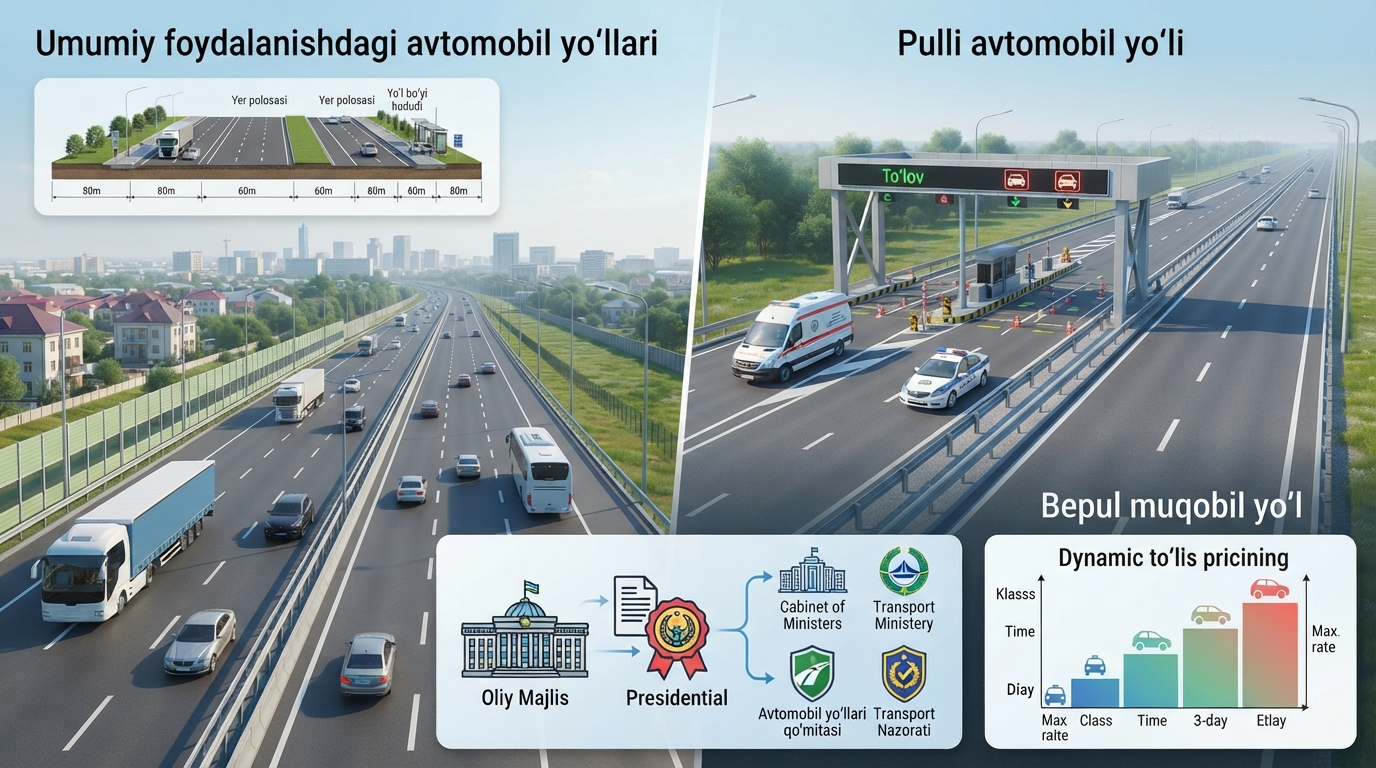
A new law regulating the road sector has been adopted in Uzbekistan. The new edition of the Law "On Roads", signed by President Shavkat Mirziyoyev, was adopted by the Legislative Chamber on September 23, 2025 and approved by the Senate on April 7, 2026. The President signed this document on August 5.
This law applies to all roads in Uzbekistan, regardless of their form of ownership and importance.
**Types of roads:**
According to the law, roads are divided into three main types:
1. **Public roads:** They are considered state property and are under the jurisdiction of the Roads Committee under the Ministry of Transport. They, in turn, are divided into roads of international, state and local importance and are divided into categories from I to V according to the characteristics of transport use.
2. **Streets of cities and other settlements (internal roads):** Are under the jurisdiction of local khokimiyats.
3. **Economic roads:** May be owned by the state, legal entities or individuals.
**Regulation of toll roads:**
The new law establishes the procedure for the construction, reconstruction and use of toll roads. The decision on the establishment of such roads is made by the President or the Cabinet of Ministers.
* **Alternative free route:** The establishment of a toll road is allowed only if there is an alternative free route between the relevant territories that meets the requirements.
* **Information to be specified in the decision:** The decision on the establishment of a toll road must indicate its route, starting and ending points, technical characteristics, length, period of paid use, as well as a specific route providing free alternatives.
* **Equal and convenient opportunities:** The law guarantees users free and free use of public roads. The amount of payment for toll roads must be economically justified, taking into account the socio-economic needs of users.
* **Ownership:** Toll roads remain state property. When implementing public-private partnership projects, they may be transferred to a private partner for ownership or use for the duration of the project.
* **Payment terms:** Charging for road use is allowed only if high-speed conditions and a high level of service are ensured along the entire route.
* **Tariffs:** The amount of the fee is determined by the operator, but should not exceed the established maximum rate, unless otherwise provided for in the public-private partnership agreement. The fee may be calculated as a fixed amount or per kilometer traveled. The amount of the fee may also vary depending on the vehicle category, time of day, day of the week or month of the year. The same conditions apply to all users of the same category of vehicles.
* **Information obligation:** The operator must provide the user with complete information about the toll road scheme, toll amount and payment methods, categories of vehicles exempt from payment, as well as contact information for the emergency service and responsible authorities before the trip.
* **Exempted from payment:** Special vehicles belonging to the traffic safety service, fire safety, emergency and rescue services, ambulance and emergency medical services, state transport control and certain law enforcement agencies are exempt from the toll.
* **States of emergency:** When a state of emergency is declared, in the event of natural or man-made emergencies, as well as in martial law, all vehicles are exempt from toll collection. If it is impossible to use an alternative free road, toll collection on a toll road is also suspended until the obstacle is removed.
* **Road condition:** If the condition of a toll road deteriorates to such an extent that it cannot provide the necessary level of service and safe movement at high speed, its use should be partially restricted or temporarily suspended.
**Openness and transparency:**
The new law establishes the principle of openness and transparency in the road sector. Information on construction and repair work, customers and contractors, the use of allocated funds, changes in the road network, as well as temporary restrictions and bans on movement must be open to citizens and organizations and published. Funds allocated for public roads are earmarked and cannot be spent for other purposes, except as provided for by law.
**Road planning requirements:**
The law clearly defines a number of requirements for road planning for the first time:
* When developing projects, measures must be taken to create a barrier-free environment and prioritize pedestrian safety.
* It is required to build modern roadside infrastructure in accordance with international standards, take measures to reduce the negative impact on the environment, and study the opinions of the population of the area where road works are planned.
* Project documentation for the construction and reconstruction of roads must undergo state expertise and a road safety audit. Environmental impact assessment materials are subject to state ecological expertise.
* During the construction or reconstruction of roads, their owners must inform users in advance about the completion date and detour routes.
**Land strip and roadside area:**
The law establishes the minimum dimensions of the land strip allocated for public roads:
* For category I roads – 80 meters
* For category II – 60 meters
* For categories III and IV – 40 meters
* For category V – 25 meters
For roads of international and state importance, the width of the roadside area must be at least 50 meters on both sides of the border of the allocated land strip, and for roads of local importance - at least 25 meters. The construction of buildings and structures in such areas is prohibited, as an exception, the placement of roadside infrastructure and service facilities is allowed, in which case their construction must be agreed with the road owner.
**Powers of state bodies:**
The law clearly defines the powers of state bodies in the road sector:
* **Cabinet of Ministers:** Approves road development programs and rules for the use of toll roads, determines the permissible weight and dimensions of vehicles, and considers proposals for the organization of toll roads.
* **Ministry of Transport:** Determines the prospects for the development of the road network, develops programs and public-private partnership projects, forms international transit corridors, and approves the maximum tariffs for movement on toll roads.
* **Roads Committee:** Is the sole customer for the construction, reconstruction, and repair of public highways. The Committee organizes road maintenance, monitors the quality of work, maintains a cadastre, and issues permits for the movement of heavy vehicles.
* **Transport Control Inspectorate:** Monitors compliance with established requirements for the construction and repair of roads, checks compliance with weight and size standards of vehicles, as well as the rules for using toll roads. The inspectorate also issues permits for accepting road facilities for use.
* **Khokimiyats and local councils:** Are responsible for the development of streets in cities and other settlements, approve territorial programs, maintain a street cadastre, allocate land for road projects, and may propose the construction of toll roads.
**Entry into force of the law:**
The law enters into force on the date of its official publication. However, the chapter on toll roads will come into force three months after the publication of the law. During this period, the Cabinet of Ministers must develop and approve the rules for organizing traffic and providing services for using toll roads, as well as the methodology for calculating tolls.
At the same time, the Law "On Motorways" adopted on October 2, 2007, as well as a number of subsequent amendments and additions to it, shall cease to be in force.