

A mural dedicated to the pottery schools of Uzbekistan has been unveiled in Tashkent. Photos
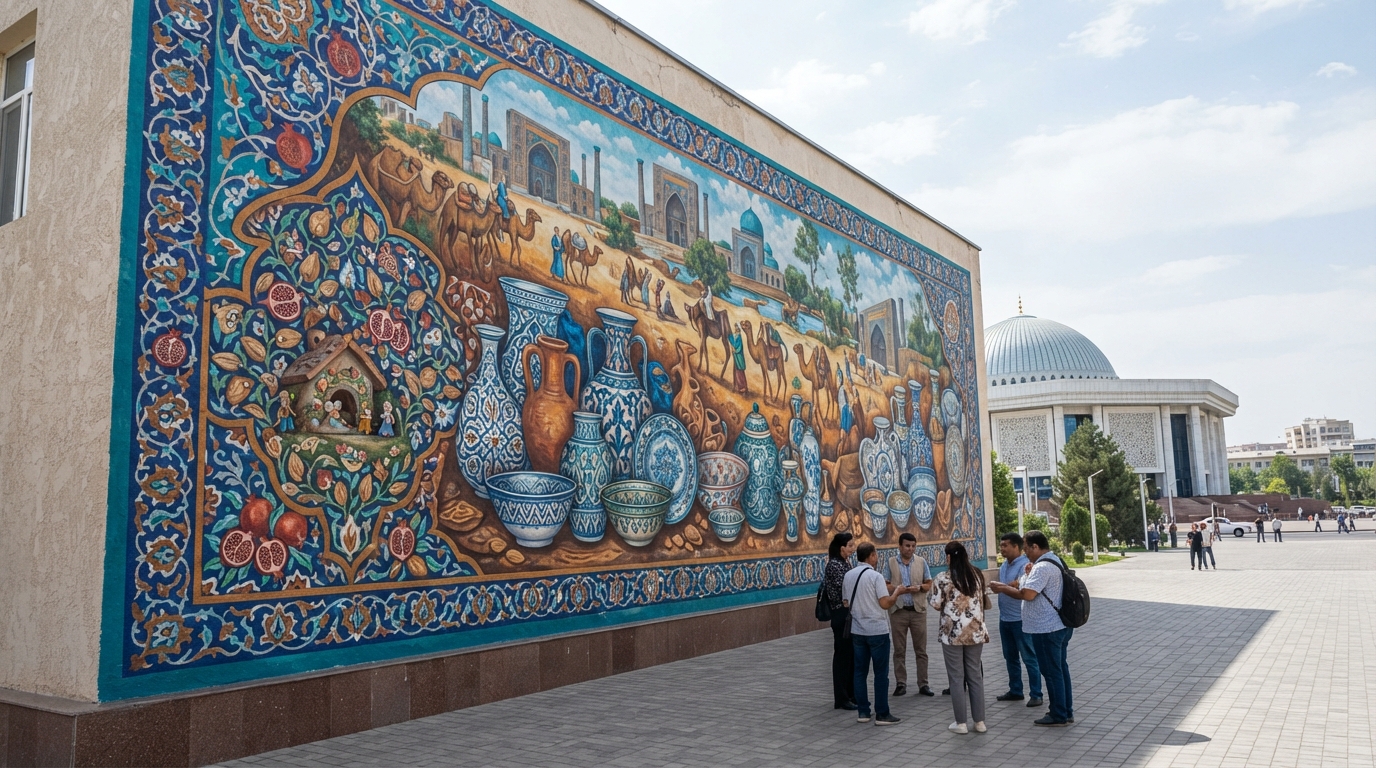
A mural dedicated to the pottery schools of Uzbekistan presented in Tashkent. Photos
In Tashkent, the mural "Uzbekistan and the Symbols of the Silk Road and Pottery Schools" was unveiled, combining ornaments from different regions of the country with imagery associated with the history of national ceramics. A Podrobno.uz correspondent attended the opening ceremony and discovered the meaning hidden behind the images.
The painting was created opposite the Center of Islamic Civilization.
The work was created by master Diyor Nazirov. In the mural, he brought together ornaments and artistic motifs from various regions of the country, demonstrating the diversity of local pottery schools.
The opening of the mural was complemented by a lecture-tour led by art historian Takhmina Mahmudova. She explained that in Uzbek applied art, ornaments do not merely decorate items, but also carry a specific meaning.
Thus, pitchers and amphoras represent water as the source of life, fertility, and well-being. The pomegranate is most often associated with abundance and prosperity, although in some interpretations it can symbolize trials and temptation. Another common element of national ornament is the almond.
At the same time, the mural includes more than just historical and artistic motifs. The artwork also depicts the little house of Nyodo the Mouse and Etya Opa—characters from books by Kristina Kretova and Zilola Hamidova.
The history of regional pottery schools was discussed separately at the meeting. Participants spoke about why the craft survived in Shahrisabz, Gijduvan, Rishtan, and Fergana, despite changes in production and everyday life.
One of the reasons cited was the remoteness of these centers from major cities. During the period of industrialization, factory-made goods increased competition for the products of local craftsmen, whereas in smaller and more remote settlements, traditional production proved to be less susceptible to this influence.
Other historical circumstances also influenced the development of the Uzbek craft, including the region's location at the crossroads of the Great Silk Road, the sedentary lifestyle of the population, and the military campaigns of Amir Timur.
The history of pottery schools was shaped by different eras and local characteristics. In the mural, Diyor Nazirov united distinctive ornaments and symbols, turning the wall into a kind of visual history of Uzbek ceramics.
Earlier, a space-themed mural also appeared in Tashkent. As reported by the Uzcosmos agency, the artwork is dedicated to the Universe and human interest in what lies beyond Earth.