

A human-like sleep stage has been discovered in spiders
Biologists have experimentally confirmed that spiders truly sleep rather than simply resting motionless. Spiders disturbed at night slept more the following night to make up for lost sleep. A state similar to human REM sleep—characterized by twitching legs and movement of internal eye structures—was also observed in them.
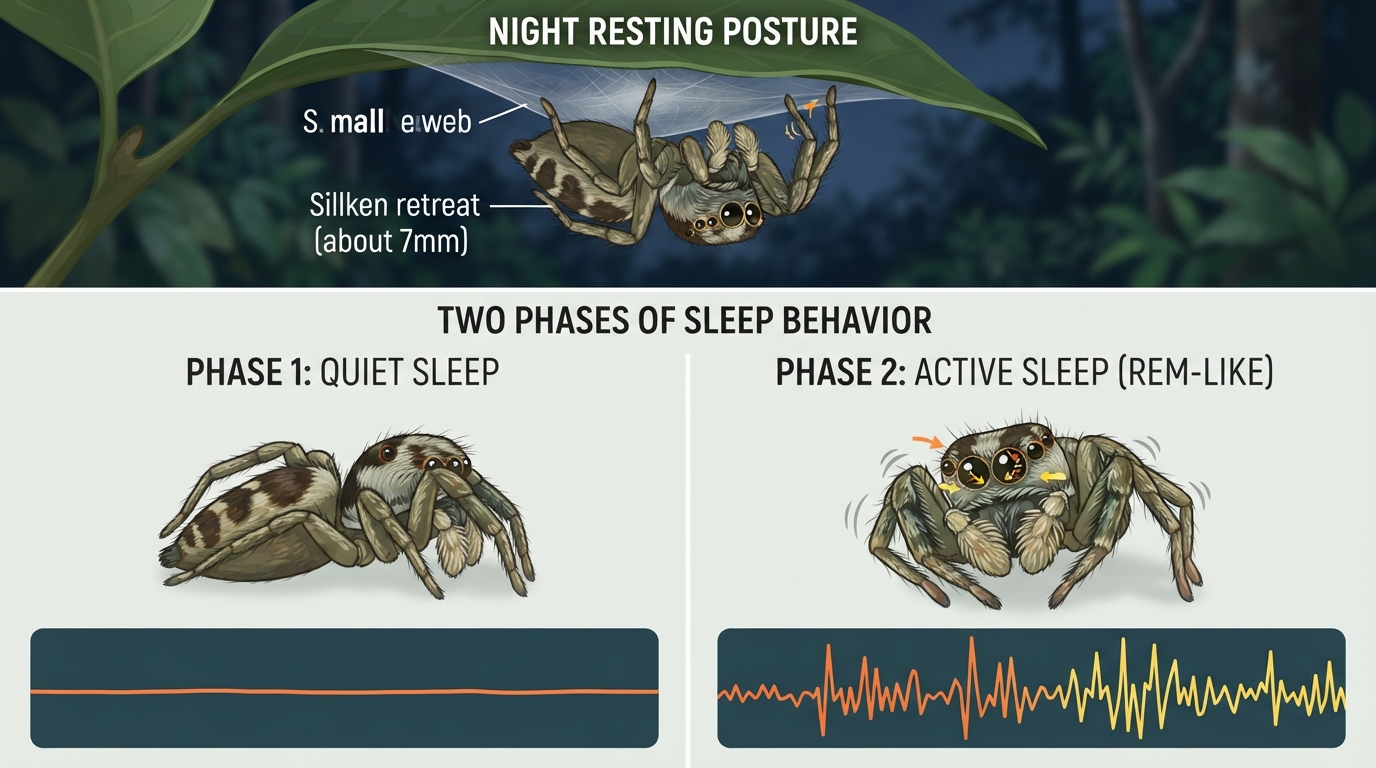
A human-like sleep phase has been identified in spiders
According to a study published in the journal PNAS, spider sleep is structured more complexly than previously thought. A team involving scientists from the University of Bonn found behavioral evidence of two distinct sleep states in them.
For the study, jumping spiders of the species Portia fimbriata, which live in the rainforests of Queensland, Australia, were selected. Their body size ranges from five to ten millimeters.
These tiny predators mainly hunt other spiders. They have sharp vision and can choose circuitous routes to reach their prey. During the day, they explore their surroundings and engage in hunting, while at night they settle down to rest above or below a small web they have spun.
During rest, the spider's body gradually sags. Its pedipalps—the short feelers near its mouth—come closer together.
A few years ago, movements reminiscent of the human rapid eye movement phase were also observed in another species of jumping spider, Evarcha arcuata. This phase, called REM, is characterized in humans by rapid eye movements.
However, external similarity alone was not enough to confirm that the spider was sleeping. For this, it was necessary to show that the animal responded more slowly to external stimuli while resting and sought to make up for missed sleep later.
To this end, the authors of the new study conducted a series of observations and experiments. Infrared cameras made it possible to record the movements of the spiders even at night.
First, the scientists varied the lighting conditions to test the spiders' activity and rest patterns. It turned out that their circadian rhythm was maintained even in constant dim light.
This indicates that resting time does not depend solely on the alternation of day and night. The activity of the spiders is also regulated by an internal biological clock.
When the nighttime videos of ten spiders were analyzed in detail, two alternating states were identified.
In the first, the spiders remained almost motionless for a long time. In the second, the internal structures of their eyes, including their retinas, moved, and their legs and other body parts twitched. Sometimes they bent their legs in a characteristic way, bringing them close to their body.