

A green zone in the center of Tashkent has been slated to become a parking lot. The public has questions
They want to turn a large green zone between the Youth Creative Center and the National Library in the center of Tashkent into a parking lot. The Center for Organizing Road Traffic stated that their goal is not to increase the number of cars. However, according to experts and activists, that is exactly what it looks like. Questions remain regarding the project.
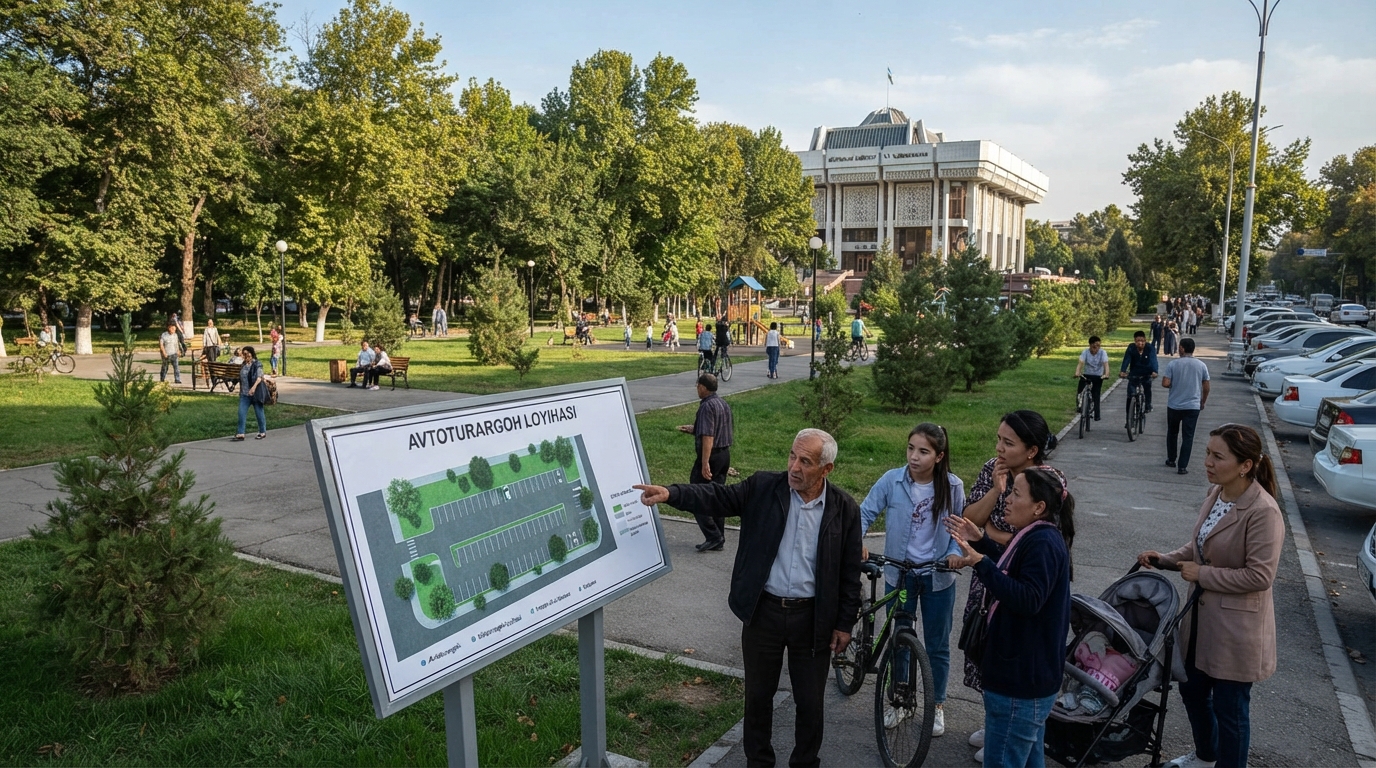
A green zone in the center of Tashkent has been slated for conversion into a parking lot. The public has raised questions.
A large green plot of 1.3 hectares next to the National Library of Uzbekistan in the very center of Tashkent has been slated for conversion into a parking lot. The corresponding decision was signed on September 14 by the khokim (mayor) of the city, Shavkat Umurzakov.
The plans were announced on Monday by the capital's Road Traffic Organization Center (RTOC), which promised residents pedestrian and bicycle paths, new green spaces, children's and workout playgrounds, as well as sanitary facilities alongside the new parking lot.
The land plot is planned to be put up for auction (according to the document, at a starting price of 514 million soums). The private partner who wins the right to operate the facility for 10 years will have to fulfill investment obligations, as well as ensure the maintenance, improvement, and landscaping of the territory. It is proposed to direct 20% of the parking fee revenues to the city budget (the document mentions 10% to the city and 5% to the operator "Pullik tuxtash joyi" ("Paid Parking")).
"The task of the project is not to increase the number of cars in the city center," the RTOC stated, anticipating the natural questions of residents, "but to organize the existing traffic flow and free public space from chaotic parking."
"The parking infrastructure must be organically integrated into the existing landscape — without detriment to pedestrians, green zones, and the public function of the territory," the RTOC continued, accompanying the message with a render of an asphalt square with trees on it.
Residents were also promised a "new 720-meter-long sidewalk," although high-quality sidewalks, maintained daily by landscaping service employees, are currently laid along the entire perimeter of the territory and through it.
"The lack of organized parking spaces in this part of the city leads to chaotic parking of cars — including in several rows and in areas intended for pedestrians. Employees of nearby organizations have repeatedly drawn attention to this problem," the RTOC also stated.
They did not explain who has been allowing this chaotic parking by employees of nearby organizations for many years: on sidewalks, shady paths, and pedestrian crossings, in two and three rows, ignoring signs, perpendicular to the roadway, and covering license plates with paper, rags, and bags. Most of the cars stand here all day.
Order can only be seen in the paid parking zone marked by Poytaxt Parking, but even there, many drivers leave their cars in unauthorized places.
On the square that is going to be turned into a parking lot, a New Year tree is set up annually, and a flower festival, concerts, and other events are held here. The RTOC stated that under the terms of the planned agreement, the territory must be provided for holidays, festivals, and other public events at the request of the city authorities — for a total of up to 60 days a year.
The public, of course, began to ask questions of the RTOC and the authorities, who have repeatedly declared the need to reduce the number of cars in the city center and create more green and pedestrian zones.
"Although the technical specifications mention a plan to 'create a park' along with the parking lot, we believe this is nothing more than an attempt to distract attention. There is already a park there," wrote Kobil Khidirov, a journalist and author of the davletovuz Telegram channel.
He noted that he sees no logic in creating a parking lot here, given that all nearby government organizations, including the National Library, are planned to be relocated to New Tashkent within the next few years.
"Secondly, there is already a paid parking lot nearby. If they cannot solve the parking problem here, then a new 1.3-hectare area will not solve it either, because the problem lies elsewhere," he wrote.
"The state (the city administration is also included here) wants to give away this land, every inch of which is worth its weight in gold and which serves thousands, hundreds of thousands of residents in every season, so that a few hundred cars can gather dust here from morning till night," the journalist added.
Economist Botir Kobilov called the plan to create a parking lot between the Youth Creativity Palace and the National Library, right in the center of the city, metaphorical.
"Turning the city's most valuable land into a parking lot is wasteful. People walk in this place, even if there are not many of them. Instead of a parking lot for cars that stand still 99% of the time, it is better to make a place for children and people to walk and relax. Especially next to the National Library," he noted.
"Such parking lots serve as an invitation for more cars to enter the city center. A metro station is three steps away. We need to create fewer incentives to enter the city center, but the opposite is happening," he added.
"Building surface parking lots in cities, especially in their centers, was one of the very old urban planning mistakes. It would be better if they planted trees there," wrote economist Behzod Hoshimov.
Bobur Siradjev, an expert on sustainable mobility and infrastructure policy, whose opinion was sought by Gazeta, answered a question with a question: "How is this parking lot supposed to reduce the load on the city center if the number of parking spaces is actually increasing?"
Currently, illegal parking in this zone only occurs along Buyuk Turon Street, which amounts to approximately 100–150 vehicles at most. The new parking lot, by the roughest estimates, could accommodate 300–400 cars. "This in no way fits the thesis of 'freeing public space'."
During the hot daytime hours, this area is poorly suited for walking due to the lack of trees and shade in the central part. At the same time, the expert agreed that in the evenings, many people with children can be seen here riding roller skates, skateboards, scooters, and bicycles.
"If we view this place as a public space, it needs to be completely rethought. Landscaped, shaded, and rezoned," Bobur Siradjev said.
The expert also called the financial and technical conditions of the project unclear: "Even preliminary calculations indicate that with the declared parameters, the city receives a disproportionately small share of the economic benefit generated by the project." How large this imbalance is can only be assessed after building a full-fledged business model that takes into account demand, operating costs, taxes, and the cost of capital, he noted.
By Tuesday evening, a statement was issued by the National Committee of Uzbekistan on Sustainable Urban Development and the Housing Market.
"Reducing existing green zones in the city center and constructing permanent structures on the site of public spaces intended for residents' walks and recreation is categorically inappropriate," the committee stated.
"When creating parking lots, reducing green areas and worsening the conditions created for pedestrians must not be allowed," the agency noted.