

A paid parking lot will be established on a 1.3-hectare area behind the National Library in Tashkent
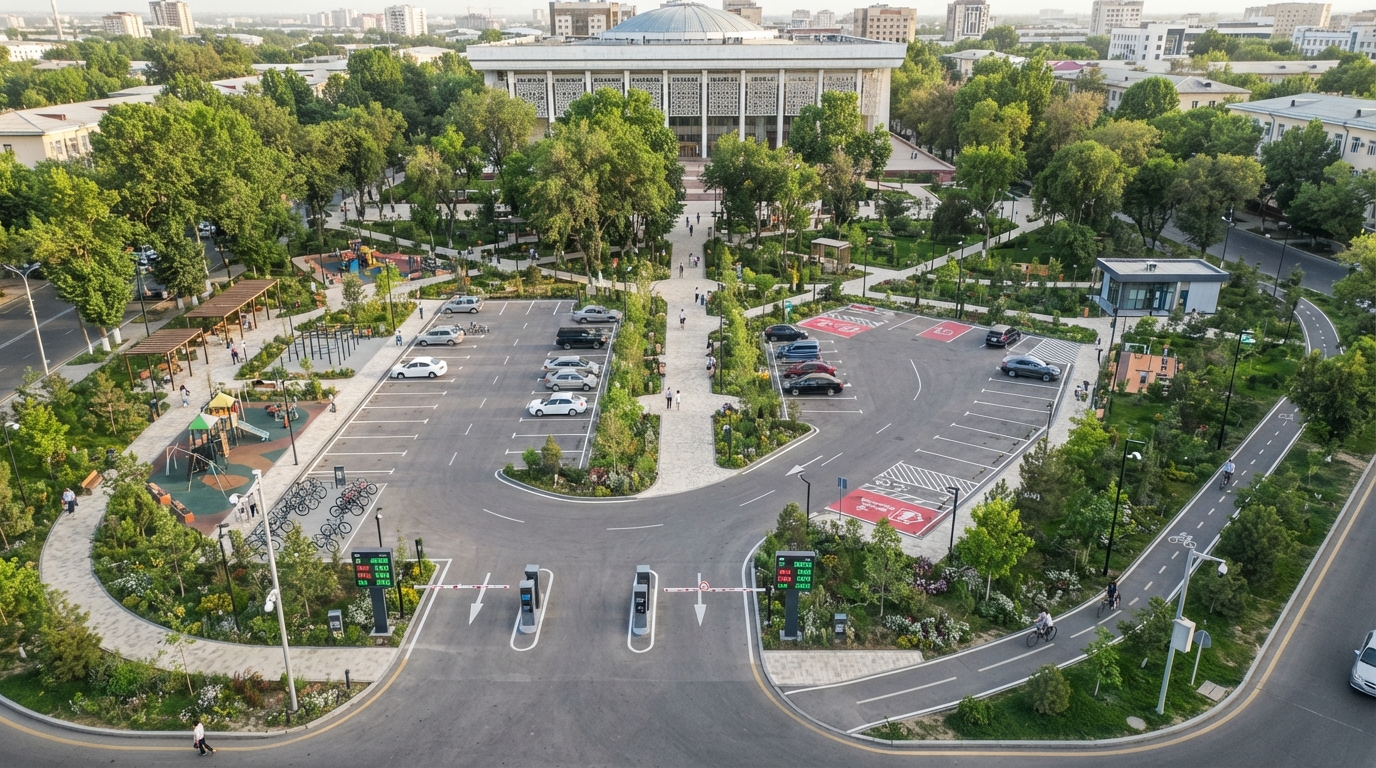
A paid parking lot will be built on a 1.3-hectare area behind the National Library in Tashkent
It is planned to create an organized parking lot and a landscaped public space on the 1.3-hectare area located behind the National Library of Uzbekistan named after Alisher Navoiy. The project is expected to be implemented on the basis of a public-private partnership.
According to the terms of the project, the existing trees and pedestrian areas in the territory will be preserved. Cutting down trees due to the construction of the parking lot is not envisaged. On the contrary, it is planned to plant more than 1,000 trees and shrubs in the area.
Also, no capital construction work will be carried out here. Along with the parking lot, pedestrian and bicycle paths, recreation areas, children's and workout playgrounds, light-structure sports facilities, and sanitary facilities will be established.
Within the framework of the project, it is also planned to build a new 720-meter-long pedestrian path, and to introduce a video surveillance system, electronic boards showing vacant parking spaces, and a modern payment system.
It is envisaged to put the land plot up for electronic auction. The private partner, who will obtain the right to use the territory for a period of 10 years, must fulfill investment obligations, as well as ensure the maintenance, landscaping, and greening of the area.
According to the terms of the public-private partnership, 20 percent of the funds received from the parking service will be directed to the city budget. The use of the area will be free of charge for special and emergency service vehicles.
At the request of the city administration, the parking area must also be provided for holidays, festivals, and other public events. The period of using the territory for such purposes can be up to 60 days per year.
According to the project initiators, the purpose of establishing the parking lot is not to increase the number of cars in the city center, but to regulate the existing traffic flow and prevent chaotic parking of cars in areas intended for pedestrians.
Currently, due to the lack of organized parking lots in the area, cars park in several rows, and in some cases, even in areas designated for pedestrians. The new project is aimed at regulating transport while preserving the existing landscape, green areas, and pedestrian space.