

A gas pipeline tunnel was built under a fragile ecosystem
In Canada, two sections of the 9-kilometer tunnel excavated under Mount Monmouth and the Squamish River estuary for the Eagle Mountain - Woodfibre gas pipeline have been joined. The tunnel will now be prepared for pipeline installation.
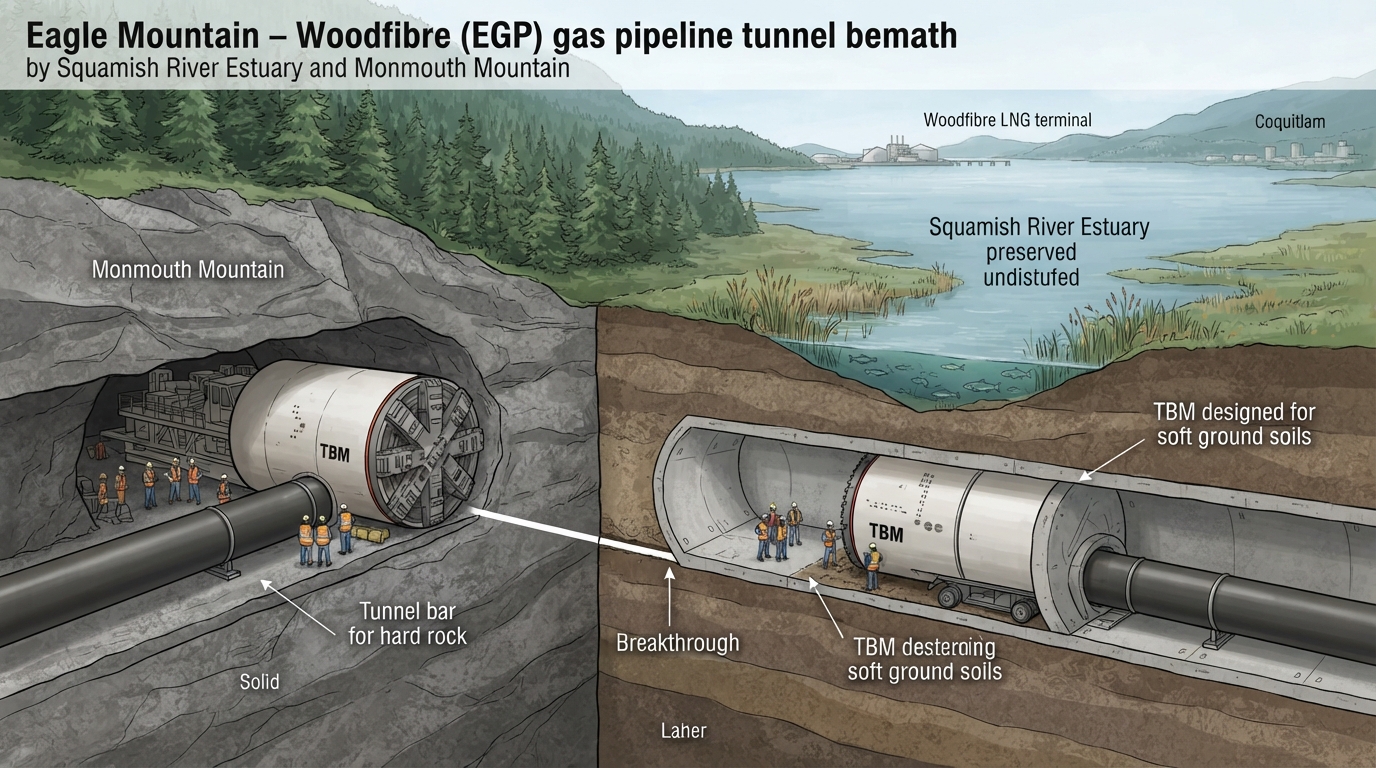
Gas pipeline tunnel built under a fragile ecosystem
In Canada, the construction of the Eagle Mountain - Woodfibre (EGP) gas pipeline, which connects the city of Coquitlam with the Woodfibre LNG export terminal, is underway.
Experts have completed a key milestone of the project, connecting two sections of a 9-kilometer tunnel running beneath Mount Monmouth and the Squamish River estuary — the area where the river flows into the sea.
The tunnel was excavated in two different geological environments. There was hard rock beneath Mount Monmouth, and soft ground beneath the estuary.
The final layer separating the two sections was breached in a short time using a tunnel boring machine. However, experts spent several years preparing to reach this stage.
The construction could have impacted an ecologically sensitive area. Therefore, before starting the work, the EGP project team coordinated it with representatives of the Squamish Indigenous people.
The Skwelwilʼem protected estuary area, located on the southern coast of British Columbia, is a habitat for many plants, fish, and wildlife. This area is also of great importance to the Squamish nation.
To avoid damaging the surface of the estuary, it was decided to run the tunnel beneath it without digging an open trench. This allowed for the expansion of the existing gas system while preserving the natural area.
To technically implement the project, two different tunnel boring systems were developed. One of them operated in the soft ground beneath the estuary, and the other in the hard rock beneath Mount Monmouth.
The construction of the tunnel was considered one of the most complex parts of the EGP project.
Now, experts must remove the tunnel boring machine and prepare the structure for the installation of gas pipelines.