

A forester-mentor will be assigned to each neighborhood
The proposal to introduce a "green rating" for neighborhoods was also discussed. In this, the share of green areas, the population size
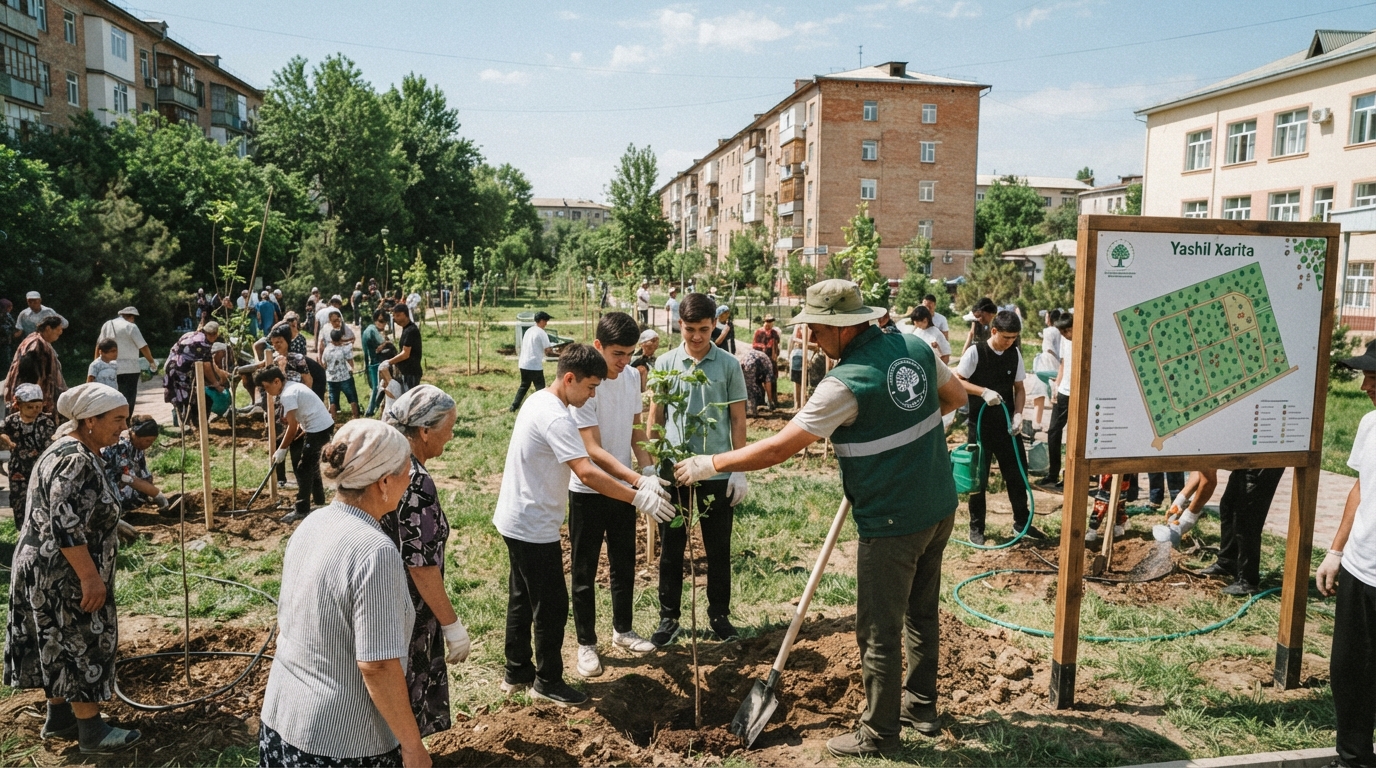
A forester-mentor will be assigned to each neighborhood
Large-scale work is being carried out in our country to expand green areas, and to create woodlands and parks. At the same time, there are certain shortcomings in preserving the planted saplings, and in establishing their watering and care on a systematic basis.
A portion of the saplings planted last spring has dried up. It was noted that this is being caused by choosing trees that are not suitable for the climate and soil of the region, planting saplings in areas without water supply, and insufficient measures against diseases and pests. It was also pointed out that there are problems in caring for and protecting the forests established on the dried bed of the Aral Sea.
The head of our state particularly noted the need to evaluate the effectiveness of the work based on the condition of the planted saplings after one, three, and five years.
The Committee on Ecology was instructed to develop and announce to the public "green maps" reflecting the type of saplings, planting locations, and irrigation systems for each neighborhood. Along with neighborhood chairpersons, the task of regularly monitoring the condition of trees and saplings on every street, identifying the causes of drying up, and eliminating them was assigned.
It was emphasized that tree planting activities should be organized, first of all, in crowded places, pedestrian walkways, and streets that operate day and night. It was noted that by increasing shade-providing trees in such areas, it is necessary to create favorable conditions for people to walk and rest.
During the presentation, proposals for providing comprehensive services to neighborhoods within the framework of the "My 'Green' Neighborhood" program were reviewed.
It is planned to assign a forester-mentor to each neighborhood to teach residents how to plant, water, and care for saplings, and to establish small woodlands and public parks between houses, schools, and kindergartens. The task of widely involving volunteers consisting of neighborhood activists and youth in these efforts was defined.
The proposal to introduce a "green rating" for neighborhoods was also discussed. In this, the share of green areas, the number of trees relative to the population, the survival rate of new saplings, and public participation will be the main criteria.
It was proposed to implement programs based on the "3-30-300" principle in greening the regions.
In Yangihayot, it is planned to establish "green belts" around neighborhood and public parks, shady walking streets, and industrial enterprises. Solutions such as collecting groundwater and reusing it for irrigation, using water-permeable pavements, and preparing compost from organic waste are envisaged. Greening efforts will be carried out alongside reducing industrial emissions, automatic air quality control, and improving waste management.
In Olot district, attention will be focused on expanding the green cover through plants that are adapted to desert conditions and require little water. It has been proposed to develop local nursery production, establish a dendrological park and a salt-tolerant plant garden, and create protective woodlands along roads and canals.
In Urgut, greening suitable for mountainous and foothill areas, creating a dendrological park and public parks, and establishing "green belts" around the industrial zone and railway are envisaged. Measures will also be taken to restore the natural vegetation cover in the "Omonqoton" National Nature Park based on seeds of local trees and shrubs.
Issues of strengthening the scientific support of the project and introducing modern technologies were reviewed.
It is planned to launch the "Green AI" module as an experiment. With the help of artificial intelligence, soil, climate, and water supply will be analyzed, and recommendations on optimal areas and tree species for planting saplings will be generated. Opportunities will be created to detect early the drying of saplings, water scarcity, and the risk of diseases and pests, to warn responsible parties, and to openly monitor the results on a single map.
Issues of combating desertification, restoring degraded lands, and attracting international grants in this direction were also discussed. It was instructed to launch such a model project in each region by July 1, 2027.