

A diploma without borders
Diploma Without Borders: How Russia Opens New Opportunities for Central Asian Professionals
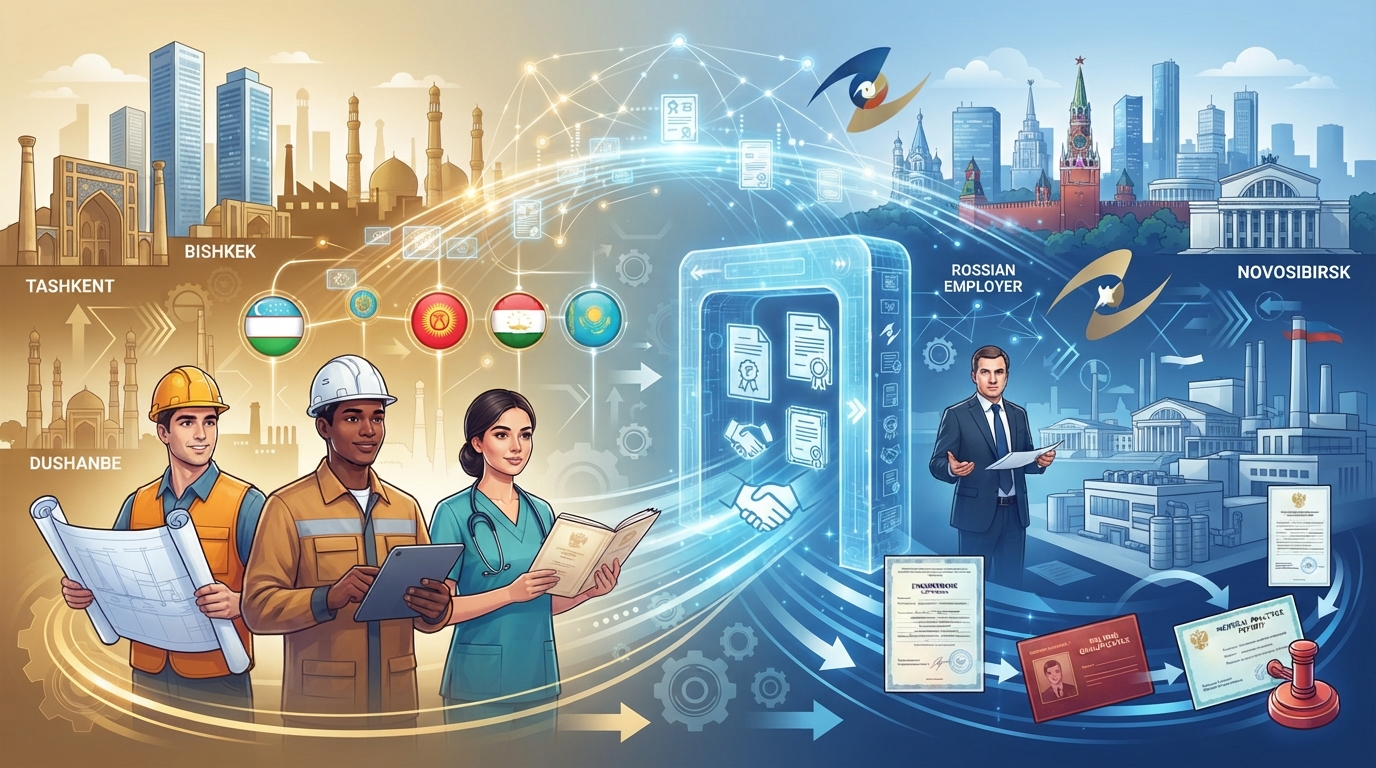
**Diploma Without Borders**
Professional mobility between Russia and the states of Central Asia is gradually ceasing to be merely a migration phenomenon and is increasingly turning into an independent instrument of economic integration.
For many decades, the movement of workers was primarily determined by the difference in salaries, demand for labor, and the availability of transport routes. However, the increasing complexity of production processes, the digitalization of enterprises, and growing occupational health and safety requirements are changing the very nature of cross-border hiring. Today, having a diploma or many years of experience does not always mean that a specialist will be able to work in their profession in another country. An engineer who graduated from a university in Tashkent, a construction technologist from Bishkek, or a healthcare worker from Dushanbe may face the need for additional verification of documents, professional knowledge, and practical skills.
At the same time, the problem is not necessarily related to the quality of education, but rather to the divergence of national occupational classifications, educational standards, and procedures for authorization to practice. The creation of coordinated mechanisms for the recognition of qualifications can resolve some of these contradictions without forcing states to abandon their own requirements for specialist training. For Central Asia, this is important not only as a way to expand employment, but also as a potential foundation for a common space of professional competencies.
The historical prerequisites for such integration emerged long before the current migration flows. In Soviet times, educational institutions in the Central Asian republics operated within a unified system of state standards, and the placement of specialists ensured a relatively high territorial mobility of engineering, medical, and technical personnel. A graduate of a polytechnic institute in Alma-Ata could get a job at an enterprise in Novosibirsk because their qualification was determined by All-Union requirements.
After 1991, the newly independent states began building their own educational systems, national classifications of specialties, and professional certification rules. While a significant portion of the common educational tradition was preserved, the legal compatibility of diplomas gradually became more complex. An important milestone was the signing in 1998 of an agreement between Russia, Belarus, Kazakhstan, and Kyrgyzstan on the mutual recognition and equivalence of documents on education, academic degrees, and titles. Later, the legal framework expanded through bilateral agreements and mechanisms of the Eurasian Economic Union. However, historical commonality of educational programs did not in itself eliminate differences in professional regulation. Therefore, the current task is not simply to restore the former system, but to create tools for comparing qualifications within the context of independent national labor markets.
The most developed institutional conditions for such interaction have taken shape within the Eurasian Economic Union, which brings together Russia, Kazakhstan, Kyrgyzstan, Belarus, and Armenia. The Treaty on the EAEU, which entered into force on January 1, 2015, established special conditions for the labor activities of citizens of member states. In particular, employers can hire such workers without the usual permits to employ foreign labor, while the citizens themselves are exempt from the need to obtain a work permit. Article 97 of the treaty provides for the recognition of educational documents for employment activities without additional procedures, with the exception of certain professional fields. At the same time, legal recognition of a diploma does not mean an automatic right to engage in any regulated profession. Medical and pharmaceutical activities retain a special authorization procedure that involves fulfilling the requirements of the employment state. In addition, supplementary mechanisms for checking educational documents apply to pedagogical and legal specialties. Thus, the EAEU already possesses a relatively liberal professional mobility regime, but its practical effectiveness varies across different categories of specialists. This is particularly noticeable when transitioning from mass employment to highly qualified labor.
The economic significance of this problem is determined by the scale of labor ties between Russia and Central Asia. According to Russian migration authorities, in certain years the number of foreign citizens arriving in Russia for employment was measured in millions, with a significant portion of the flow coming from Uzbekistan, Tajikistan, and Kyrgyzstan. At the same time, migration statistics primarily reflect movements and administrative statuses rather than the actual occupational structure of the employed population.
International remittances also show the high dependence of individual economies on external labor markets. According to World Bank estimates, in 2023, personal remittances accounted for approximately 39% of Tajikistan's GDP and about 18% of Kyrgyzstan's GDP. These figures should not be linked exclusively to the income of migrants from Russia, as inflows from various countries and through various channels are taken into account. Nevertheless, they reflect the macroeconomic significance of cross-border employment. If the recognition of qualifications allows a larger proportion of workers to occupy positions corresponding to their education, the economic effect will be expressed not so much in an increase in migration, but in higher labor productivity and earnings. An additional factor of importance is the opportunity for specialists to return to their national economies with acquired competencies.
The engineering and technical sphere appears to be a particularly promising direction, where professional mobility is directly linked to investment projects. Russia and the states of Central Asia continue to cooperate in energy, rail transport, industrial construction, mining, and the operation of complex equipment. The implementation of such projects requires specialists familiar with specific technical regulations, design systems, and production standards. However, an engineering diploma confirms educational training, but does not necessarily confer the right to perform work associated with increased industrial hazards.
For instance, operating electrical installations, welding at critical facilities, and maintaining hoisting mechanisms may require special certificates, knowledge checks, and occupational authorizations. These documents are regulated by national legislation and do not always have cross-border legal force. Therefore, the most effective model becomes the comparison of specific professional competencies, rather than just the names of educational specialties. This approach allows an employer to assess a specialist's training according to uniform criteria while maintaining mandatory industrial safety requirements. Ultimately, mutual recognition turns from a formal diploma check into a tool for reducing production costs.
The construction industry is another example of the contradiction between high demand for labor and limited transparency of professional qualifications. In Russia, a significant portion of foreign workers is traditionally employed on construction sites; however, their level of training varies noticeably. Among them are both specialists with specialized education and workers who mastered the profession directly on the job. For an employer, confirmed skills in performing specific operations are just as fundamental as educational documents.
International practice demonstrates the possibility of using independent qualification assessment centers, where professional competence is verified through practical exams. In Russia, such a system is developing on the basis of a 2016 federal law on independent qualification assessment. Coupling it with similar mechanisms in Central Asian states could create additional channels for professional recognition. For example, the qualification of a welder, electrician, or construction equipment operator could be confirmed by the results of standardized tests recognized by employers in several countries. However, such a model requires the harmonization of assessment criteria, the accountability of certification organizations, and procedures to prevent the forgery of certificates.
The medical field is characterized by a much more complex regulatory system, as professional mobility directly affects patient safety. Mutual recognition of medical diplomas cannot be viewed merely as an administrative simplification. Even with comparable training durations, the content of clinical training, residency requirements, and professional accreditation procedures can differ significantly. In Russia, admission of specialists with foreign medical education involves fulfilling legally established procedures for recognizing education and confirming the right to practice professionally. For graduates of medical universities in Kazakhstan, Kyrgyzstan, Uzbekistan, and Tajikistan, this means the need to account not only for academic qualifications, but also for the specific requirements of the Russian healthcare system.
At the same time, the development of joint educational programs, clinical internships, and coordinated professional exams can gradually reduce the differences between national training systems. Such mechanisms are especially important for district hospitals experiencing a shortage of specialized personnel. However, increased mobility among doctors creates a risk of labor redistribution in favor of economically more attractive healthcare systems. Consequently, sustainable cooperation requires not only facilitating employment, but also expanding joint training of medical staff.
The situation of Uzbekistan and Tajikistan deserves separate consideration, as these countries are not members of the EAEU, yet maintain large-scale labor ties with Russia. Unlike Kazakhstan and Kyrgyzstan, their citizens do not enjoy the general employment regime established by the union treaty. This creates additional administrative costs associated with migration permits and the confirmation of educational documents in cases provided for by law.
At the same time, the development of national universities and vocational colleges is gradually increasing the number of specialists trained for modern sectors of the economy. Uzbekistan, for example, is expanding engineering education, industrial cooperation, and technical training programs. For such countries, bilateral qualification recognition agreements can serve as a tool for deepening economic ties without the need to join integration blocs. A step-by-step alignment for individual professions with comparable educational programs and confirmed demand from employers appears to be the most realistic approach. This approach makes it possible to account for differences in national legislation without creating a universal system with excessively complex requirements. Simultaneously, it provides an opportunity to extend successful practices to other professional fields.
The technological aspect of qualification recognition acquires independent significance in the context of the digitalization of public services. The traditional procedure for verifying a foreign diploma involves interaction between the applicant, educational institutions, government agencies, and employers. In the absence of accessible electronic registries, confirming the authenticity of documents can take a long time. Creating compatible digital systems for verifying educational documents can reduce administrative costs without automatically changing national professional authorization requirements. Furthermore, a single diploma database is not a mandatory condition for cooperation, as states can use secure request exchanges between their own information systems. Comparing educational programs, academic hours, and learning outcomes remains an important technical issue. Additional difficulties arise when verifying qualifications obtained several decades ago, when digital archives did not exist. Therefore, an effective system must combine electronic verification of modern documents with procedures for confirming archival data. Its economic value primarily lies in reducing uncertainty for employers and specialists.
In a broader context, the recognition of qualifications is changing the very structure of relations between educational systems and Eurasian labor markets. Today, a significant portion of professional mobility remains asymmetrical, as the Russian market offers a relatively wide range of employment opportunities for citizens of Central Asia. However, the expansion of industrial production, energy construction, and transport infrastructure in Kazakhstan, Uzbekistan, and Kyrgyzstan is gradually increasing domestic demand for skilled personnel. This creates prerequisites for more complex forms of mobility, including the temporary participation of specialists in international projects followed by a return to the national labor market. In such a scenario, professional qualification becomes a transferable economic asset whose value is not limited to the territory of the state that issued the diploma.
At the same time, competition among educational institutions for the quality of graduate training is intensifying. Universities and vocational colleges receive an additional incentive to focus on verifiable competencies that are in demand across multiple economies. However, excessive standardization could limit national educational specialization and lead to dependence on the requirements of the largest labor market.
Therefore, the most sustainable model appears to be mutual comparability of qualifications while maintaining the autonomy of national educational systems. The strategic rationale for such an approach lies in a gradual transition from migration as the physical movement of labor to professional mobility as a mechanism for allocating knowledge, competencies, and industrial experience among states.