

"A deposit has not yet been discovered there." Uzbekneftegaz on the SOCAR and BP project in Ustyurt
The joint project of Uzbekneftegaz, SOCAR, and BP in the Ustyurt region has not yet led to the discovery of an oil and gas field; the project is currently in the geological exploration phase. Seismic exploration has been conducted over an area of more than 3,000 square kilometers, with the drilling of the first wildcat well planned for 2027.
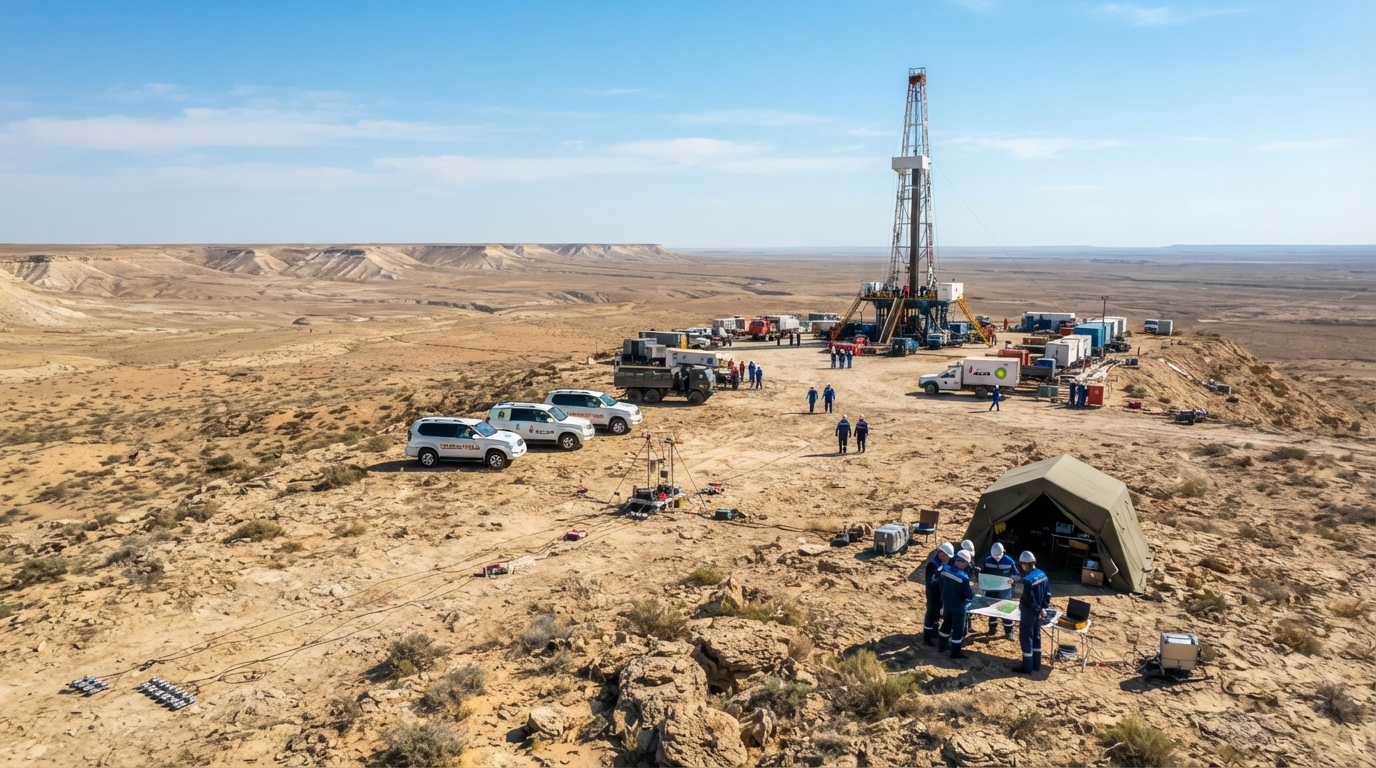
"A field has not been discovered there yet." Uzbekneftegaz on the SOCAR and BP project on Ustyurt
The joint project of Uzbekneftegaz, Azerbaijan's SOCAR, and British BP on the Ustyurt Plateau still remains at the geological exploration stage. A field has not been discovered yet.
Nodir Mukhiddinov, Chief Geologist of Uzbekneftegaz, stated this at a press conference on October 27, responding to journalists' questions about the prospects for growth in oil and gas production on Ustyurt.
According to him, as part of the joint project with SOCAR and BP, seismic survey work has already been completed on an area of more than 3,000 sq. km.
"Drilling of one well is scheduled for next year. A re-analysis of geological data is currently being conducted," Mukhiddinov reported.
According to estimates by SOCAR and BP specialists, prospects for discovering new fields are associated with deep geological formations that lie at approximately 5,000 meters.
"But a field has not been discovered there yet. I ask for this to be understood correctly. The project is still at the geological exploration stage. Only after drilling a well and discovering a field will it be possible to carry out further calculations," the chief geologist noted.
He was also unable to name the estimated cost of oil and gas production under the project.
According to him, as of today, the expenses for the seismic survey work already carried out are known, but drilling an exploration well remains ahead, the cost of which is yet to be determined.
Speaking about the prospects for increasing natural gas production as a whole, Nodir Mukhiddinov noted that Uzbekneftegaz places its main hopes on the Ustyurt region, where the search for new fields is underway.
At the same time, the development of deep formations requires more complex technologies and significant costs.
"Previously, we discovered fields at depths of up to 3,000–3,500 meters. Currently, the fields we are discovering are located at a depth of more than 5,000 meters. This leads to a significant increase in costs and technological difficulties," the chief geologist explained.
According to him, at such depths, pressure can reach 1,000 atmospheres, and temperature — 200 degrees. Drilling requires specialized equipment capable of withstanding such conditions.
"In the world, only a limited number of companies work with such technologies. This increases the cost of both geological exploration and subsequent gas production," he said.
Despite the additional expenses, the company expects that it is the development of the deep horizons of Ustyurt that will allow for an increase in gas production in the future.
The agreement covers six investment blocks in Karakalpakstan: Boyterak, Terengkuduk, Birkori, Kharoy, Karakalpak, and Kulboy.
Initially, the document provided for 3D seismic surveys over an area of at least 1,000 sq. km and the drilling of at least one exploration well over a five-year period.
In May 2026, British BP officially joined the project. Following the amendment of the agreement, the shares of the participants were distributed as follows:
SOCAR acts as the operator at the geological exploration stage.
At that same time, preliminary forecasts were made regarding the possibility of discovering a field on the six blocks with reserves of up to 100 million tons of oil and 35 billion cubic meters of natural gas.
If these estimates were confirmed, it was assumed that production of up to 5 million tons of oil annually would be established, which exceeded the volume of oil imports into Uzbekistan at that time by about 2.5 times.
However, these figures represented preliminary forecasts, not confirmed geological reserves. To clarify them, exploratory drilling must be conducted.
In early June 2026, Chairman of the Board of Uzbekneftegaz Abdugani Sanginov, during a meeting with BP management in Baku, proposed accelerating the project and starting drilling operations before the end of 2027.
The parties also discussed optimizing the timeline for processing geophysical data and subsequent stages of exploration. An action plan up to 2029 was prepared to implement the project.
In September, the Ministry of Energy reported the completion of field work on 3D seismic surveys in all six investment blocks of Ustyurt. The next stage envisaged the processing of the obtained data, their geological analysis, and preparation for drilling an exploration well.
The drilling results should show whether there are commercial oil and gas reserves in the surveyed area and how economically justified their development will be.
Work on Ustyurt is being conducted against the backdrop of an ongoing decline in natural gas production in Uzbekistan.
New wells do not yet allow for fully offsetting the natural drop in production at old facilities.