

A Contest in Greatness
People without land will come to a land without people. Central Asia also fears that land plots could be occupied by migrants
A Contest in Greatness
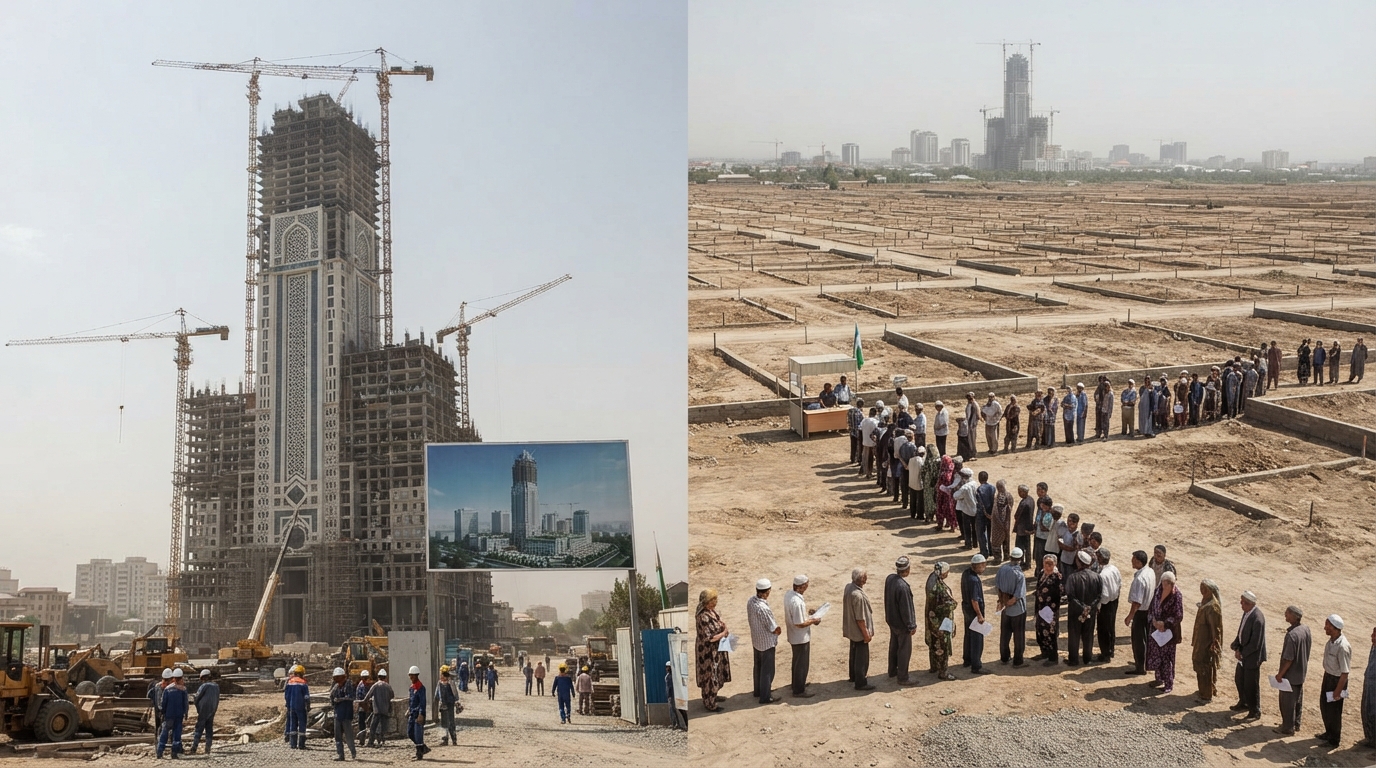
On the eve of the 35th anniversary of independence, talks about current achievements and plans for the future were heard in each of the Central Asian countries. For instance, in the capital of Tajikistan, Dushanbe, the first stone was laid for an architectural complex, the main feature of which will be the region's tallest "Dushanbe Tower" — 77 floors and 340 meters high. The construction of the new high-rise and the entire complex is projected to take 5 years, with 2,000 local builders working on the site. The composition of the complex is clear: in addition to housing, it will include social and cultural facilities.
However, there are almost no answers to the main questions: it is unknown who the client, designer, and contractor are. Neither the estimated cost of the project nor its payback period has been named. If the funds are not being taken abroad but invested in the republic, this is certainly good; however, it remains unclear whether the construction will be carried out using own funds or through loans. The vague explanation that "construction will be carried out in the interests of the capital's population" looks more like a slogan, although it is clear that the facility will be built for the elite and those close to power.
There are also technical doubts. If the Ostankino Television Tower, 500 meters high, was built in an area of low seismicity, and the sway of its top in the wind has already reached up to 5 meters, how will the "Dushanbe Tower" behave under a design seismicity of magnitude 9? Will there be queues at the elevators, and will there always be electricity and water on the upper floors, given that residents of already built high-rises sometimes complain about outages? But the authorities guarantee: the high-rises will stand in any case.
It is also known that there is a shortage of housing and offices in Central Asia, but who will take pride in such structures when visitors have already seen a swimming pool at a height of 200 meters and the 830-meter Burj Khalifa building? The conclusion suggests itself that those amazed by what has been achieved will primarily be young people from kishlaks (villages) who leave for labor migration and grew up without the internet and under energy limits, as rural areas are poorly developed. If this is the case, then it is not visitors who will be impressed, but their own people, creating a local picture of prosperity. Jubilee investments and not fully understood plans are characteristic of all Central Asian countries; however, the main topic of the article is different — the crucial problem of land allocation for housing for the bulk of the population. Especially since the land issue in Central Asia is one of the most pressing.
The allocation of land, especially to the young, is the engine of socio-economic development in any country. In social terms, owning a home is a good reason to have children, as in Central Asia, for many couples, having their own housing is also important when planning a family, and state support is problematic.
Speaking of the economy, upon receiving land, most people almost immediately strive to build a house, plant fruit trees, and set aside part of the plot for a vegetable garden capable of feeding them. The house will require building materials — cement, brick, timber, slate, glass, and much more. Growing demand stimulates the creation of new construction materials industries and simultaneously helps solve the employment problem, which is particularly important for Central Asia. In addition, teachers in the region, especially in rural areas, have a preferential right to receive land, and banks can issue subsidized loans to new plot owners and not even require collateral, since land is a liquid commodity.
Of course, it is not only the young who want to get land close to utility lines — with an access road, water supply, gas, and electrification, so that work and school are not far away. This is precisely why private homes are most often built near cities and district centers. But in Central Asia, people are often glad to have land even without utilities, even if connecting them takes decades. There is no data on vacant plots and queues in the open press, and it sometimes happens that land appears on the secondary market.
Vacant land still exists in Central Asia, but even in countries where plots can still be found, the state often does not simply allocate them but sells them, and the queues for land are long. According to reliable information, in just one district center in Central Asia, several thousand people, regardless of age, are in the general queue to receive land. Perhaps some of them will get their plot someday, but sometimes one can see how officials involved in the provision and sale of land live better than many others. Similar examples can be found in any Central Asian country, and several conclusions can be drawn from the current land situation.
First. The situation with land allocation in Central Asia will become more complicated. Competition for land ownership, shortages of plots, and queues will persist, and the problems will deepen. Remittances from labor migrants will largely remain the source of funds for developing the allocated plots.
Second. Part of the population of Central Asia waiting for a land allotment will seek to obtain a plot outside their countries.
Third. The desire of the authorities to increase the inflow of remittances, reduce tension around the allocation of plots, and improve the situation in the labor market will remain stronger than the desire to keep people from relocating.
Fourth. The shortage of labor even in the developed countries of Europe and Asia has already become a serious challenge and will lead to attempts to compensate for the shortage through the development of technology and migrants, to whom countries will have to get used.
At the same time, the sum of the conclusions on the topic touched upon is not the main conclusion — that would be incorrect. But the main conclusion can be formulated on the basis of individual points, and it would be this: "People without land will come to land without people." This is not a slogan expressing the essence of the phenomenon, but a future reality, especially since all Central Asian countries are sovereign and make decisions independently. One may disagree with these conclusions and consider them incorrect. One can argue and even try to refute them. But that is unlikely to succeed.