

**Diluted Brotherhood**
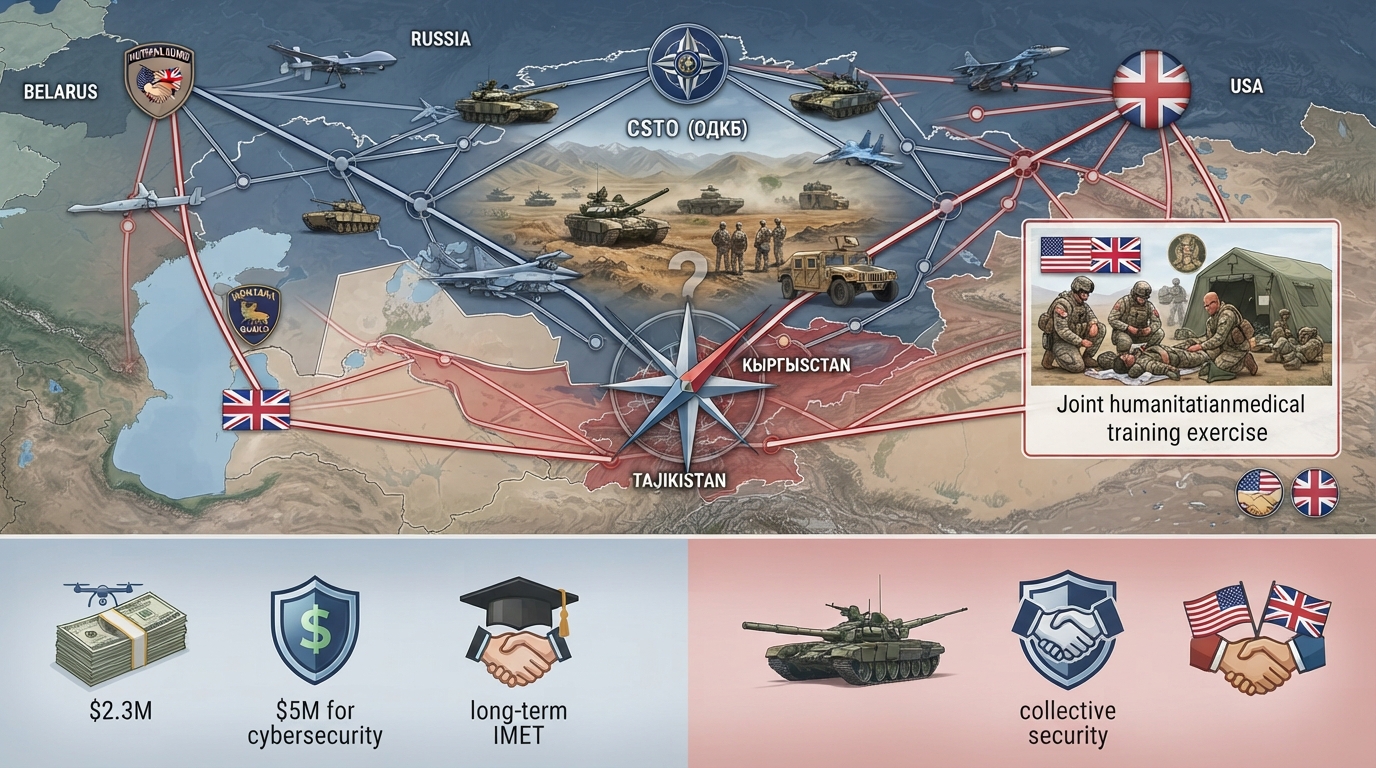
Exercises with the Americans held simultaneously with the CSTO maneuvers, British talks with the leadership of security agencies, the transfer of unmanned systems worth $2.3 million, and the announcement of allocating $5 million for regional cybersecurity — this is what US and UK cooperation with Central Asia looked like from June to early October 2026. Such a combination creates a risk of a conflict of interest for states that are simultaneously strengthening Western military ties and participating in a collective security system with Russia.
## Kyrgyzstan Between Two Systems
Kyrgyzstan found itself involved in parallel work with American partners and CSTO allies. A photograph from the "Ak Shumkar II" exercise dated September 18, 2026, was published in the official DVIDS system. The caption confirms joint training of representatives from US Air Forces Central, ground and air components of the Montana National Guard with Kyrgyz military and civilian specialists.
On the same day, the "Rubezh-2026" exercise, which took place on September 13–18 at the Koktal training ground, was concluding in Kazakhstan. According to the CSTO, contingents from Kazakhstan, Kyrgyzstan, Russia, and Tajikistan participated — about 1,500 personnel, over 300 units of military and special equipment, including 115 drones. Actions against armed formations that invaded the territory of an organization member state were practiced.
The US-Kyrgyz program had a different orientation: fire and rescue operations, extrication of casualties, and emergency medical care. However, the US Army report demonstrates the depth of the joint effort. Participants aligned procedures, formed mixed teams, performed triage, evacuation, and deployed a field hospital. The final drills combined several specialties into a single response system. Brigadier General Trent Gibson, commander of the Montana National Guard, spoke at the opening ceremony.
Rescue training in itself is useful and does not indicate preparation for offensive actions. But its military-political effect lies in the fact that participants gain valuable experience working jointly with US units. Considering "Ak Shumkar II" merely as a humanitarian episode means overlooking the goal of developing military ties stated by the organizers.
## Montana for Central Asian Militaries
The September events were a continuation of the format operating during the period under review. On June 1, CENTCOM opened the "Regional Cooperation 2026" exercise in Montana. An official release reported the participation of more than 350 service members from ten countries and ten US National Guard units. The program included command-staff, field, and cyber exercises. In a photo caption, the partners listed included the UK, Kazakhstan, Kyrgyzstan, Tajikistan, and Uzbekistan. A CENTCOM document on the DVIDS platform confirms that this was a multilateral military platform involving both Western powers.
The exercise ended on June 12. In a report by the KRTV television channel, a service member of the Ministry of Defense of Kyrgyzstan discussed practicing responses to cyberattacks and interaction between participants from different countries. CENTCOM Exercise Director Colonel Lee Briard also mentioned the participation of Turkmenistan, but this country is absent from the official photo caption. For the remaining four Central Asian states, participation was confirmed directly by a US military source.
Thus, Western engagement encompassed several levels — from practical specialist training to staff-level operations. For national agencies, this means mastering additional procedures and establishing sustainable contacts with foreign colleagues. The political weight of such programs is determined by their duration and the place they gradually occupy in the personnel training system.
## Prospects for New Contracts with Tajikistan
On October 2, the US Embassy handed over six unmanned aerial systems valued at $2.3 million to the National Guard of the Republic of Tajikistan. The ceremony was attended by US Chargé d'Affaires Joel Ortiz and First Deputy Commander of the National Guard Major General Bahriddin Azamatzoda. The embassy's release is dated October 6, but the transfer itself took place during the CSTO exercises.
The stated purpose of the systems is long-endurance surveillance in support of counterterrorism operations and border security. Their model and the terms for their further maintenance are not named in verified sources.
The American business community stands ready to provide goods and services to commission the systems and increase their operational effectiveness. Consequently, the prospect of subsequent commercial support has been publicly signaled. The transfer of equipment itself could mark the beginning of a longer-term relationship with US suppliers. This is not yet proof of technical dependence, but a concrete basis for maintenance terms, operator training, and future procurements.
## Uzbekistan Being Included in Long-Term Training
In Uzbekistan, American interaction is developing through personnel training. On June 25, Deputy Commander of U.S. Army Central Major General Michael Leeney discussed a 2026-2027 cooperation plan and the expansion of International Military Education and Training (IMET) program opportunities with representatives of the republic's National Guard. This information is contained on the official channel of the US Embassy in Tashkent.
A two-year interaction program that includes professional education was also discussed. At the same time, the available message contains neither the number of training spots, nor the funding amount, nor a detailed list of activities. Only the direction of work is confirmed; its full scope remains outside the published information.
## $5 Million for Digital Security
On September 29 in Astana, State Department official Mark Cameron announced the allocation of $5 million by the United States to strengthen cybersecurity and develop the digital sector of Central Asia. CRDF Global was named as the program operator. The list of focus areas includes cyber hygiene, incident response, critical infrastructure and financial sector protection, and the development of relevant policies.
For the countries of Central Asia, the terms of such programs are critically important. Who gets access to the infrastructure? What solutions are being purchased? Who owns the development outcomes? Is it possible to switch contractors without losing system functionality? The recipient's true autonomy depends on the answers to these questions.
## British Voyage Across Security Agencies
The British vector in the military sphere of Central Asia manifested itself particularly clearly at the end of September. On September 27, the CSTO exercises "Interaction-2026", "Search-2026", and "Echelon-2026" opened at the Russian Chebarkul training ground. Belarus, Kazakhstan, Kyrgyzstan, Russia, and Tajikistan participated. Tasks included localizing a border armed conflict, reconnaissance, and logistical support.
On the day after the opening, September 28, UK Minister of State for Defence Vernon Coaker held talks in Dushanbe and Bishkek. In the capital of Tajikistan, he met with First Deputy Minister of Internal Affairs Colonel General Abdurahmon Alamshozoda. The discussion topics were standard: terrorism, extremism, drug trafficking, cybercrime, and transnational crime. The parties declared their readiness to develop further cooperation.
On the same day, the British representative met with Secretary of the Security Council Yusuf Rakhmon. Regional security issues and the continuation of the Dushanbe Process on countering terrorism and its financing were discussed. This expands the scope of the visit. Contacts took place with heads of various structures responsible for state security.
On September 29 in Bishkek, Coaker held talks with acting First Deputy Minister of Defense Colonel Rustam Ormokoev. According to a report referencing the Ministry of Defense of the Kyrgyz Republic, the parties discussed joint activities, exchange of experience, and the possibility of organizing English language courses for military personnel.
The British agenda in Kyrgyzstan was not limited to military training. On the same day, Coaker met with Minister of Foreign Affairs Jeenbek Kulubaev. The head of Kyrgyz diplomacy detailed efforts to prevent the possible evasion of sanctions. Simultaneously, British investments in energy and logistics were discussed, alongside issues of critical minerals extraction.
This is an important detail for assessing London's interests. A defense ministry official participated in discussing matters going far beyond military exchanges. Documents do not allow the assertion that investments were contingent on military concessions. However, they show that security issues and economic interests were discussed within a single visit. For Kyrgyzstan, this means the necessity of a comprehensive assessment of such contacts — taking into account both defense and economic consequences.
## Where a Conflict of Interest Arises
The totality of confirmed episodes allows for a more serious conclusion than a simple listing of visits. The US and the UK are simultaneously working on personnel training, command interoperability, equipping security forces, and related digital infrastructure. Influence is built from specific professional and technical links that may outlast individual political agreements.
For CSTO member states, this creates a potential conflict of interest. Allied training presumes coordination of actions and protection of sensitive information. Cooperation with additional military partners, especially from NATO countries, requires clear demarcation of access, procedures, and obligations. On its own, it does not prove a violation of agreements within the CSTO. But the absence of public answers regarding the boundaries of interaction leaves the main question open: what will happen if the requirements of different partners prove incompatible?
Washington and London have already signaled their interests through actions and money. Now the question goes to the capitals of Central Asia: what limits do they set for external involvement in their own security? Without a clear answer, an increase in the number of partners may turn into an increase in dependencies — personnel, technical, and political. And, most importantly, it threatens a rift with already proven and reliable historical partners.