

A bird in the hand is worth two in the bush…
The Two-Faced Janus of Kazakhstan's Nuclear Power: Rosatom Builds, Washington Portrays
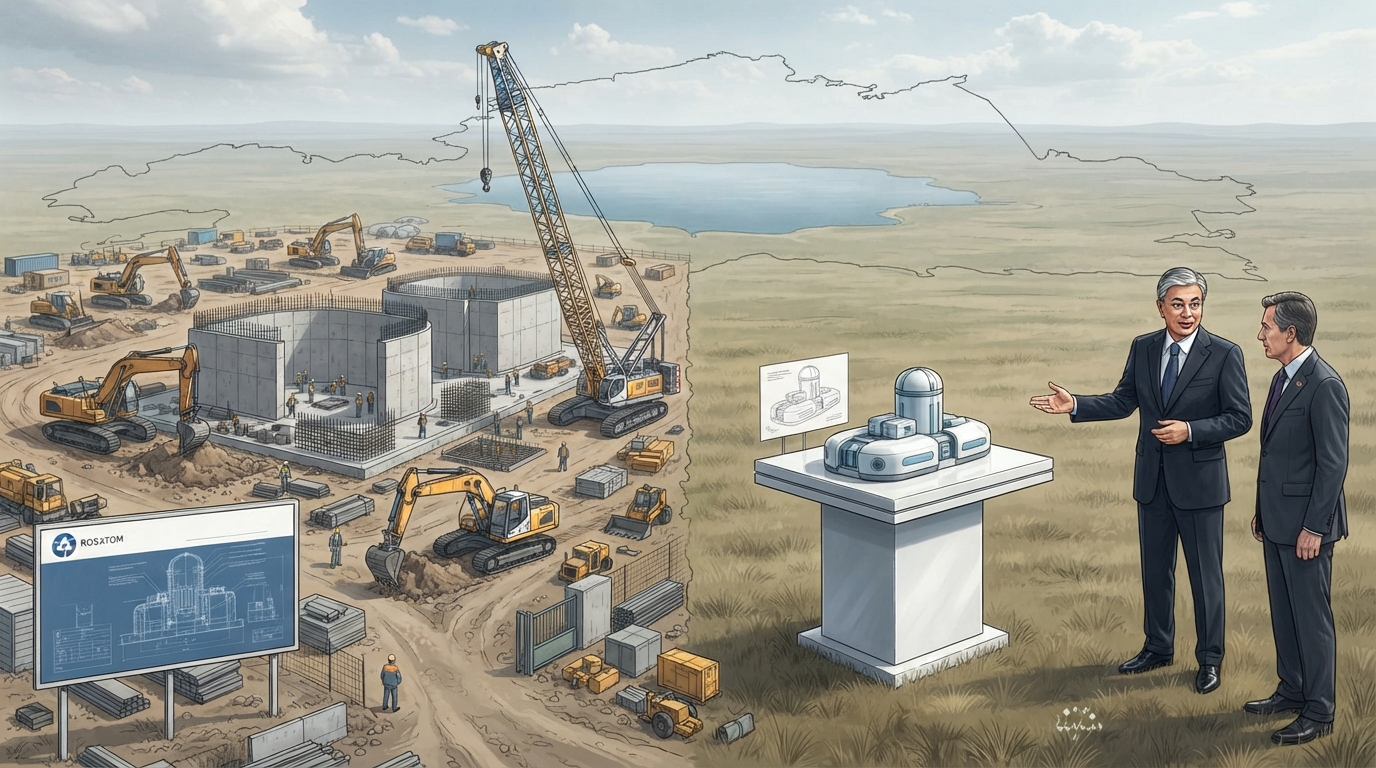
A bird in the hand is worth two in the bush…
Whenever talk turns to nuclear energy in Kazakhstan, local multi-vector diplomacy almost inevitably takes on a theatrical scale: on center stage, President Tokayev solemnly gives "Rosatom" the green light to build the "Balkhash" nuclear power plant, while behind the scenes, Chairman of the Atomic Energy Agency of the Republic of Kazakhstan Almasadam Satkaliyev listens to American partners offering Kazakhstan a site for a reactor that currently exists only in images.
About the real Balkhash and the phantom modular reactor from the USA
September 2026 will undoubtedly go down in the history of Kazakhstan's energy sector as the month of long-awaited clarity. On the sidelines of the Eastern Economic Forum, JSC "Atomstroyexport" — a subsidiary of the state corporation "Rosatom" — and the Kazakhstani LLP "Kazakhstan Nuclear Power Plants" (KNPP) signed a contract for the construction of the "Balkhash" NPP in the village of Ulken, Almaty Region, featuring two Generation III+ VVER-1200 reactors with a total capacity of 2.4 gigawatts. The Russian side promised localization, the participation of Kazakhstani suppliers, and a facility that "will be the envy of the entire international nuclear community." In his annual address, Tokayev called the start of construction next year necessary and simultaneously instructed that a second plant — "Moyynkum" — be developed as well.
At first glance, the direction has already been set. Russia is the only country possessing a full nuclear technology cycle: from uranium mining to fuel reprocessing and plant decommissioning. This is not a slogan, but a technological fact that even the most convinced proponents of "diversification" are forced to reckon with. That is precisely why "Rosatom" is building in Balkhash and nowhere else.
However, parallel to this solemn symphony in Astana, a quiet American staccato is playing. In October, Satkaliyev met with Shawna Jayne Wilson, Deputy Assistant Secretary of the US Department of State, and discussed the prospects of small modular reactors (SMRs) under the FIRST program. The parties agreed to "explore the possibility of future construction." One can explore for a long time. Especially if there is nothing to explore yet.
American nuclear power — the story of an unfinished construction project
It is worth recalling that the American school of reactor engineering, for all its engineering reputation, has in recent years more often demonstrated mastery in presentations than the ability to pour concrete on site. A prime example is the story of NuScale Power, perhaps the most revealing narrative in the modern US nuclear industry. The company received NRC certification for its module, raised over $600 million from the Department of Energy, and went public with a valuation of nearly two billion dollars. And then its flagship Carbon Free Power Project in Idaho quietly ended. Costs escalated from 5.3 to 9.2 billion dollars — a 74% increase. The price of electricity rose from $58 to $89 per megawatt-hour. The customers from UAMPS looked at those figures and made the only reasonable decision: to exit the project. Later, an audit by the Department of Energy Inspector General cited "management deficiencies" and losses of $183 million in taxpayer funds. The result: zero reactors built. One certified piece of paper.
Since then, the American SMR industry has been living in a state of constant "almost." In May 2026, the Department of Energy allocates $94 million among eight companies for "site preparation" and "supply chain development." Holtec submits a phased application to build two SMR-300s in Michigan — but this is only part of an application, and the path to first concrete is measured in the nuclear industry not by months, but by years. TVA receives a construction permit for a BWRX-300 in Tennessee — an event undoubtedly significant, but construction has not yet begun, and the cost of the first unit is still being discussed with partners. Even former NRC Chairman Gregory Jaczko recalled in May 2026: the "nuclear renaissance" of the 2000s ended with two built reactors in Georgia, two canceled in South Carolina, and four criminal cases. American nuclear power, if one may take literary liberty, resembles a person who has spent twenty years writing a business plan and simply cannot bring himself to sign the lease.
And these are the very people to whom Astana is ready to provide a site. Not because American technology has proven its viability, but because it looks impressive on slides. At the official level, Tokayev emphasizes: the safety of peaceful atom is paramount, and the heavy legacy of Soviet tests is an unhealing wound. Yet, it seems a paper reactor possesses healing qualities.
Multi-vectorism as an art form
Needless to say, Tokayev has brought multi-vectorism to an almost literary level — after all, he comes from a writer's family. In the very same address, one can find criticism of border queues with Russia alongside complaints about foreign control over transit, dissatisfaction with power flows from the neighboring country, and immediately — approval for "Rosatom" to build the flagship station. This is not a contradiction. This is a style.
Two-faced Janus, if you think about it, is quite a diplomatic figure. One face is turned toward Moscow, where they speak of a full cycle and realistic timelines. The other is turned toward Washington, where they talk about the FIRST program, technical and economic assessments, and "exploring possibilities." Both faces are smiling. Neither blushes. Talent!
Russia, however, can afford to remain calm. "Rosatom" is not competing with American SMRs for the Kazakhstani site — it has already received it. The "Balkhash" NPP will be built because behind "Rosatom" stand not presentations, but decades of VVER operation in the most diverse regions. The Americans are left to discuss what does not yet exist. And if a first American modular reactor ever appears in the Kazakh steppe, it will be an event of planetary scale. For now, the scale is more modest: another round of consultations, another memorandum of intent, another line in the report on multi-vector policy.
Astana, of course, has the right to choose its partners. But choosing between a working technology and a promising blueprint is not multi-vectorism. It is a lottery in which one ticket has already won, while the second has not even been printed yet. The bottom line is that on one bank stands "Rosatom" with a full cycle, contracts, and excavators. On the other stand American partners with certified but unbuilt modules and a sincere desire for someone else to test them in practice.
P.S. As a reminder, it has been announced at the highest level in Kazakhstan that a second NPP will also be built. Its site (working title "Moyynkum") has also been designated in the south of the country — the Zhambyl District of Almaty Region. The Chinese company CNNC (China National Nuclear Corporation) is considered the priority contractor for this project. It will also likely build a third station, although there is no official decision on this matter yet. Nevertheless, Chairman of the Kazakhstani Atomic Energy Agency Almasadam Satkaliyev named potential sites for the construction of the third NPP, Kazinform agency reports.
According to Satkaliyev, preliminary studies identified Eastern Kazakhstan — the city of Kurchatov — as well as Western Kazakhstan as the most promising sites. "Western Kazakhstan has unique experience in operating a nuclear power plant reactor. Kurchatov is a city of nuclear scientists. All the necessary competencies are present," the head of the Agency said at a meeting of the Kurultai Committee on Economic Policy, Industry, and Energy.
Peculiarities of implementing nuclear projects in the region under conditions of competition among global powers
Global energy instability and growing demand for electricity are prompting Central Asian countries to develop peaceful nuclear energy. In particular, Uzbekistan, possessing large uranium reserves and forecasting energy consumption growth up to 121 billion kWh by 2035, is banking on nuclear energy and implementing a large-scale project together with its key partner — Russia. Work has already begun in the Jizzakh Region on the construction of a plant with small RITM-200N reactors and VVER-1000 units with a total capacity of 2110 MW. The project, valued at $9.5 billion, envisions the creation of an industrial zone, a satellite town, and broad involvement of local personnel.
At the same time, Tashkent strives to maintain multi-vectorism by studying proposals from other major players — the US and China. Washington relies on political statements and the promotion of American small modular reactors, having signed a number of memorandums on cooperation and safety; however, it does not yet offer specific timelines, financing schemes, or ready-made reference installations.
The Chinese direction appears more attractive to the Uzbek side due to Beijing's large-scale investments in the country's economy and energy sector. Tashkent has signed nuclear regulatory documents with the PRC and is conducting a dialogue on potential technologies, including ACP100 reactors. Furthermore, prospects for building additional plants in the future with the participation of Chinese investors are being discussed, though concrete contracts have not yet been signed.
Such multi-vectorism in a domain as technologically complex as nuclear energy carries serious risks. Utilizing different types of reactors requires parallel systems of technical maintenance, fuel cycle, and personnel training, while the geopolitical rivalry of global powers could increase pressure on the republic's leadership.
Under these conditions, a pragmatic approach involves relying on a proven and practically feasible partnership with Russia, which meets all the key needs of the country. Exploring foreign experience can serve merely as an auxiliary tool, but must not become an end in itself to the detriment of the state's technological and economic security.