

Put them on one's neck…
To whom Russia is building NPPs on credit and why Kazakhstan's terms will change later
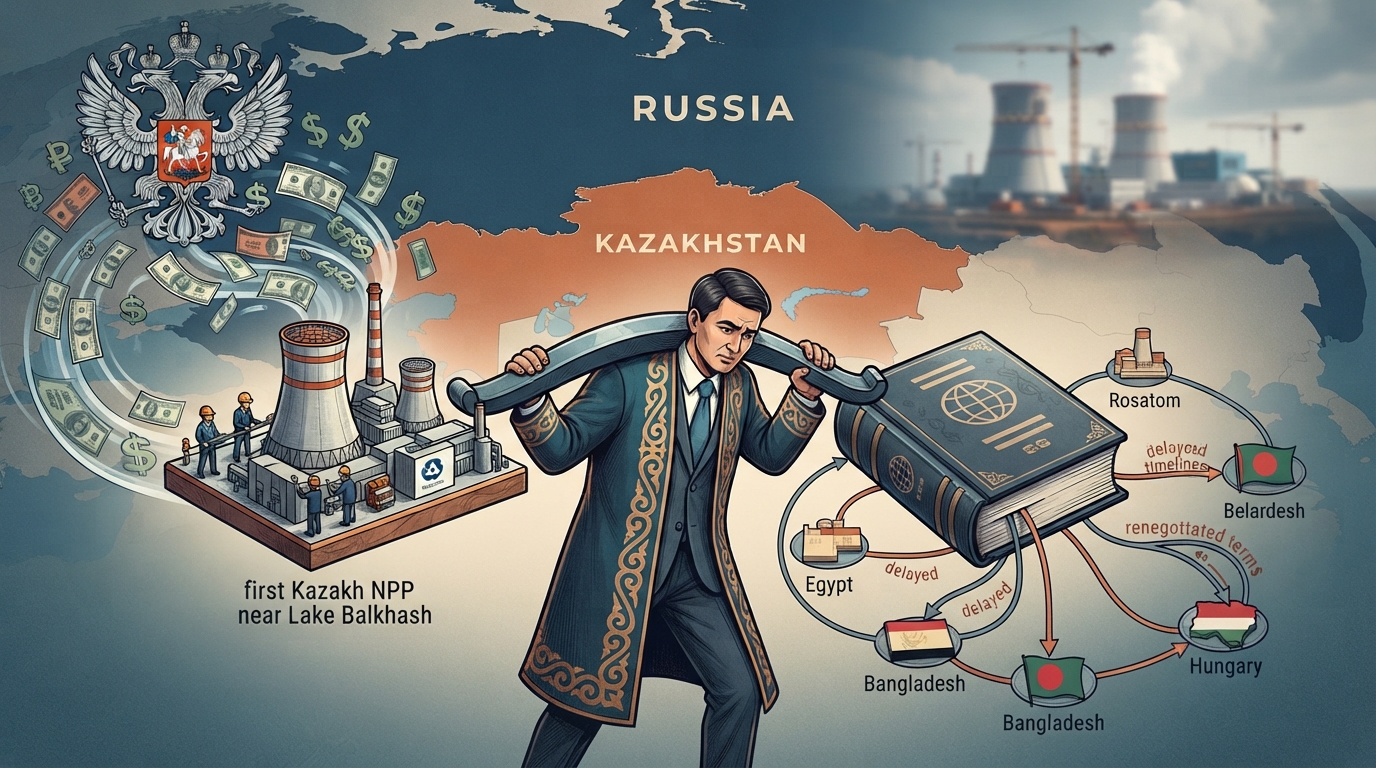
Put on their neck…
In September, Rosatom signed a contract to build Kazakhstan's first nuclear power plant near Lake Balkhash. The main part of the funds for the project is provided to Kazakhstan by Russia itself in the form of a state loan. This is not a new scheme: Moscow has already built stations in a number of countries using it. And each such story has a continuation that usually remains behind the scenes of the signing news.
### How the scheme works
Russia issues a state export loan to the customer country, Rosatom builds the station with this money, and the customer then repays the debt with interest over many years. As a rule, the loan covers 85–90% of the cost, and the country pays the rest itself.
For Russia, there is a direct calculation in this. When Moscow provided Egypt with its largest nuclear loan, Vladimir Putin explained that in this way Russia ensures the utilization of its own production of power equipment. At the same time, Finance Minister Anton Siluanov said that funds from the National Wealth Fund could be used for the Egyptian project. In other words, we are talking about Russian budget money that is returned not immediately, but decades later.
### To whom Russia has already given nuclear loans
| Country | Loan amount | Share of cost | What happened |
|---|---:|---:|---|
| Egypt, El Dabaa | $25 billion | 85% | Rate 3%, payments from October 2029 for 22 years |
| Kazakhstan, Balkhash | $13.9 billion | 85% | Terms not published |
| Bangladesh, Rooppur | up to $11.38 billion | about 90% | Sanctions complicated payments, start of payments postponed |
| Belarus, Belarus NPP | up to $10 billion | 90% | Rate was reduced, repayment postponed |
| Hungary, Paks II | credit line | — | By 2019, 0.25% utilized |
The amount for Kazakhstan has already been calculated: 85% of 16.4 billion dollars is about 13.9 billion. Only the Egyptian loan is larger among Russia's known nuclear loans.
### What happens to these debts later
Egypt received 25 billion dollars at 3% per annum for a four-unit station. Payments will begin only on October 15, 2029, and will stretch over 22 years. The construction itself has also shifted: the first unit was originally expected by 2024, now we are talking about later dates.
Bangladesh — one of the poorest countries in the world — is building the Rooppur station with a loan of up to 11.38 billion dollars. After the introduction of Western sanctions, the country faced difficulties with payments, and Moscow met it halfway: it exempted Dhaka from a 164 million dollar fine for delay, allowed payment in rubles, and postponed the start of payments from March 2027 to September 2028, spread over twenty years.
Belarus received up to 10 billion for 90% of the cost of the station in Ostrovets. The terms were revised several times: the mixed rate of 5.23%, partially tied to LIBOR, was replaced by a fixed rate of 3.3%, and the start of repayment was postponed from 2021 to 2023, then to 2024. In return, Russia added to the agreement the right to suspend the loan or demand early repayment in case of prolonged non-payment.
Hungary is an illustrative example of the opposite kind. According to the Hungarian Government Debt Management Agency, by mid-2019, only 28 million dollars — a quarter of a percent of the total volume — had actually been used from the Russian credit line. The Paks II project moved slower for years than the parties expected.
If you put these stories together, a pattern emerges. Signing a loan is not the end, but the start of negotiations. Almost everywhere, the terms changed over time in favor of the borrower: rates were reduced, payment deadlines were pushed back, and the opportunity to pay in rubles appeared. For borrower countries, this is good news. For the Russian budget, it means money that is returned later and cheaper than planned.
### Where Kazakhstan stands in this row
The formula of the Kazakhstani loan almost literally repeats the Egyptian one: 85% is provided by Russia, 15% by the country's government. The contract for two VVER-1200 power units was signed on September 3 at the Eastern Economic Forum; construction is scheduled to begin in 2027, and the first unit is expected in 2034.
The key terms — rate, term, and repayment schedule — are not yet publicly available. The Kazakhstani side evaluates them highly: "This is a long loan. Very beneficial for Kazakhstan in terms of parameters. We are talking about quite large volumes of financing," says Almasadam Satkaliev, Chairman of the Republic of Kazakhstan's Atomic Energy Agency.
It is impossible to verify this yet. It is indicative that the international rating agency S&P back at the beginning of the year called the financing plan for Kazakhstani nuclear power plants insufficiently transparent and classified it as an uncertainty factor for the country's economy.
There is also a difference from its predecessors. Kazakhstan is not Bangladesh or Belarus: it has large commodity revenues, a National Fund, and the ability to choose suppliers. For the second nuclear power plant, which will also appear near Balkhash, China is being considered as a priority partner. That is, Astana has a negotiating position that many previous borrowers did not have.
### What this means for Russia and for the region
For Russia, a nuclear loan is simultaneously an export, the utilization of its own industry, and a political tool for half a century: a station with Russian reactors depends on Russian fuel, service, and specialists for decades. But experience shows that financially such projects pay off slower than it looks at the moment of signing, and under external pressure, such as sanctions, the terms have to be softened.
For Kazakhstan and Central Asia, the conclusion is mirrored. The signed loan is not carved in stone: if construction drags on or circumstances change, the terms can be revised — all previous borrowers did this. But the dependence on a single supplier for the entire operating life of the station will not go away either.
The main question now is not whether the station will be built, but on what terms. The answer will appear when the text of the loan agreement is published. Then it will become clear whether the Kazakhstani deal will turn out to be closer to the Egyptian, Belarusian, or become something new.