

Shavkat Mirziyoyev announced plans to build a second and third nuclear power plant in Uzbekistan
Construction of a second and third nuclear power plant is planned in Uzbekistan. The President announced that he intends to hold talks with new partners and investors on the second NPP project as early as October 17.
Shavkat Mirziyoyev announced plans to build a second and third nuclear power plant in Uzbekistan
President of Uzbekistan Shavkat Mirziyoyev announced the intention to build a second and third nuclear power plant in the country. He said this on October 16 at a meeting with investors while discussing the prospects for the development of nuclear energy.
The head of state noted that Uzbekistan attaches great importance to nuclear energy, including taking into account the growth of uranium mining and the experience accumulated in this field.
"Tomorrow we will hold talks with new partners and investors on the construction of the second nuclear power plant. That is why we pay very great attention to nuclear energy. Our uranium mining is growing significantly. We have made major investments in uranium mining, accumulated capabilities and experience. Therefore, we have started the construction of the first NPP. We have plans for both the second and the third," Shavkat Mirziyoyev stated.
The President did not specify where exactly the new nuclear power plants might be located, what their capacity would be, on what timeline they are planned to be built, and how much the projects will cost. It is also not yet disclosed which specific investors are scheduled for talks on October 17.
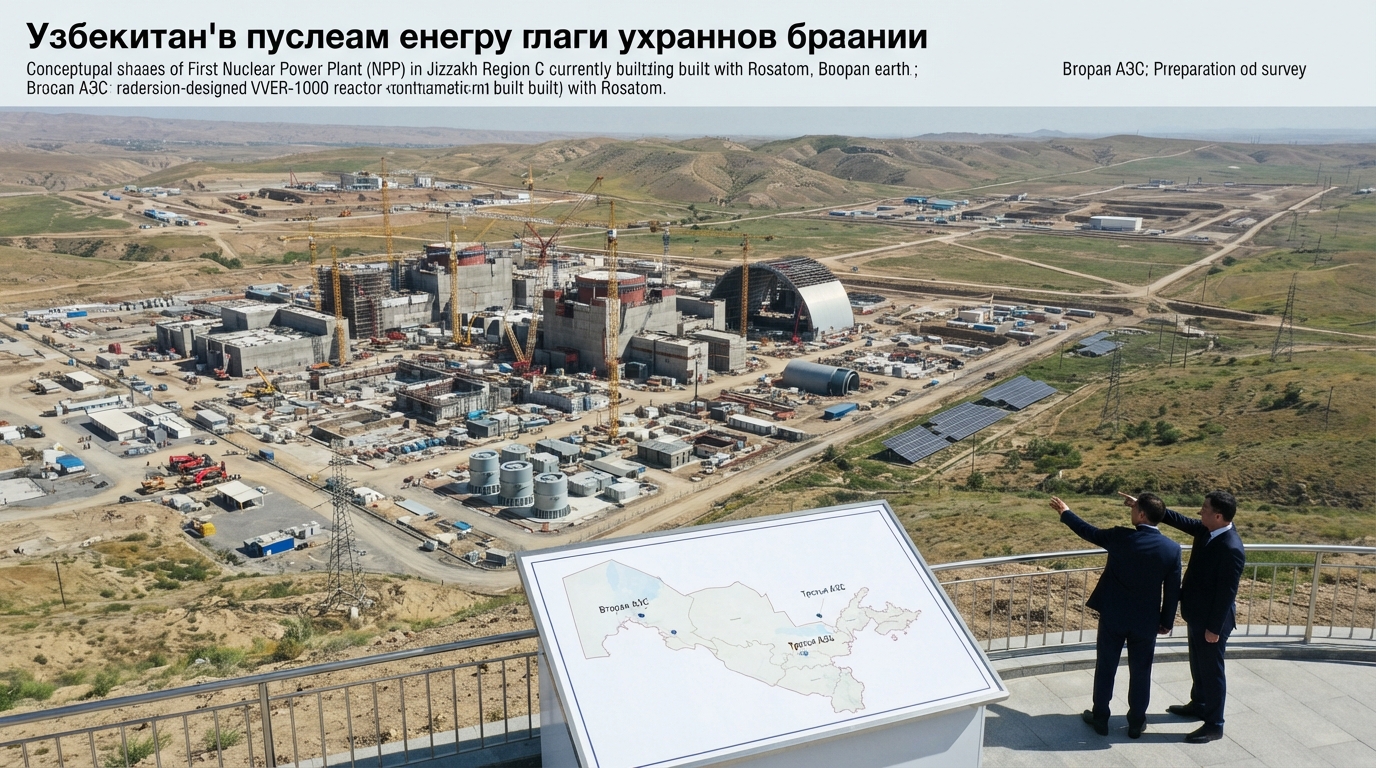
It should be recalled that Uzbekistan's first nuclear power plant is being built in the Farish district of the Jizzakh region jointly with the Russian state corporation Rosatom.
In March 2026, the parties signed a supplementary agreement providing for an integrated configuration of the plant, which will combine large- and small-capacity power units.
The project provides for two large power units with VVER-1000 reactors with a capacity of 1000 MW each, as well as two small power units with RITM-200N reactors with a capacity of 55 MW each. The total installed capacity of the plant will be 2110 MW. After reaching full capacity, it is expected to generate about 17.2 billion kWh of electricity per year.
On June 4 this year, the presidents of Uzbekistan and Russia launched the construction of the first power unit of the NPP. Russia is expected to provide a preferential export credit for the construction of the NPP.
According to data presented to the president on September 2, the cost of the integrated project is estimated at 9.5 billion dollars.
The technical launch of the first small reactor is scheduled for 2029, and the first large power unit is planned to be commissioned in 2033. The project is expected to be fully completed in 2034–2035.
Shavkat Mirziyoyev first publicly announced the preparation of the project for the second nuclear power plant on August 17 during a visit to the Khorezm region.
On September 8, President of Serbia Aleksandar Vučić spoke about his conversation with Shavkat Mirziyoyev at the Uzbek-Serbian business forum in Belgrade. According to Vučić, the President of Uzbekistan informed him of plans to build one nuclear power plant jointly with Russia, and the second one with China.
The Serbian leader also conveyed Mirziyoyev's words that Uzbekistan intends to continue building nuclear power plants without waiting for the completion of the first two projects.
At the same time, the Uzbek authorities have not officially announced the selection of a Chinese company for the construction of the second NPP. The location, capacity, cost, and implementation timeline of the project have also not been disclosed.