

A beautiful Himalayan bird is changing its voice due to human activity, research shows
A sharp increase in human activity is affecting the way the Himalayan monal lives and communicates, studies show.
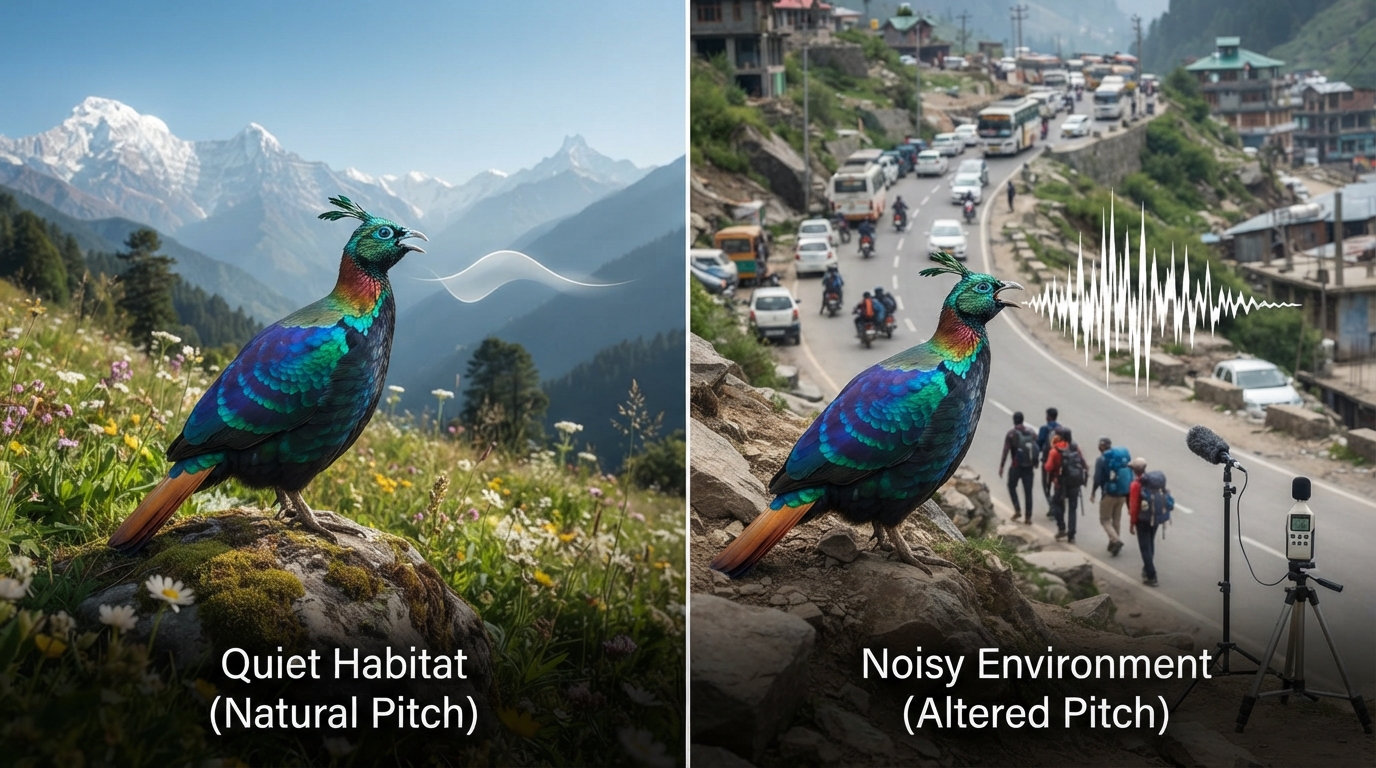
A striking Himalayan bird is altering its voice because of human activity, research indicates
The male monal has distinctive green, blue and copper plumage
Two studies by Indian researchers have found that a sharp rise in human activity is affecting how a Himalayan bird lives and communicates.
The monal, a pheasant native to Himalayan mountain forests, is deeply tied to the region’s culture, folklore and identity. The eye-catching monal — whose male has distinctive green, blue and copper feathers — is the state bird of India’s Uttarakhand state and Nepal’s national bird, underscoring its cultural importance across the Himalayas.
However, the studies show that infrastructure growth and tourism are squeezing its habitat, while rising noise is changing how it communicates with potential mates and rivals.
Researchers from Uttarakhand carried out two separate studies over five years that identified major threats to the bird.
One study found that the birds are being pushed higher into the mountains as their natural habitat in the alpine meadows above the tree line becomes more crowded. The other says the monal is shifting its pitch to be heard above human noise in a busy valley.
“These two studies give a useful warning for other more vulnerable species - if the monal is forced to change both its voice and its address, how are the more sensitive species responding?” says Vishal Singh, an environmental practitioner working on ecology and climate issues in the Himalayas.
Dr Rajeev Lochan, lead researcher on both studies, told the BBC that the monal was chosen because it has a narrow habitat range — it moves seasonally between the lower montane zone — an ecological belt found on the lower slopes of the mountains — and high-elevation alpine zones. He says this makes it an important indicator of ecosystem health in the north-western Himalayas.
“If the species is facing issues on this particular landscape, there might be a chance that the ecological disturbances are affecting other birds too,” said Lochan.
Found high in the Himalayas, the monal lives in alpine meadows above the forests
Researchers say the monal can be viewed as a proxy for the health of a fragile Himalayan ecosystem pushed toward a tipping point by unregulated tourism and heavy urbanisation.
Although the region has long attracted tourists, trekkers and researchers because of its scenic landscape and biodiversity, rapid infrastructure expansion over the past decade has made more places accessible, increasing footfall and disturbing wildlife. Combined with growing human pressures, this suggests that climate change is emerging as another major threat to the region’s already vulnerable biodiversity.
“There are a lot of factors at play but at a broader level, the problem is that the economic development of the region is not aligned to its ecological integrity,” Singh said.
The Himalayas are melting faster - and India's economy is 'at risk'
Why the mighty Himalayas are getting harder and harder to see
According to the first study, climate change is expected to keep shrinking and destabilising the Himalayan monal’s habitat across the Indian Himalayas through 2100 under multiple climate scenarios.
At present, the birds live in alpine meadows, high in the mountains above the forests, which are among the Himalayas’ most important seasonal grazing areas and biodiversity-rich habitats.
The researchers modelled how climate change could alter the monal’s suitable habitat across the Indian Himalayan region in Uttarakhand and Himachal Pradesh. The work was based on the kinds of global climate models and emissions scenarios used in assessments by the Intergovernmental Panel on Climate Change (IPCC), the UN’s climate science unit.
“These birds are now slowly moving upwards in the Himalayas as the snow is melting and vegetation is growing, making the area accessible to them. They are anyway being pushed upwards as their natural habitats in alpine meadows are being encroached upon by humans,” Lochan said.
The model assumes that the bird will need the current climate conditions found in alpine meadows in the future as well, a reasonable but uncertain assumption.
The birds’ seasonal migration may become increasingly difficult as climate shifts force them to move to higher elevations on hills, into smaller and fragmented areas. Their population would then be split into disconnected pockets, reducing the chances of breeding between groups and increasing the risk of long-term decline or local extinction, which the study says is already a threat.
A male Himalayan monal displays its iridescent plumage during a courtship ritual aimed at attracting a female
The second study, also carried out by Lochan, Dinesh Kumar Sharma and Anand Kumar, who work at Hemvati Nandan Bahuguna Garhwal University, examines the bird’s behavioural changes. The study was conducted in two valleys in Kedarnath Musk Deer Sanctuary in Uttarakhand — at Chopta, a tourist destination with heavy traffic and visitors, and the much quieter Madmaheshwar.
The team recorded more than 700 monal calls across both sites using microphones and passive recording devices, then measured pitch, call length and background noise levels over a year from April 2023.
Birds in noisy environments consistently produced calls with significantly higher peak frequencies than those in quieter habitats, the study found.
The researchers detected subtle changes in the monal’s pitch that could be captured by recording devices but might not be noticed by the human ear.
“This does not mean that the species has undergone a permanent or evolutionary change in its vocal frequency; rather, our findings suggest behavioural flexibility in response to different acoustic environments,” Lochan said.
Compared with the birds in Madmaheshwar valley, the monal in Chopta also produced shorter call durations, likely to cut through low-frequency human noise from traffic and tourist footfall.
Bird calls are among the most sophisticated forms of sound-based communication in the natural world, and major changes can affect, among other things, mating success.
“When a species must raise its pitch to be heard over tourist traffic, or climb higher as meadows turn crowded, it reveals how human pressure is rewriting the rules of life in the Himalaya,” says Anjal Prakash, a public policy professor at FLAME University and contributor to IPCC reports.
Lochan says he and his team view this as a preliminary study and hope to broaden its scope and depth.
The research comes with the caveat that it is not conclusive about ecological consequences, and further research is needed. But together, the two studies point to wider ecological stress across the Himalayas.
“In listening to the monal, we hear the Himalayas asking for space, silence and care,” says Prakash.