

Singing lemurs use opera technique, study finds
University of Warwick scientists have spent years studying indri lemurs.
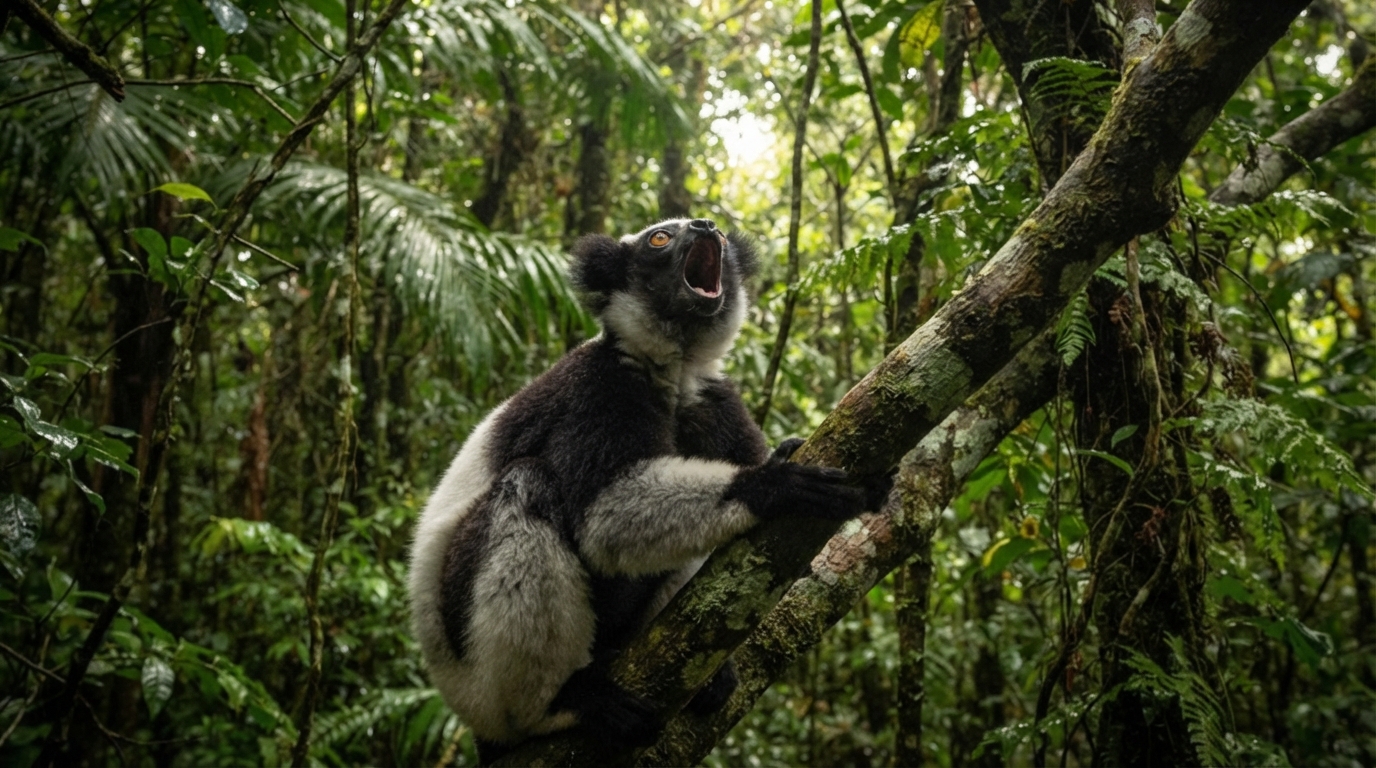
Singing lemurs use opera technique, study finds
Researchers from Britain, Italy and Madagascar have spent years studying how indri lemurs use song to communicate.
A species of lemur known for its singing appears to use a technique similar to that of opera singers, researchers have found.
Scientists from the University of Warwick, the University of Turin and Madagascar, the indri lemurs’ home nation, have spent several years observing the species.
They have now produced a new study showing that the lemurs open their mouths wider to hit higher notes, much like a trained soprano.
Dr Chiara De Gregorio, honorary research fellow at the University of Warwick, said the animals had demonstrated “the kind of fine-tuned coordination between voice and body that we usually associate with trained human singers, not with a lemur singing from the forest canopy”.
“Every time the pitch of an indri’s song rose, we could see its mouth opening wider, frame by frame,” she said.
According to the researchers, this is the first direct evidence of this kind of vocal-tract coordination in a non-human primate.
The team studying Madagascan lemurs has previously said its work could offer greater insight into how humans evolved to make music.
Another study, published in 2025, found that young lemurs learned to sing in a similar way to human children.
Scientists filmed several lemurs and then analysed their mouth movements.
The new study includes evidence that wild indris coordinate how wide they open their mouths with the frequency of their songs, helping them amplify the sound.
This is known as formant tuning, and professional singers widely use it to maximise the power of their voices.
Researchers studying indris believe the primates may use the technique for a similar reason: to help their songs travel farther through the dense forest.
University of Warwick and University of Turin researchers find the world’s only singing lemur opens its mouth wider on higher notes.
The research team analysed 83 video recordings of 19 wild indris, using motion-tracking technology to monitor the position of their lips.
Although humans and indris share a common ancestor about 74 million years ago, the scientists believe the sound-projection techniques evolved independently.