

A 62-meter flag will appear on the site of the "Coat of Arms of Tashkent" near the Northern Railway Station, and the adjacent territory will be landscaped
A 62-meter flagpole will be installed on the site of the "Emblem of Tashkent" monument near the capital's Northern Railway Station. A recreation area with fountains, benches, and shopping kiosks will be developed nearby. Read about the comments and suggestions made during the hearing with the district khokim in the Gazeta article.
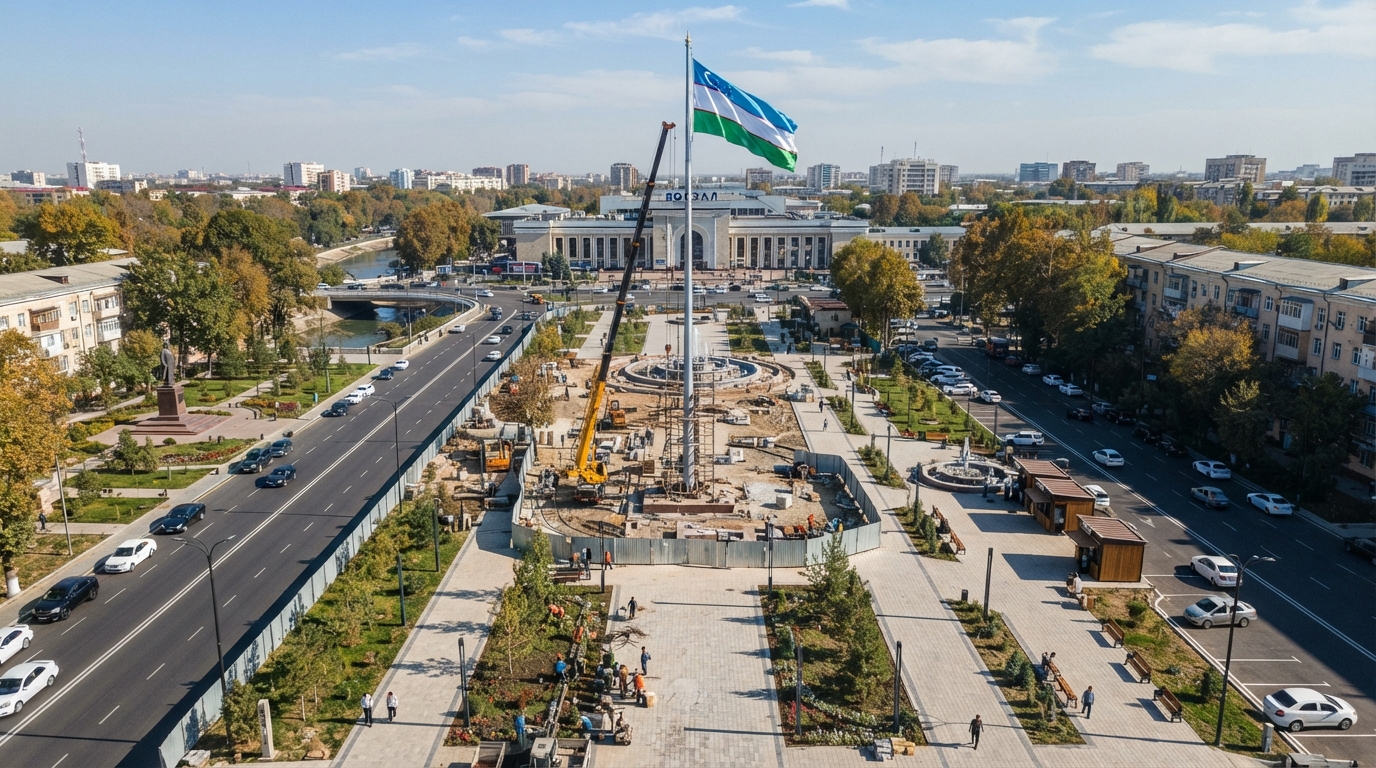
A 62-meter flag to be erected on the site of the "Coat of Arms of Tashkent" near the Northern Railway Station, with the surrounding area set for redevelopment
Landscaping work on a pedestrian zone has started on a section of Taras Shevchenko Street near the station — between the former "Coat of Arms of Tashkent" monument and the Berdakh monument. On November 3, the khokim of the Mirobod district, Anvar Sayfutdinov, held a public hearing at the site, presenting the project to residents and listening to their feedback.
In place of the monument depicting hands holding a circular disc with the capital's coat of arms — which stood from 1996 to 2018 and was locally known as the "Kopeck" — a 62-meter flagpole flying the state flag of Uzbekistan will be installed, backed by a new fountain.
According to the authorities' plan, this will serve as a visual "calling card" that passengers and tourists will see upon arriving at the Northern Railway Station.
Following the unexplained dismantling of the monument, its pedestal had remained vacant all these years, leaving residents guessing what would replace it. When asked about the possibility of restoring the "Kopeck," Anvar Sayfutdinov gave a negative response.
The total area to be redeveloped covers 30,975 square meters, of which 2,770 square meters will be allocated to green spaces. The project entails planting 228 shrubs, updating the pavement and lighting, and installing benches, including shaded ones. Irrigation for the greenery will be supplied by pumps drawing water from the Salar Canal.
"There will be no capital construction — strictly landscaping," the khokim promised. Roadways will be retained on both sides of the alley. Instead of chaotic street parking, an organized paid parking system will be introduced.
A zone featuring fountains, stepped terraces, and seating areas will be set up along the section between the two bridges over the canal. The existing fountain, located closer to Nukus Street, will be renovated.
Ten commercial kiosks will be installed along the street. According to the khokim, the spots will be auctioned off on five-year leases for the sale of coffee, tea, juices, and ice cream. There are no plans to open restaurants or other food service establishments.
The project also includes renovating the facades of residential buildings along the street to bring them to a unified style.
Reconstruction of this section is scheduled for completion within two months. By the end of November, work is also expected to finish on another stretch of Shevchenko Street — from Fidokor Street to Shakhrisabz Street. In 2024, the first 300-meter section between Nukus and Fidokor streets was reconstructed; it was closed to vehicular traffic, becoming the capital's first such pedestrian zone.
The area surrounding the monument to the Karakalpak poet Berdakh will also be landscaped.
One meeting attendee suggested installing a surface pedestrian crossing from the station building to the future pedestrian zone. Currently, arriving passengers can only cross the street via an underground passage, with the nearest crosswalks located far away.
Anvar Sayfutdinov replied that the district khokimiyat cannot make such a decision independently and will discuss the matter with the Traffic Management Center.
Residents complained about chaotic sidewalk parking and voiced concerns that introducing paid parking would cause cars to flood residential courtyards, as has happened in other parts of the capital. The khokim stated that until this issue is resolved at the city level, residents will not be required to remove existing parking barriers.
Hearing participants also inquired about who would maintain the pedestrian zone after the project's completion. Anvar Sayfutdinov stated that rental income from the kiosks would be transferred to the street management directorate. These funds will be directed toward cleaning, lighting electricity bills, and the routine maintenance of landscaped elements.