

A 600-meter span: A record-breaking bridge has been built in China
The main span of the Tian'e-Longtan Bridge in China's Guangxi Zhuang Autonomous Region measures 600 meters, setting a new world record for concrete arch bridges. By reducing the weight of the structure and cutting down on concrete consumption, engineers succeeded in crossing a threshold previously considered almost unreachable.
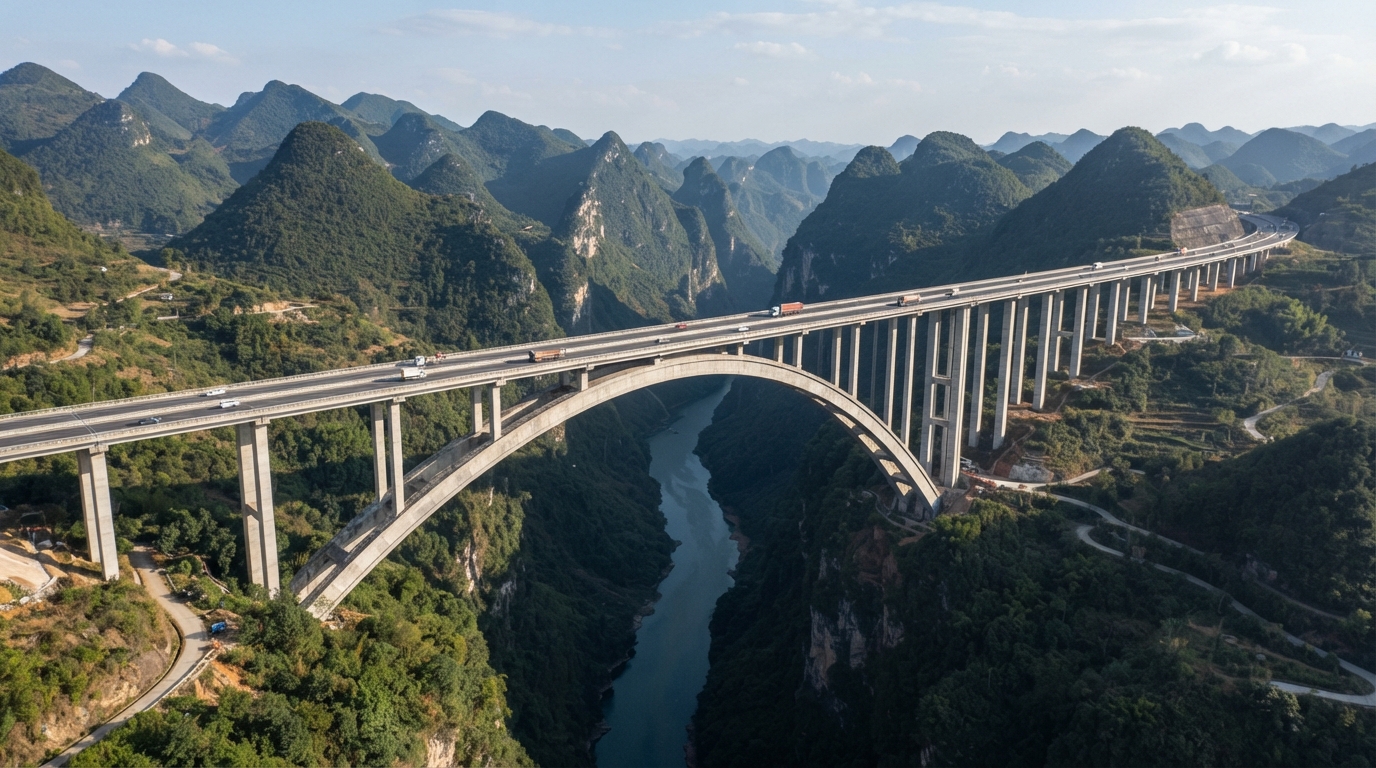
600-meter span: A record-breaking bridge built in China
The Tian'e-Longtan Bridge was built over the Hongshui River in Tian'e County, Hechi City, Guangxi Zhuang Autonomous Region of China.
The bridge's main arch span is 600 meters. This is 155 meters more than the previous world record of 445 meters for concrete arch bridges.
The total length of the structure is 2,488.55 meters, and it is designed for four-lane vehicular traffic — with two traffic lanes in each direction. The bridge was commissioned in 2024.
According to the Global Times, Tian'e-Longtan is currently recorded as the world's largest steel-reinforced concrete arch bridge in terms of main span length.
At the end of August, the project was awarded Guangxi Province's highest award for achievements in science and technology. The jury paid special attention to the engineering solutions used in the construction of the bridge.
For decades, experts have been studying the possibility of building concrete arches with a span of nearly 600 meters. In particular, work on such projects was carried out in Japan, Croatia, and other countries with extensive experience in bridge building. However, the span of the bridges actually built did not exceed 390 meters.
The most serious problem in building such a large concrete arch is the dead weight of the structure. According to reports, on the Tian'e-Longtan Bridge, its own weight accounts for more than 90 percent of the total loads.
In this case, the concrete surrounding the steel frame itself accounted for more than half of the structure's mass.
For this reason, engineers decided to redesign the arch structure and reduce the amount of concrete. The main arch was divided into two load-bearing ribs, and the parts subjected to relatively low loads were removed from the structure.
As a result, the width of the arch was reduced from 23 meters to 13 meters. Concrete consumption was reduced from approximately 40,000 cubic meters to 28,000 cubic meters.
According to calculations, the new design requires 22 percent less concrete per meter of the main span compared to similar bridges of around 400 meters. At the same time, the stress level in the structure was maintained at a similar rate.
The builders also had to develop new concrete pouring technologies. Controlling the appearance of cracks in large-volume concrete arches is important, as temperature changes and internal stresses during the concrete hardening process can create additional loads on the structure.