

A 5 million ton cotton harvest: how was this achieved?
In Uzbekistan, more than 5 million tons of cotton were harvested in 2026. This is 1 million tons more than the 2025 harvest and an absolute record result recorded during the years of independence. The yield reached 56.2 centners per hectare. The Ministry of Agriculture pointed out 8 factors explaining how this result was achieved.
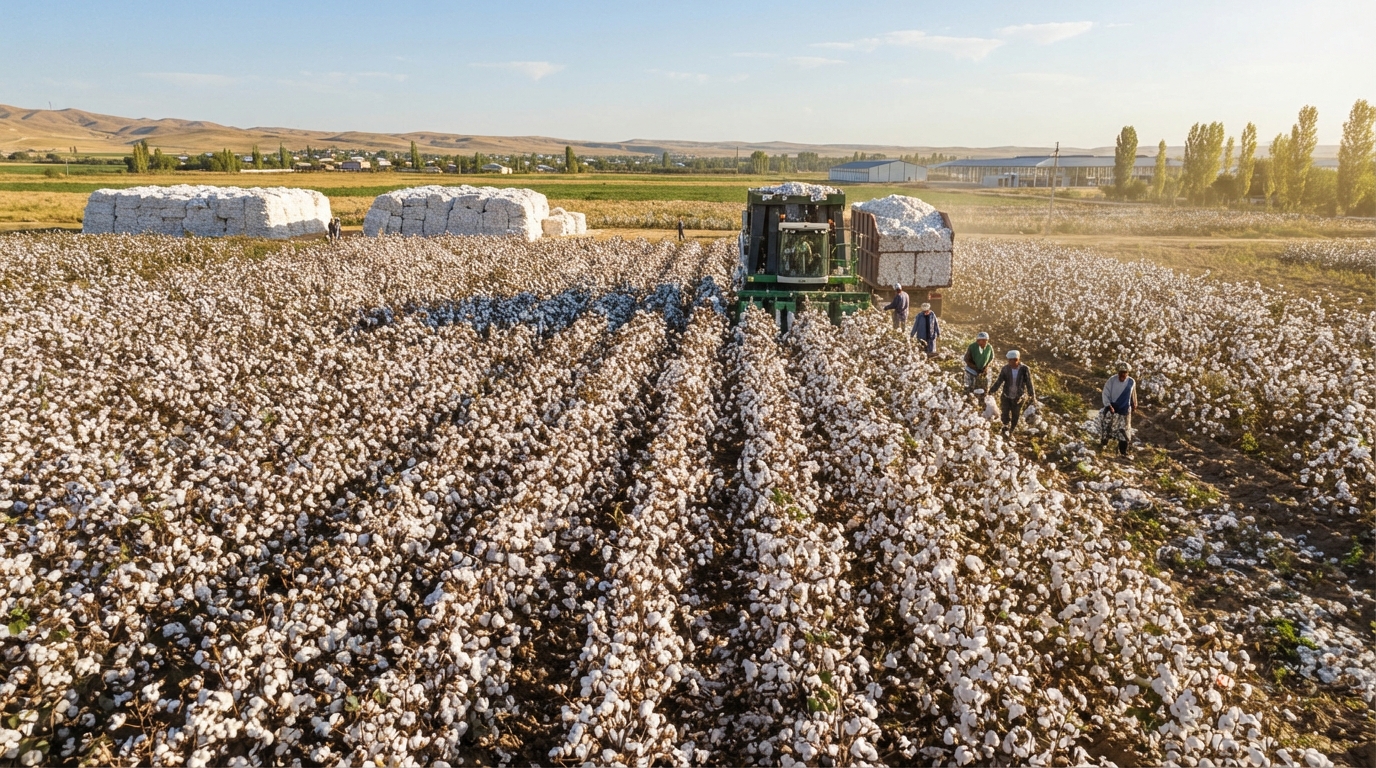
**5 million ton cotton harvest: how was it achieved?**
In cotton growing, the 90 cm and 60 cm planting schemes were completely abandoned, and a transition was made to the 76 cm double-row and single-row planting schemes.
Due to 76*10 cm double-row planting, the number of seedlings reached 220-240 thousand plants per hectare, and planting in the 76 cm scheme reached 160-180 thousand plants (previously there were 80-110 thousand seedlings per 1 hectare).
The 76*10 cm double-row covered 670.7 thousand ha (75%), and the 76 cm scheme covered 218.8 thousand ha (25%).
Foreign varieties resistant to bollworm and herbicides were planted on a total of 603.8 thousand hectares (68%) across the republic, and early-ripening local varieties with high fiber quality were planted on 285.7 thousand hectares (32%).
In order to expand cotton cultivation based on modern advanced agrotechnology, seeds were sown using the "Xinjiang" method on an area of 305.2 thousand hectares (+124 thousand ha more compared to last year).
Eight important "laws" that must be fulfilled by farmers and clusters in cotton growing were developed on the basis of scientific recommendations, and cotton was grown on this basis.
They are the following: seedling density, planting scheme, plant management, nutrition, cotton ripening, creation of protective zones, adherence to field culture and laws, and an ecologically clean field.
In order to increase the resistance of cotton to water scarcity and pests in scorching heat, it was treated with boric acid and aspirin, yeast, and silicon fertilizer.
Defoliation and desiccation measures were systematically organized in 3 stages on a scientific basis using a new approach to accelerate the full ripening of cotton and increase productivity.
Stage 1 - the process of cotton "aging" was accelerated through treatment with ethephon.
Stage 2 - defoliation was carried out with mild defoliants.
Stage 3 - desiccation was carried out with strong preparations and desiccants (diquat+ion). In this process, the full opening of bolls accelerated, and the opportunity was created to harvest the yield produced in a short time.