

A 42-year day, a double sunrise, and the Sun rising in the west: extraordinary sights on planets
At the poles of Uranus, daytime lasts for approximately 42 years; in certain regions of Mercury, the Sun rises, sets again, and rises once more. On Venus, however, the Sun rises in the west. The rotational characteristics of the planets completely alter the morning landscape that is familiar to us.
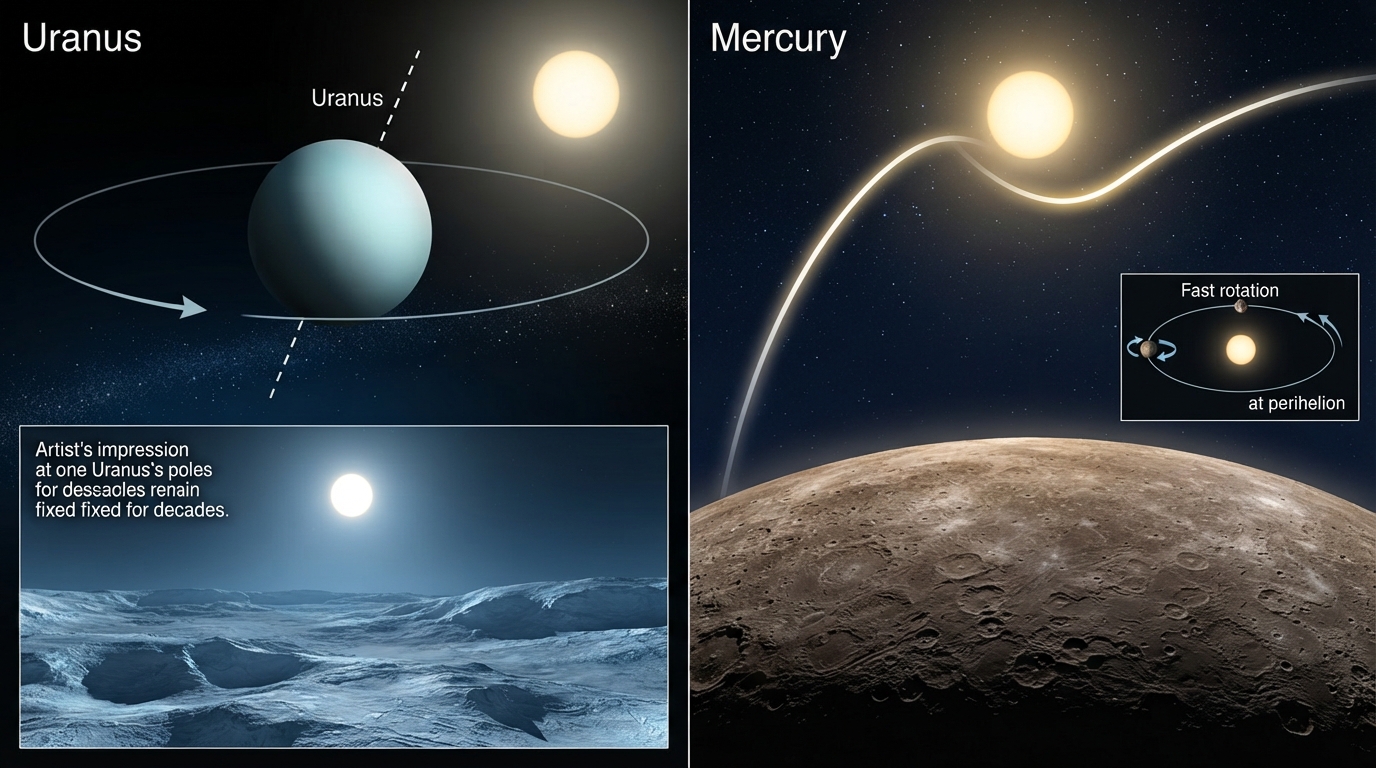
A 42-year day, two sunrises, and the Sun rising in the west: unusual landscapes on planets
In most parts of the Earth, the Sun rising in the east and setting in the west is a normal part of daily life. However, on other planets, the alternation of day and night occurs differently. This is caused by their rotation speed around their own axis, direction, and axial tilt.
**Uranus: Once the Sun rises, it may not set for 42 years**
Uranus's axis of rotation is tilted by nearly 98 degrees. Because of this, it moves as if lying on its side compared to most other planets.
Uranus orbits the Sun approximately once every 84 Earth years. As a result, nearly 42 years of continuous daylight at its poles is replaced by a night that lasts just as long.
This does not mean that the process of the Sun rising above the horizon lasts 42 years. It means that once the Sun rises, it does not set for decades.
The reason for such an unusual tilt of Uranus is still debated. One possible explanation is a collision with a large celestial body in the early period of the Solar System.
Near the equator, however, the situation is different. Uranus rotates on its axis in about 17 hours, so day and night alternate much faster in these regions. However, the height of the Sun above the horizon and its path in the sky change along with long-lasting seasons.
**Mercury: The Sun rises twice in one morning**
Mercury rotates on its axis three times for every two orbits it makes around the Sun. This ratio is called a 3:2 spin-orbit resonance.
A solar day on the planet—the time it takes for the Sun to return to the same position in the sky—is equal to about 176 Earth days. A year on Mercury lasts 88 Earth days. That is, a solar day here is equal to two local years.
An even more interesting phenomenon is observed when the planet passes through its closest point to the Sun. At that moment, its angular orbital speed temporarily exceeds its rotation speed around its axis. As a result, the apparent motion of the Sun in the sky briefly reverses direction.