

A 25-Year Journey. How the "Salomatlik" Clinic on Wheels Brings Hope and Doctors to the Country's Remote Regions
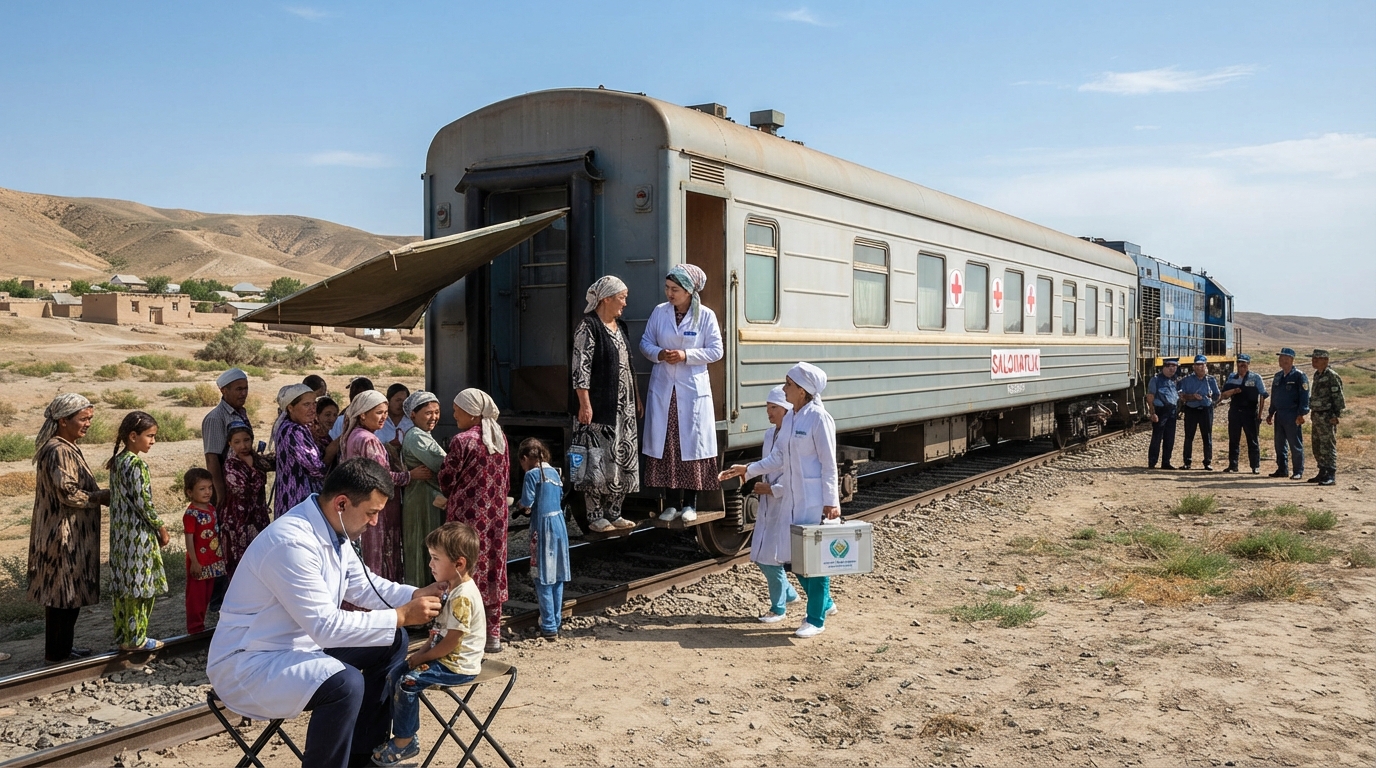
A journey 25 years long. How the "Salomatlik" clinic on rails brings hope and doctors to remote regions of the country
For 25 years now, the "Salomatlik" medical train has been running in Uzbekistan, delivering doctors to remote regions where it is difficult for people to receive qualified medical care. On the anniversary of the project, a Podrobno.uz correspondent spoke with its author and first chief physician, Nadira Yuldasheva, about how the train was created, what it does today, and what changes await it.
The idea of a medical train occurred to Yuldasheva back in 2000. At that time, she approached the management of JSC "O'zbekiston Temir Yo'llari" and the Tashkent Passenger Car Repair Plant with a proposal to create a special train that could bring doctors and medical equipment to hard-to-reach areas of the country. Seven cars were allocated for the project, which needed to be converted.
The official launch of "Salomatlik" took place on June 1, 2001. According to Yuldasheva, the first president of Uzbekistan, Islam Karimov, attended the opening.
"We started organizing and building the train in 2000, and launched it in 2001. Now a quarter of a century has passed, but the train continues to work and provide medical assistance to people who live far from the capital," she said.
### How the train's work is structured
The organization of "Salomatlik" trips is handled by the railway polyclinic. It is from there that doctors and nurses travel to remote regions to provide assistance to local residents. Approximately 14–15 specialists participate in each trip. While one group works on site, the remaining medical staff continue to see patients at the polyclinic. Then the employees replace each other so that the train can regularly set off on new trips without halting the work of the polyclinic. JSC "O'zbekiston Temir Yo'llari" helps organize the trips and provides the necessary conditions for the work of the medical teams.
Today, the train is equipped for ultrasound examinations, electrocardiography, fluorography, and laboratory diagnostics. The teams include general practitioners, neurologists, pediatricians, gynecologists, endocrinologists, dermatologists, and dentists.
The main goal of "Salomatlik" is to make medical care more accessible to residents of remote areas, including desert regions and the Aral Sea region. Specialists conduct examinations and consult patients on site so that they do not have to travel to major cities for treatment.
"Our task is to bring medical care closer to people who live far from central cities. We bring specialists there, conduct examinations, and provide the necessary help," Yuldasheva explained.
Special attention is paid to the elderly, children with disabilities, women, and families in need of social support. Medical care is provided free of charge.
In addition to medical services, medications, food, clothing, and other essential items are delivered to remote settlements. Various organizations participate in organizing humanitarian supplies, including "Sog'lom Avlod Uchun" and "Ekosan".
### The train has also been to Afghanistan
Over 25 years, the project expanded beyond Uzbekistan. About two years ago, "Salomatlik" was sent to Afghanistan.
"The train was sent to Afghanistan, and it successfully fulfilled its mission. As far as I know, both the host side and the patients were satisfied with the results," she noted.
In recent years, "Salomatlik" has been spoken about publicly less often. Yuldasheva explained this by the fact that the team had become accustomed to the continuous operation of the train and did not consider it necessary to regularly remind people about the project.
At the same time, the organizers count on expanding its capabilities. The plans include updating the rolling stock and building additional cars. According to Yuldasheva, these include separate cars for women and men, as well as specialized medical cars.
Another direction of development is surgical care.
While in the first years of operation mostly minor surgeries were performed on the train, now the organizers hope to increase their number and expand the list of interventions that can be performed in such conditions.
"When we just started, minor surgeries were performed on the train. Now there is an opportunity to perform more complex interventions that can be carried out in an outpatient setting," said the project's first chief physician.
### 25 years later — together again
For the 25th anniversary of "Salomatlik", a meeting was organized to which former and current employees were invited — doctors, nurses, orderlies, and engineers. They were able to gather together again and remember the people who created the project and ensured its operation over many years.
Yuldasheva confessed that at first the team planned to celebrate the 30th anniversary of the train, but decided not to postpone the meeting for another five years.
"We thought about celebrating the 30th anniversary, but over those five years even more people might pass away. Therefore, we decided to celebrate the 25th anniversary after all and gather together while we can still see each other," she explained.
Yuldasheva herself now lives in Canada, but continues to follow the fate of the project she created. For the anniversary, she prepared a book on the history of "Salomatlik", published in Russian, Uzbek, and English. It contains information about the creation of the train, stages of its work, and statistical data.
After Yuldasheva's departure, her former assistant Fatima Uraeva, who has been working on the project since 2007, continued to lead the work.
Over a quarter of a century, "Salomatlik" has become a way to deliver medical care to where access to specialists is limited by distance. Now the organizers expect that updating the train and expanding treatment capabilities will allow this work to continue.