

8 historical inaccuracies in the TV series "Magnificent Century"
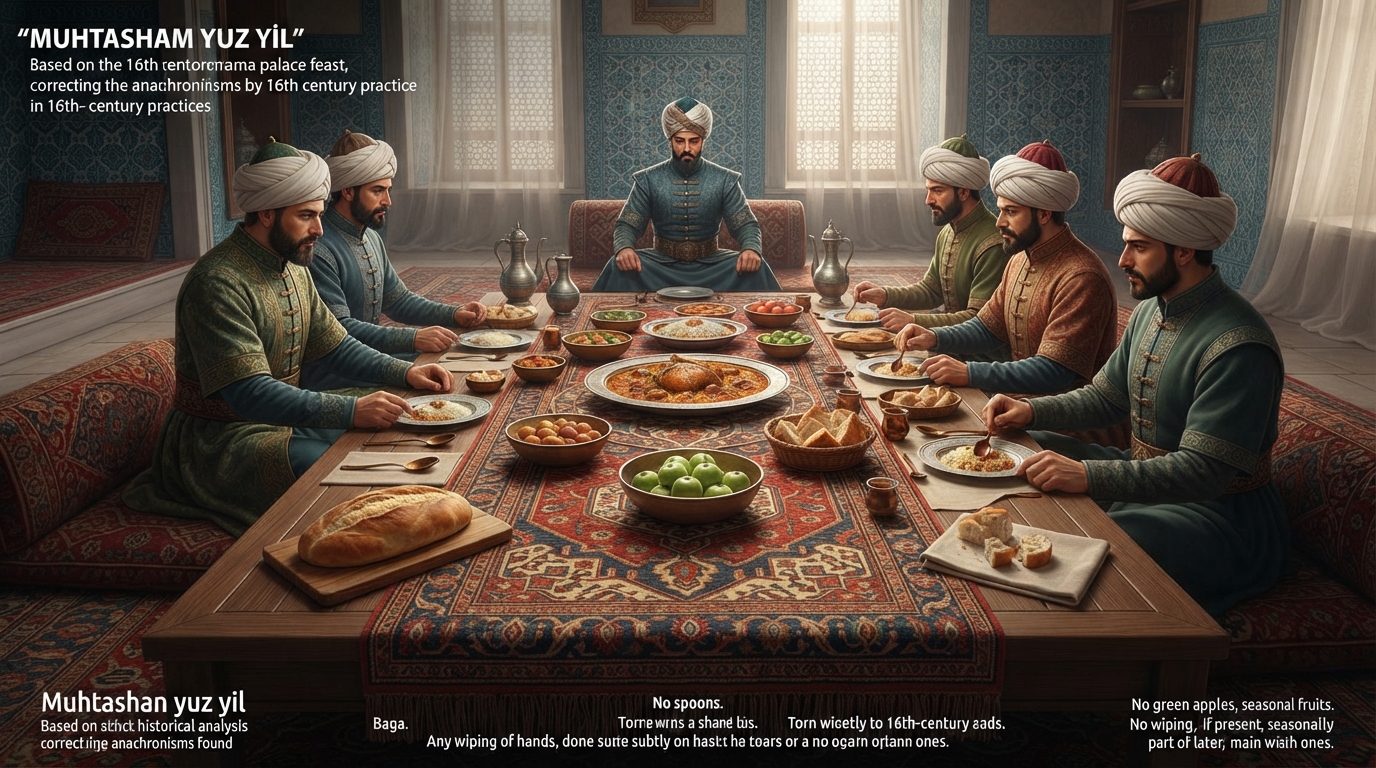
8 situations in the TV series "Magnificent Century" that do not correspond to historical reality
"Magnificent Century" captivated millions of viewers with its luxurious interiors, costumes, and the atmosphere of the Ottoman palace. However, historians and culinary experts still believe that the creators took a superficial approach to depicting feasts in the Sultan's palace.
1. Green apples
In several scenes, green apples are visible on the table — but in the 16th century, such varieties did not yet exist in the Ottoman Empire. They were brought from Europe much later. Historian Turgut Kut, in his comment to the Haberturk portal, noted ironically:
"Green apples stick out like a sore thumb."
2. Napkins instead of tablecloths
In that era, there were no delicate napkins for the Sultan and Sultanas to wipe their hands. In reality, the Ottomans wiped their hands on the edge of the tablecloth, which would have undoubtedly looked unsightly in the film.
3. Ottoman-style "buffet"
The tables in the series are overflowing with delicacies — but this contradicts historical sources. Dishes were served in courses: first soup or cold appetizers, then meat dishes (rice and meat were in separate dishes), and finally dessert and fruit.
"The table here resembles a knights' table in Western films more than anything else!" objects Turgut Kut.
4. Spoons that did not exist at the time
The metal spoons on Sultan Suleiman's table are considered a gross mistake. In the 16th century, spoons made of tortoiseshell ("baga") were used. Even in Europe, metal utensils were rare at that time.
5. Mistakes related to bread
In the series "Magnificent Century," broken pieces of bread are frequently seen on the table — but in those times, everyone broke off what they needed from a whole loaf of bread.
The "freshly baked" appearance is also a mistake; bread for the Sultan's table was prepared in advance, and it did not steam as if it had just been taken out of the tandoor, notes Ozge Samanci, associate professor of the Department of Gastronomy at Yeditepe University.
6. Viziers did not sit at the same table with the Sultan
The scene where Suleiman is having dinner with the viziers is absolutely incorrect, asserts Turgut Kut:
"No one would have dared to sit with their back to the Sultan, let alone eat with him."
The reason for this is that according to the law of Mehmed II, the Sultan was required to dine alone.
7. Decanters on the table
Glass decanters containing drinks are characteristic of the 19th century and do not correspond to the 16th century at all. In Suleiman's time, cups were brought by servants upon request, and the vessels were kept in a separate place.
8. Non-existent porcelain tableware
Lidded plates and special tableware for the table also appeared much later. In the 16th century, food was served in one common dish, and everyone ate from that dish.
As the historian noted, "This is a prime example of 19th-century tableware," and by the way, fruit plates were also not placed on the table during meals.
Why were such mistakes made?
The creators of the series sacrificed historical accuracy for the sake of spectacle: a full table looks more beautiful; napkins and separate plates are more familiar to the modern viewer; dining scenes together with the viziers enhance the drama. It is worth reminding once again that "Magnificent Century" is not a documentary chronicle, but a series with elements of fiction. However, this does not diminish its value.