

Uzbekistan starts importing jet fuel from Georgia and Iraq amid rising demand
Uzbekistan’s demand for jet fuel is expected to reach 375,000 tonnes during July-December, up 27% year on year, as geopolitical tensions have increased transit flights through Central Asia. Domestic refineries will most of the demand, with additional imports from Georgia, Iraq and other countries.
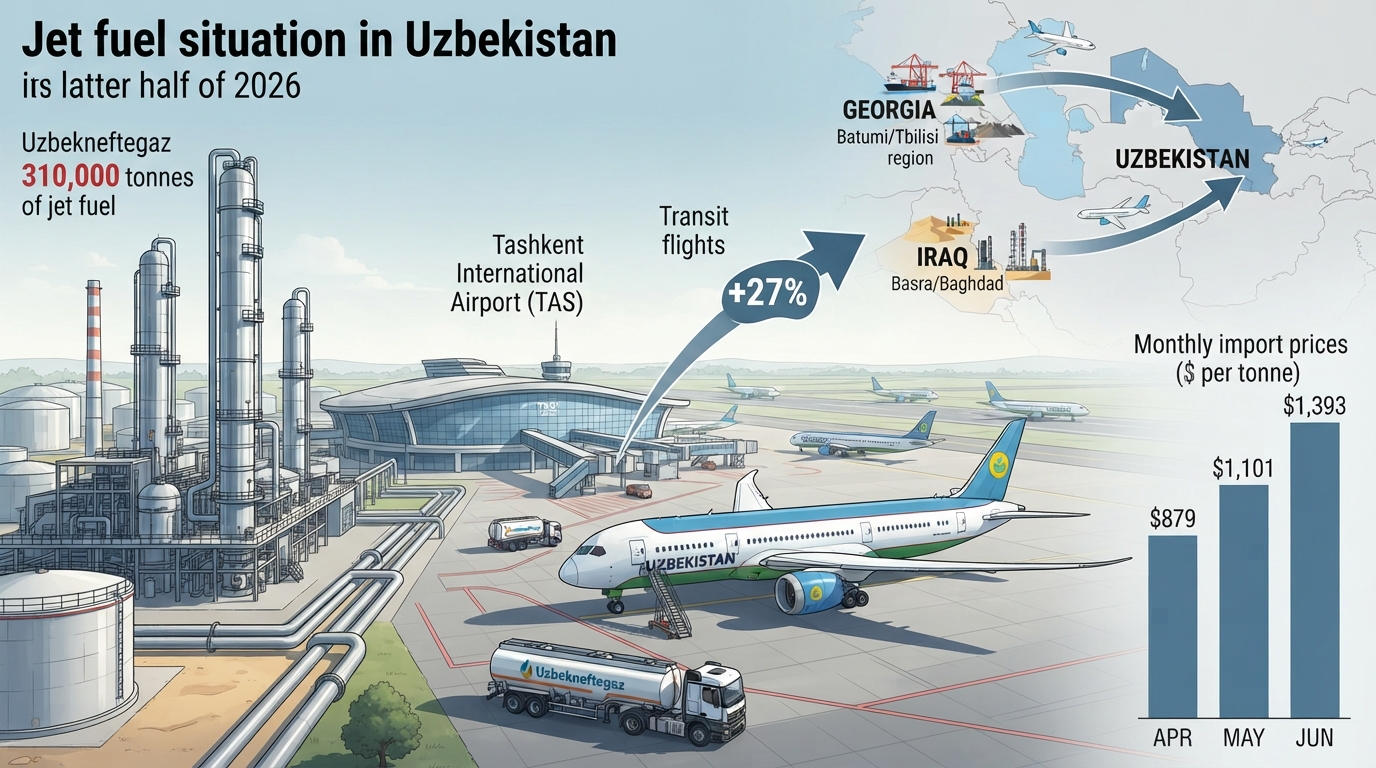
Uzbekistan has begun importing jet fuel from Georgia and Iraq to meet increasing demand. The country anticipates needing 375,000 tonnes of jet fuel between July and December, a 27% increase compared to the same period last year. This surge is attributed to heightened geopolitical tensions, which have led to more transit flights through Central Asia. While domestic refineries will cover most of this demand, additional supplies have been secured from Georgia, Iraq, and other nations.
The presidential press service reported that President Shavkat Mirziyoyev received an update on Uzbekneftegaz's performance for the first half of 2026 and its plans for the remainder of the year.
In the first six months of 2026, the state-owned energy company, Uzbekneftegaz, produced 11.5 billion cubic meters of natural gas. Production of crude oil, diesel fuel, jet fuel, and liquefied petroleum gas (LPG) surpassed their respective targets.
By the close of the year, Uzbekneftegaz projects its output to include 1.1 million tonnes of petrol, 983,000 tonnes of diesel fuel, 310,000 tonnes of jet fuel, and 606,000 tonnes of LPG. The company also intends to produce approximately 1.18 million tonnes of synthetic products.
A key topic at the meeting was the escalating demand for aviation fuel. Officials noted an increase in both transit flights through Central Asia and flights to Uzbekistan compared to 2025.
Although domestic refineries are expected to satisfy the majority of this demand, Uzbekistan has also arranged imports from new sources like Georgia and Iraq. This move comes after certain partner countries imposed restrictions on petroleum product exports.
Data from the Customs Committee, reviewed by Gazeta, indicates a 2.5-fold decrease in kerosene imports during the first half of the year, falling from 49,700 tonnes to 19,500 tonnes. The monetary value of these imports dropped by 59.9% to $19.7 million.
According to the International Air Transport Association (IATA), jet fuel prices experienced a sharp rise in early 2026 due to supply disruptions in the Strait of Hormuz caused by tensions involving Iran. While prices softened from their April peaks by the end of May, they remained considerably higher than late-February levels.
Uzbekistan also experienced a significant drop in kerosene imports during the April-June quarter. Imports decreased to 5,500 tonnes in April from 8,700 tonnes a year prior, to 1,800 tonnes in May from 11,100 tonnes, and to 1,900 tonnes in June from 23,900 tonnes in June 2025.
Concurrently, import prices continued their upward trend, averaging $879 per tonne in April, $1,101 in May, and $1,393 in June. This represents a 38.6% increase from the $1,005 per tonne recorded in June of the previous year.
On June 12, Uzbekistan Airways announced a reduction in flight frequencies on several routes between Uzbekistan and Russia, citing a shortage of jet fuel and elevated jet fuel costs.