

Uzbekistan has disclosed tariffs for the production, transmission, and distribution of electricity for the first time.
The Interdepartmental Tariff Commission in Uzbekistan has approved new tariffs for key elements of the electricity sector, from generation to distribution. The cost of generating 1 kWh ranges from 522 to 1,126 soums, grid transmission costs 98 soums, and regional distribution costs 171 to 410 soums.
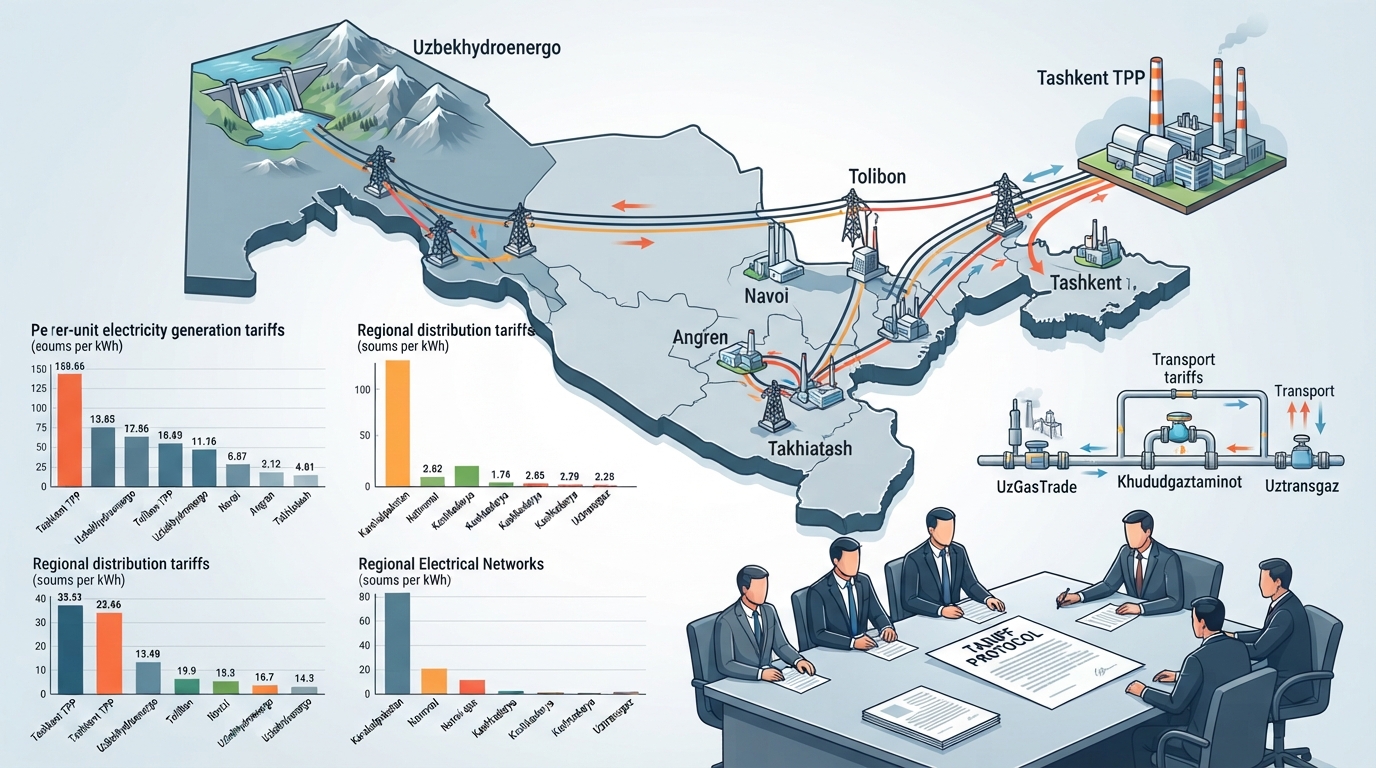
For the first time in Uzbekistan, tariffs for the production, transmission, and distribution of electricity have been published. The Interdepartmental Tariff Commission under the Cabinet of Ministers approved the corresponding tariffs, as well as prices and tariffs for natural gas.
The published document, for the first time, comprehensively presents rates not only for power plants but also for trunk and regional power grids. The decision was made on July 15 at the 37th meeting of the commission, chaired by Deputy Prime Minister and Minister of Economy and Finance Jamshid Kuchkarov. According to the minutes, a revision of the current tariffs became necessary following the increase in gas and electricity prices effective June 1.
The appendix to the minutes sets tariffs for the production of 1 kWh of electricity, including VAT. The lowest tariff was recorded for Uzbekhydroenergo—522 soums per 1 kWh.
Among thermal power plants, the lowest tariff is set for the Talimarjan Thermal Power Plant (TPP) at 579 soums. The tariff for Thermal Power Plants JSC is 834 soums, the Novo-Angren TPP at 828 soums, the Angren TPP at 947 soums, and the Takhiatash TPP at 957 soums.
The highest tariff among these power plants is set for the Tashkent TPP at 1,126 soums per 1 kWh.
The Navoi TPP has two tariffs: 887 soums for Uzenergosotish and 832 soums for Navoiazot.
Thus, the Tashkent TPP tariff is more than twice the tariff of Uzbekhydroenergo and almost twice the tariff of the Talimarjan TPP.
The tariff for electricity transmission via the main grid of JSC National Electric Grids of Uzbekistan has been set at 98 soums per 1 kWh.
Separate sales tariffs have also been established for the single electricity purchaser. For the Energosavdo enterprise, it is 704 soums per 1 kWh.
Electricity to cover the losses of the distribution system operator is provided at a tariff of 843 soums, and to cover the losses of the transmission system operator, it is 735 soums per 1 kWh.
**Cost of Electricity Distribution in the Regions**
The Commission separately disclosed tariffs for the services of JSC Regional Electric Grids enterprises. They vary significantly depending on the territory, from 171 to 410 soums per 1 kWh.
The highest distribution tariff is set in Karakalpakstan. It is 2.4 times higher than the lowest tariff recorded in the Kashkadarya region.
For the Samarkand regional power grids, managed by Turkey's Aksa Enerji, the tariff is 278 soums per 1 kWh.
The document applies not only to electricity. The commission also approved prices and tariffs for natural gas.
UzGasTrade will sell gas to Khududgaztaminot at 1.39 million soums per 1,000 cubic meters, including VAT. For Uztransgaz's own needs, the price is set at 1.6 million soums per 1,000 cubic meters.
Uztransgaz's tariff for gas transportation for UzGasTrade and other companies is 195,000 soums per 1,000 cubic meters, while transportation through the Khududgaztaminot network costs 240,000 soums. The document stipulates that if Uzbekistan's international treaty provides for different rates, the terms of that treaty apply.
According to Gazeta, as of late May, the cost of 1 kWh of electricity was 1,100 soums, and 1 cubic meter of gas was 2,200 soums. As of April 2024, the cost of electricity was estimated at 1,000 soums per 1 kWh, and gas at 2,000 soums per cubic meter. Thus, the cost of energy resources has increased by 10% over two years.
Moreover, the cost price includes not only the prices for the production, transmission, and distribution of electricity, but also the import of gas.
As a reminder, at a meeting in October 2023, the President announced that a free wholesale market, based on electricity supply and demand, is planned to be introduced by 2026.
At the beginning of 2026, a list of wholesale consumers consuming more than 10 million kWh of electricity annually was compiled. For these enterprises, it was proposed to introduce a mechanism for purchasing electricity on the wholesale market through direct contracts with hourly pricing.